Note dated January 30, 2008.

...
Note dated January 30, 2008.
I wrote this sentence on September 17, 2001:
Recently (September 2001), we saw the extreme vulnerability of massive skyscrapers, such as the Twin Towers, the pride of Manhattan—structures made of steel and concrete. When terrorists crashed their two planes into these towers, they deliberately chose planes loaded with fuel that had just taken off, knowing that the resulting fire would severely weaken the structure and ultimately cause it to collapse like a house of cards. Without this use of heat, the towers would have suffered considerable damage but would have remained standing. This phenomenon of successive floor collapses, like falling dominoes, is unavoidable. If such an event were to happen again, it would be crucial for building occupants to evacuate in record time, before the effects of heat could take hold.
This shows how we all believed the official narrative without questioning it, right after the event.
...After the San Francisco fire, Americans, traumatized by the effects of fire in that city, began installing external staircases universally. But this solution cannot be applied to large buildings. Here, we propose a solution worth studying.
...Below is a general evacuation plan for the tower, involving descent along cables on the exterior. These cables are attached to reels located on various floors, depending on which groups of people need to evacuate. Thus, central cable A would be used to rescue residents on floors within range a, on one side of the building; there could be four such sides if isolated. At top left, the reel system is shown. Upon receiving the activation order inside the building, near the corresponding evacuation station, the latch is released. Pulled by a shaped weight (to prevent snagging on any protrusions on the facade), the cable unwinds at high speed, though limited by an aerodynamic braking system (using rotating paddles linked via gear transmission).
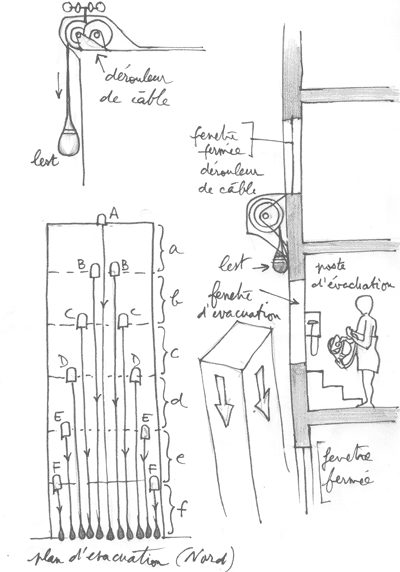
...As Canadian engineer Alexandre Berube pointed out, more cables would be needed for upper floors. Despite my Canadian friend Norman’s objections, using standard descenders and climbing ropes wouldn’t work. Indeed, to install such a descender, the rope must form a zigzag pattern. This is impossible if several people are already using the same rope below.
...The “sock” evacuation system was also mentioned. It’s quite ingenious. Long nylon tubes are unfurled on the facade. People simply enter through the top opening. Their permeability ensures no one can suffocate inside. Once started, descent can’t be stopped: there are no internal obstacles, so unconscious bodies can’t get stuck either. Speed is limited by clothing friction against the tube wall; it remains roughly constant regardless of size or build. As Norman reminds us, a heavier person has greater contact area with the tube fabric. Speeds average around 2 m/s. Since the tubes never touch the ground, evacuation occurs automatically. Of course, access is only possible from one entry point; however, multiplying these tubes could overcome this issue. They’re relatively inexpensive and mass-producible. The sole drawback: if users wear short-sleeved shirts or shorts, skin friction at height could cause minor burns. But aren’t slight burns preferable to being buried under a heap of steel and concrete after a collapse?
...One note: Are buildings in earthquake-prone areas equipped with such evacuation systems? Several things must be considered. In an earthquake, even if buildings don’t collapse, deformation invariably wedges all doors shut; they become impossible to open. One must break them down if able. Also, as in fires, stairwells are among the first elements damaged. Earthquakes often involve multiple tremors rather than a single wave. How many lives might have been saved, even in low-rise buildings, if evacuations had begun at the first warning signs?
...In the next diagram, an evacuation station seen from inside. Only these windows can fully open, leading to a small platform where several people can stand safely. Other windows merely allow ventilation, not escape. A staircase provides quick access to the evacuation platform. Visible: the unwound cable (diameter ~5 mm). Bottom image: a rescue cable being deployed, with the rotating aerodynamic brake visible.
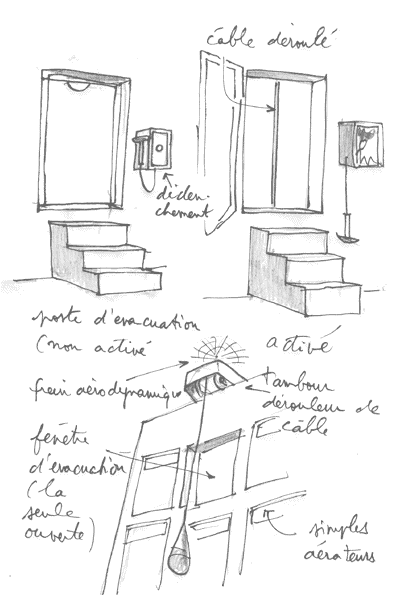
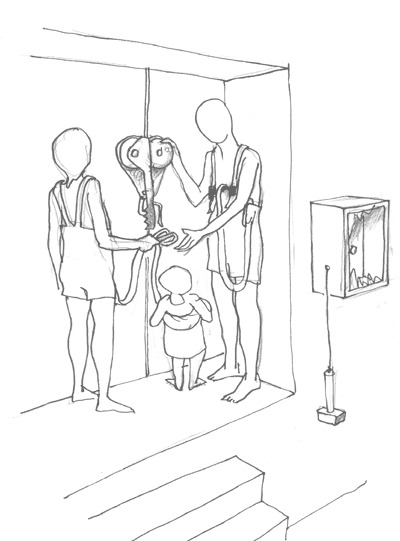
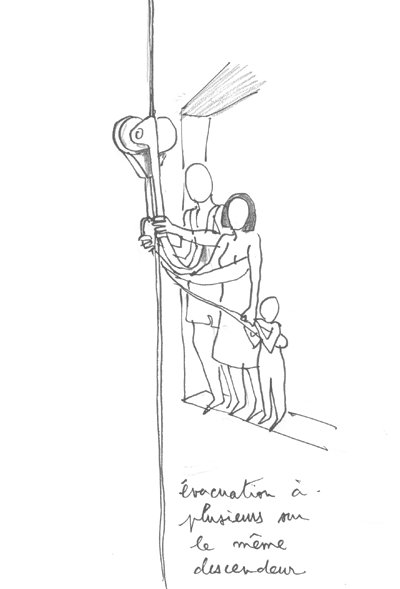
...In the following picture, a group of people (couple with child) in evacuation position. Their equipment will be described later.
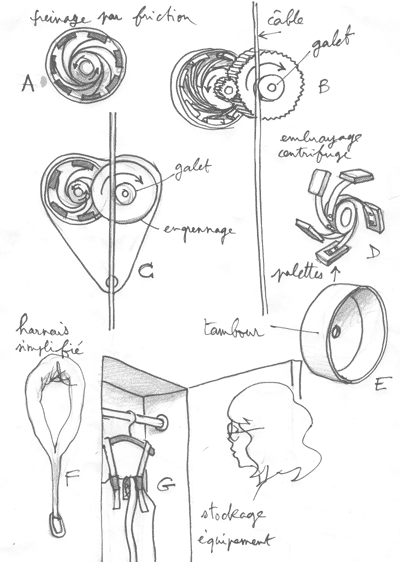
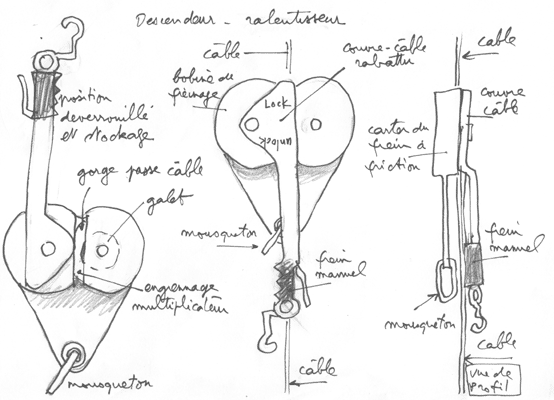
...Below is the basic mechanism: a friction-based descent retarder. In A, inside its casing, the flexible paddle system derived from Citroën 2 HP centrifugal clutches. In D, the paddle assembly emerges from its casing. Flexible steel blades connect to pads rubbing against inner surface E. In B, cable rubbing against a pulley linked to a gearbox multiplying rotation. C shows a schematic view: right, pulley-gear assembly; left, rotating brake paddles. G is a storage cabinet for two different coupling devices for the retarder. Left, a simplified harness (similar to helicopter rescue harnesses).
...Next drawings: the complete descent retarder. Friction paddles are now hidden inside casing. Image A: “cable cover” is lifted and unlocked. This is also how the device is stored, hanging from a hook at top. Below, a plate linking both casings (second casing contains multiplier gearbox linked to rubber pulley; small black section visible). Plate has carabiner for attachment. Device features a groove where cable is tightly secured by heavy weight pulling it to ground; spring tension prevents wind displacement. To lock cable, rotate “cable cover” + manual brake handle 180°. Drawing B: system ready for descent. Triangular cover hides cable groove; motion presses cable against first rubber pulley (visible here transparently). Manual brake handle at bottom. C is side profile.
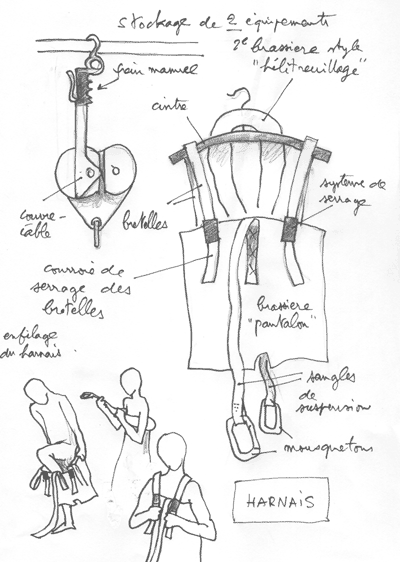
...Next: storage components. A: Descent retarder fixed, manual brake on top, unlocked. Cable groove visible. B: Nylon harness resembling pants; useful for evacuating unconscious or panicked individuals. Being helicoptered or swinging from 400 meters surely induces very different feelings. Must also consider elderly, disabled, children. C: Person putting on harness-pants. D: Fastening straps; beside him another wearing simpler harness (helicopter-style). Suspension via simple nylon strap ending in carabiner.
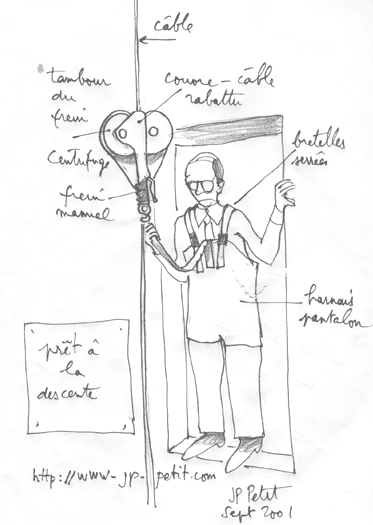
...Here, a person ready to jump. Retarder positioned; cable cover flipped down ensuring pulley-cable contact. Straps tightened, attached to retarder. Right hand holds suspension strap; left hand about to grasp brake handle. Neither grip is strictly necessary; device can autonomously lower load to ground.
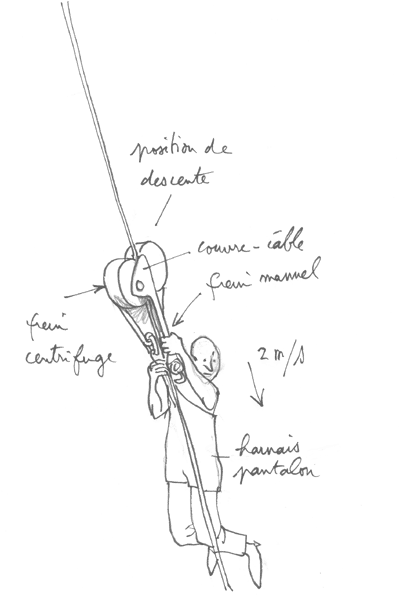
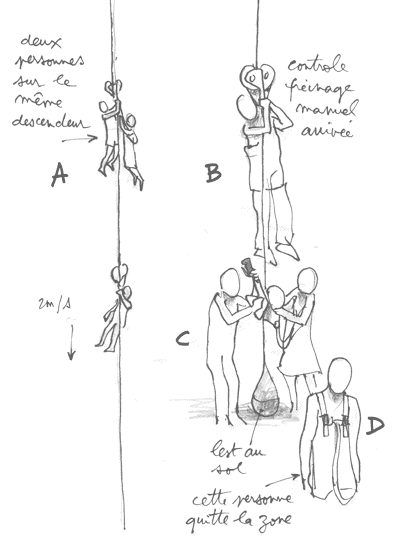
...Top-down view: individual descending. Left hand on manual brake, which he’ll use only near ground to avoid hitting others already arrived but not yet cleared. A “normal-weight” person could descend at ~2 m/s. Friction scales with square of speed; thus adding more people or greater weight won’t much increase speed. In old hemispherical parachutes I used, normal impact speed was 6 m/s.
...Next theme: multiple users sharing one descender. During operations, an evacuation supervisor stands at each platform level with window access. He attaches descender-retarders to cable, then carabiners of arriving persons. He points out brake handle, explains its use, verifies everything before giving go-ahead.
...Finally, reception of those descending closely spaced on same cable—to ensure swift evacuation. Using manual brakes (“climbing descenders”), they must control speed and maintain distance from those below without slowing overall flow. In evacuation drills (to be practiced regularly by staff and new hires), two key roles exist: first person waits below to receive “packages”; quickly releases cable from groove via lever. Above, another person has engaged manual brake to wait, not obstruct. Foreground: third person leaving area rapidly.
...Had such a system existed on all four sides of each New York Twin Tower, thousands of lives would have been saved. But who could have foreseen such horror?
...Now, we know.
September 17, 2001.
...Cable deployment, especially from towers hundreds of meters tall, remains problematic due to possible lateral winds. Risk exists of cables tangling and people snagging on one another. We initially considered heavy weights. Yet for cables spanning 200–400 meters, no weight could keep tension under crosswinds. Solution: anchor weight at bottom. Such weights could be shaped like projectiles (B) and drop (A) swiftly (minimal aerodynamic braking) into plastic plugs strong enough to bear human weight yet fragile enough to shatter on impact. Projectile centers in conical receptacle (C); locking automatic.
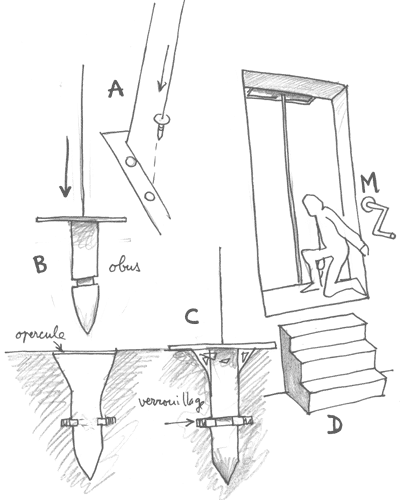
...In D, operator triggers vertical cable deployment, then maintains tension via simple crank. Should several cable sets serve specific floors, deployment and tensioning could occur from multiple stations (some may be inaccessible for some reason).
...We considered a friction retarder inspired by automotive clutches. Perhaps a system based on James Watt’s classic “ball governor”:
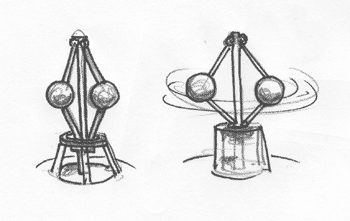
Ball Governor.
might ensure constant descent speed regardless of load (given device’s highly “non-linear” response). Under such conditions—preferably—manual brakes could be omitted. Risk exists that panicked or dizzy individuals might grip brake, halting entire chain. If speeds remain similar across users, spacing departures from platform suffices to let ground receptionist clear arrivals.
...These are merely scattered ideas, but they suggest retrofitting existing buildings with effective evacuation systems is feasible. No one truly contemplated horrific impact such attacks would have on structure. No firefighter, architect, or safety expert imagined tens of thousands of liters of jet fuel igniting instantly, softening steel framework within minutes, then causing floor collapses like dominoes—disaster leaving fewer chances for survival, as seismic experts noted. All fire scenarios were envisioned in these “Hellish Towers,” including explosives brought on site. Yet no one imagined “such huge volumes of highly flammable fluid could be delivered so rapidly.” In future, wildest concepts must be considered, akin to worst-case James Bond scenarios, reviewing all available technology. Recent killing of Commander Massoud (explosives hidden in cameras carried by suicide cameramen) exemplifies new weapon: suicidal terrorism. .....................................................................................................................................J.P.PetitSeptember 18, 2001
Clarification:
...This text isn’t preamble to patent filing. I believe saving lives is more urgent than trying to profit from “security industry.” Thus these ideas, if useful to implementers, are obviously free. When house is burning, no time to repaint living room.
Contents “Dangers” Contents “Geopolitics”
Counter initialized September 18, 2001