Text updated on July 12, 2007
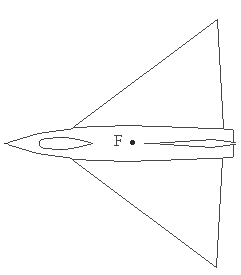
...Delta wings have one peculiarity: their center of pressure is located at 40% of the “chord,” as shown in the drawing above. They fly and glide very well, thanks to their characteristic “S”-shaped profile.
The “deltaplane.”
...What’s the connection between these rigidly constructed delta wings and the “deltas” used by hang gliders? Initially, these two types of wings had little in common. The earliest hang glider wings were “single-surface” designs: two triangles made of Dacron stretched over three lightweight alloy tubes.
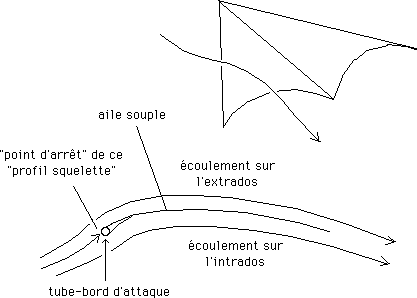
The “Rogallo wing.”
...This wing was invented by Rogallo, an engineer at NASA. His original motivation had nothing to do with sports. Military officials were dissatisfied with the accuracy of their intercontinental missiles at the end of their ballistic trajectory. So they asked Rogallo if he could devise some kind of wing capable of delivering a military payload—like an atomic bomb—to its target, while remaining somewhat controllable during that phase of flight. The Rogallo wing was supposed to unfold from the rocket body once its speed dropped sufficiently, using a parachute. But over time, missiles became more accurate. It became preferable to control them during re-entry rather than at such low speeds that enemies could easily shoot them down using simple slingshots. Thus, the Rogallo patent became public domain. Like all brilliant ideas, it was quite simple. In the U.S., “hang gliding” was born when a few brave individuals thought of attaching themselves beneath these structures made of tubes, fabric, and cables. Controlling the wing seemed straightforward: to dive, one simply leaned forward; to climb, one leaned backward, using a “trapeze” connected to the wing via cables. Shifting weight to either side allowed for turns. This led to the creation of the first “Manta” wings, produced in France starting in 1973. I personally bought my first Manta deltaplane in 1974.
...Early wings were designed in the simplest manner imaginable. When disassembled, they were completely flat; thus, in flight, both lobes formed a conical shape. The sweep angle was pronounced (80°). It was the pilot, leaning backward from the wing’s center of pressure (the point where aerodynamic forces acted), who counteracted the wing’s tendency to dive by using his own weight.
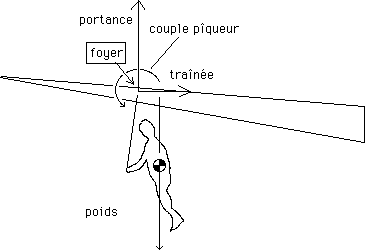
It’s the pilot’s weight that counteracts the diving tendency.
...I remember my first flight on such a device. The son of famous mountaineer Lachenal had purchased one. He operated near Chamonix, at “Grands Montets.” After some brief instructions, the customer, wearing skis, was strapped under the apparatus using a harness and carabiner, then launched down a steep slope. He was told to keep the nose pointed downward “until the sail fully inflates” (a sailor might use the verb “to fill out”). Then, pushing the control bar ten or fifteen centimeters forward would send him ten meters into the air, enabling a 150-meter flight.
“Once you’re airborne, you don’t touch anything; it flies on its own and lands the same way.”
...Indeed, landing on skis posed no real problem and required only minimal finesse. Back in Aix, I immediately ordered a Manta; a delivery service brought it to my home. I continued practicing alone on all the local ski slopes. Once the snow melted, I attempted several takeoffs by attaching wheels from strollers to an old pair of skis (keep in mind that at the time, no one taught anyone how to use a hang glider anywhere). Fortunately, I soon met other “mad flyers on their strange contraptions” who taught me how to take off by running—much safer than using those stroller wheels.
...At the time, I wrote articles for Science et Vie. In 1974, I published an article about this new sport, which probably helped its popularity. But soon, things took a turn for the worse. Our friend Delacourt died right in front of television cameras. His machine went into a dive and he couldn’t recover it. Immediately, I traveled to Paris to question the manufacturer. His reply:
“Pilot error,” declared the French Manta seller at once.
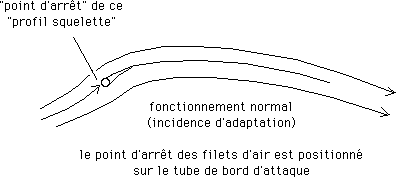
...That was false. Manta wings were indeed extremely dangerous devices. Here’s why. As seen in the earlier drawing, the Rogallo wing is a “skeletal profile.” There exists an optimal angle of attack, called the “adaptation angle,” at which the profile performs best. The stagnation point (where airflow splits into two streams—one flowing over the upper surface and the other under the lower surface) lies on the rigid leading-edge tube.
...When an aircraft wing moves through air, a high-pressure zone forms underneath (on the lower surface) and a low-pressure zone on top. Air tends to flow from the lower surface toward the upper surface, like this:

This generates a system of edge vortices (which cause condensation trails behind planes flying at high altitudes in humid air).
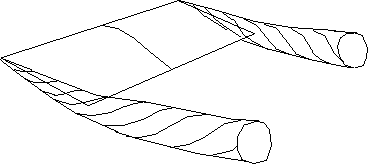
Edge vortices
...Incidentally, this turbulence dissipates energy. It can be reduced by increasing aspect ratio:
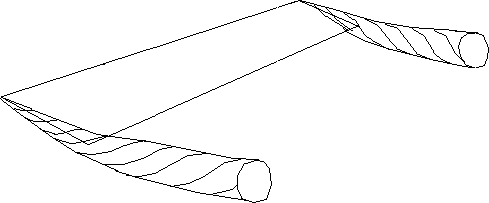
Reducing edge vortex effects by increasing aspect ratio.
...That’s why albatrosses fly better than pigeons, and why gliders have wings with very high aspect ratios. But then, why do airplanes feature delta wings with very low aspect ratios? Jet fighters aren’t gliders. Their priority is “cutting through the air.” At supersonic speeds, this requires very thin, knife-like wing profiles. So, it’s either:
Either choose a straight, very thin wing, like on the F-104 fighter
Or opt for a swept-back wing, which reduces the “relative thickness of the profile” for a given thickness.
...Variable-geometry wings, despite their mechanical complexity, are easy to imagine and combine both qualities. They slice through air well at supersonic speeds with folded wings, yet remain decent gliders at low speeds with wings deployed again. Delta wings form a separate category since they perform exceptionally well at high angles of attack.
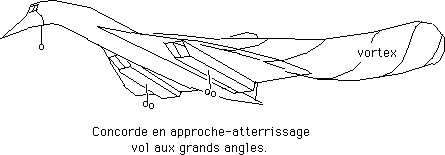
A Concorde approaching for landing at high angle of attack.
...Two vortices form then, exerting a stabilizing effect on airflow. The same applies to Rogallo wings (Manta).
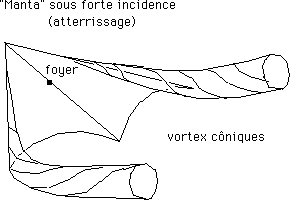
...This ability to retain decent lift at large angles made landing with a Manta very easy. It was a wing that didn’t stall but smoothly transitioned into a “parachute descent.” Though hard to imagine nowadays, with those highly swept wings, if one got stuck above a forest, one could “push everything forward.” The machine would stop and descend like a parachute. Provided one had strong ankles (hemispherical parachutes let you land at 6 m/s), one could land in this rather unusual fashion without any damage, material or human. I landed several times in clearings this way, descending vertically (impossible today with modern wings, which lack this capability).
Problems arose at low angles of attack:
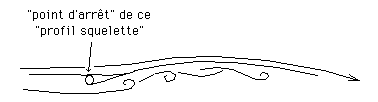
...The stagnation point shifted to the upper surface, which immediately caved in. In a wing, however, the most load-bearing portion is the front section. As ONERA engineer Claudius Laburthe later demonstrated using footage from Chalais-Meudon wind tunnel tests involving full-scale Manta models, the wing became “flag-like,” generating a massive diving moment. Schematically, negative lift developed on the front portion of the wing. Catastrophic.
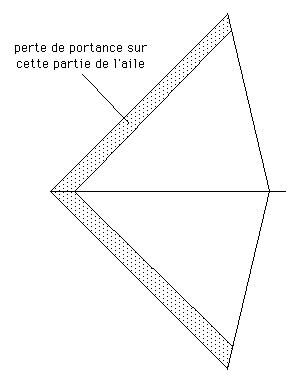
“Flagging” of early free-flying wings.
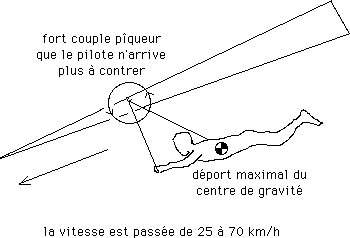
...Recall: in Rogallo wings, it’s the pilot’s weight leaning backward that counters the diving moment—nothing else. Past a certain point (the diving moment increases proportionally to the square of speed), the pilot could no longer correct his machine:
...After conducting tests on scale models, I published another article in Science et Vie, exposing the issue. Numerous fatal accidents occurred until a solution was found. We won’t mention names, but some still well-known manufacturers bear much responsibility for not urging customers to return their machines for at least minimal modifications to prevent this “flagging” phenomenon. Yet the solution was very simple. While preserving the wing’s flexibility and deformability, one merely needed to attach two fifty-centimeter-long tubes to the rear ends of the leading-edge tubes. Meanwhile, wing shapes evolved; ribs were added: