Text updated on July 12, 2007
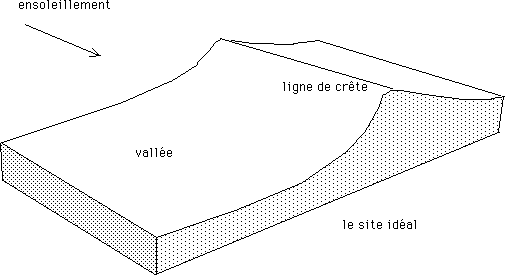
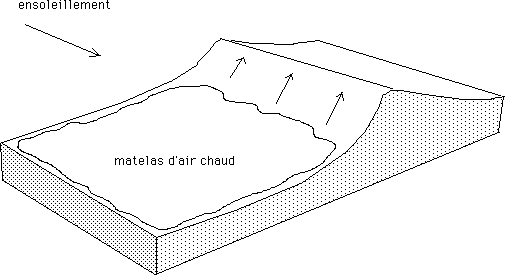
...The cliff, just below the ridge, is practically perpendicular to the light rays. The overheated air will create updrafts that will tend to pull this layer of hot air toward the slopes.
..At midday, the system becomes unstable.
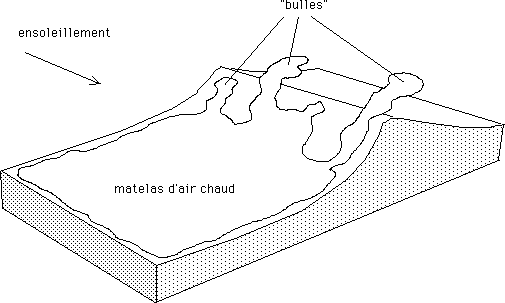
...On a generally upward airflow, say at 1 m/s, due to the general rise of air mass under the effect of gentle wind; superimposed on this are “bubbles” corresponding to more pronounced updrafts (from two to four m/s).
...Ultralights (delta wings or paragliders) can take advantage of this system to stay airborne for hours, make round trips along a ridge, then possibly jump to another “elevator”, after a “transition”, by crossing as quickly as possible, without losing too much altitude, an area with no or slight updrafts.
...The upward movement of air can be more or less regular. There may be fairly extensive areas where the aircraft is gently pulled upward. But meteorological randomness can give rise to more intense turbulence, to regions of “shear” where ascending and descending currents coexist over distances of a few meters.
...An ultralight can thus traverse an area where very different air currents prevail:
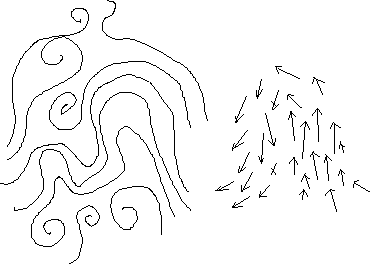
Areas with high levels of turbulence. Shear.
...The aircraft then gets tossed about. A glider flying at 120 km/h would hardly notice this local turbulence, which it would cross swiftly.
...A delta wing pilot will see one of his wings lift up. He can:
-
Counteract this by quickly shifting his body weight in that direction.
-
Pull on his harness to increase speed and escape this predicament. His speed range is relatively wide: (35 to 70 km/h).
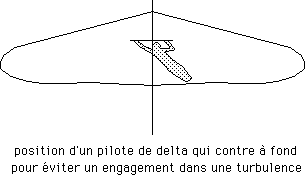
...All aircraft have their own limits, their “flight domains”. In this sense we can compare ultralights to pleasure boats, and more specifically to fragile sailboats, which aren’t designed to cope with any weather conditions. Let’s say that the flight domain of a delta wing is broader than that of a paraglider; we’ll see why.
...The speed of a paraglider is much lower. The pilot cannot dive, gain speed to escape a difficult situation, something a delta pilot can do. Above all, a paraglider’s sail isn’t designed to withstand any strong gusts. It will deform, fold up, temporarily losing its aerodynamic qualities. The pilot will lose altitude.
...Deformation can even lead to complete closure. For those who’ve witnessed such a sad event, the sail then resembles a crumpled handkerchief.
...I witnessed such an incident on Sunday, August 30, 1998 at 4 p.m., at the site called “Col Saint Jean”, near Seyne les Alpes. Conditions seemed perfect: light northern wind (10 km/h). A system of thermodynamic updrafts got underway (see diagram above). Blue sky, no signs of stormy instability.
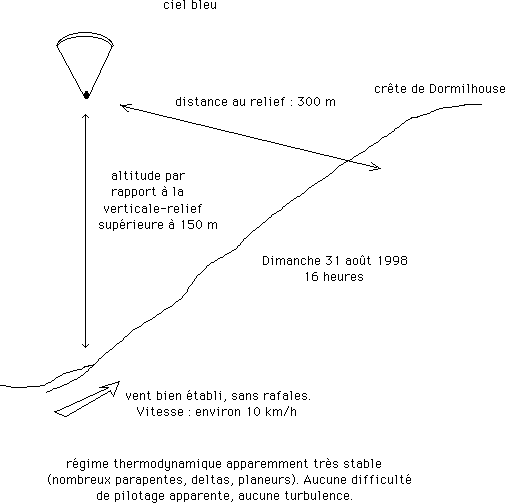
Suddenly the sail closed up in a “Z” shape:
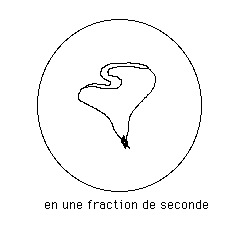
...The man fell some twenty meters, screaming. Then the sail reopened; the whole incident lasted three seconds in total.
...This type of incident, if we’re to believe practitioners of this sport, is quite common; average altitude loss is 50 meters.
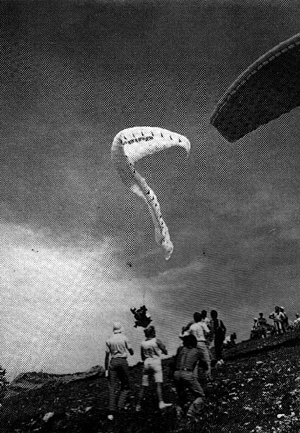
Flight incident near terrain. Pilot flying in a seated position; his body detaches above the head of the woman in shorts in the foreground. Extract from the FFVL manual.
...This type of shear occurs frequently near ground level or near terrain features. In such cases the pilot doesn’t have time to reopen his sail before making contact with the ground. He may suffer serious injury, or even death.
...Accidents involve ankles, legs, pelvis, spine; they correspond to vertical falls.
...Delta wing accidents mostly involve hard landings at high speeds (possibly with tailwind). Hands, arms, shoulders get damaged.
...Recently helmets have become widely used to protect the jaw; they’re specially designed for ultralights. Harnesses also almost always feature wheels measuring 20–30 cm in diameter, allowing pilots to recover from poorly executed landings.
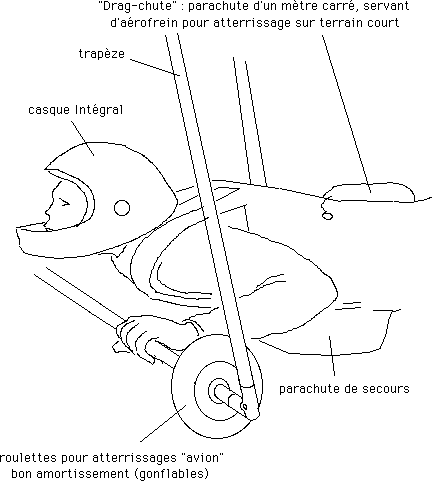
...I don’t want to stir controversy, just report facts. Delta wings have a rigid tubular frame to which their sails are attached; paragliders lack this. We can compare these two types of sail to a ship’s Marconi sail, fixed to its mast, versus an unfixed spinnaker. Everyone knows a spinnaker can roll up at the slightest gust. It’s far less stable than a sail fixed to a mast. But what mechanism leads to a paraglider’s closure?
...We’re now past the stage of primitive box parachutes (which, besides enabling considerable gliding, must also open during freefall; this excludes overly long deployment times). A paraglider’s profile is carefully designed; a complex system of suspension lines maintains its shape. The leading edge consists of a flexible mesh through which air freely enters, ensuring inflation of the cells. As long as the point where airflow stops lies on this mesh serving as air inlet, the sail retains its shape.
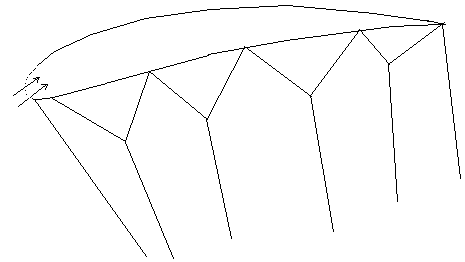
Below: normal airflow pattern:
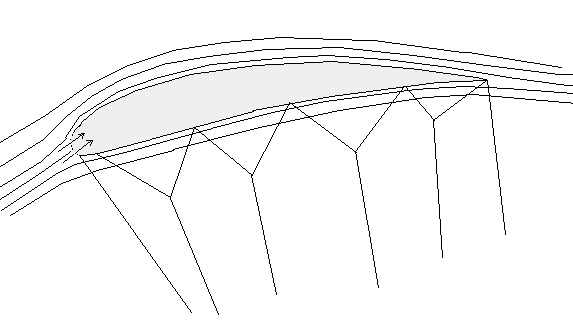
...Gray areas indicate slightly pressurized air. But what happens if turbulence or “shear” changes the direction of “relative wind”, like this:
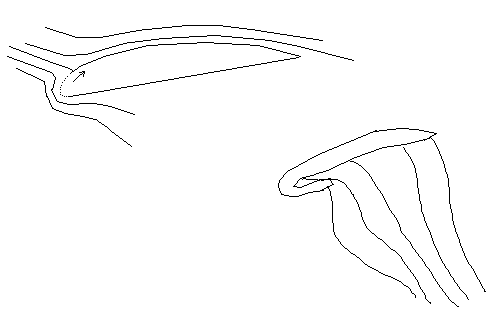
...That portion of the sail then folds up, as shown. This results in immediate loss of lift and tendency toward autorotation.
...Thus the dangerous configuration for a paraglider is low incidence (as was the case for “Manta” wings formerly). Yet “high-performance”, fast wings have flat profiles and narrow tolerance regarding incidence.
...When a glider pilot wants to “cover distance” he must move from one updraft to another. Between two updrafts he must fly as fast as possible to make his “transition”; some delta models feature “overdrive” systems. These consist of a rope linked to pulleys that extend and flatten the sail, boosting penetration speed. Some wings can thus reach nearly 100 km/h (maximum speed). For a paraglider this is impossible. Thus, to boost performance manufacturers sacrifice safety.
...The problem of paraglider closure is discussed on page 38 onward in the federation manual, chapter 1.28.2, reproduced below:
1.28.2. Closure.
...Closure results from low incidence. We can visualize what happens by pulling the front of an inflated sail on the ground on a windy day. From one standpoint this ability of the sail to “fold up” during sudden gusts is good; it prevents breakage due to stress on a rigid structure or inversion of the wing at negative incidence. But this isn’t what pilots think when they’re a few meters from a slope and half their sail closes, causing a sudden dangerous turn. Some sails are more prone to closure; however this doesn’t mean they’re more or less dangerous. What matters most are:
-
Trajectory when asymmetric closure occurs; a healthy sail only deviates a few degrees from its original path; many modern high-aspect-ratio sails are not healthy in this regard, since they undergo autorotation; the pilot can escape only by staying calm, braking and shifting weight to the side opposite the rotation; a beginner’s wing (Level 1 ACFPUL) theoretically shouldn’t experience such situations.
-
Ease of reopening: a beginner’s wing (Level 1 again) theoretically reopens on its own; still it’s advisable to help it by braking (up to halfway) on the side opposite closure, then pumping one or two times on the other control if it hasn’t reopened; note again how useful “countering via the harness” is in cases of one-sided departure and how dangerous it is to fly using “big brake strokes”; closure isn’t fatal and reopening rarely means life-or-death; we should allow ourselves time to think about what to do rather than worsening the situation via inappropriate maneuvers.
...The best remedy against closure is obviously preventive. Simply keeping brakes pressed down 30% of the time greatly reduces risk. Configurations favoring closure include:
-
Pilot pulling forward on front suspension lines to gain a few extra km/h in penetration (airspeed actually rises, but rather downward).
-
Lateral gust at takeoff (asymmetric closure).
-
Sudden drop upon leaving a thermal updraft.
-
Crash after dynamic stall (symmetric closure).
-
Sharp turns at high speed (external asymmetric closure).
-
Gliding without braking in gusty wind (symmetric or asymmetric closure).
...Obviously at final approach, just before rounding, when gradient dictates maximum speed, this last scenario arises. Safer to keep braking, even if landing somewhat roughly, without surprises.
End of quote.
...A second characteristic of paragliders is how violently they react to stall. An airplane wing stalls when incidence becomes excessive. This can happen in two ways: either pilot flies at “too large angles” or a sudden strong updraft triggers stall. Lift is then lost; the wing “bows down”. In airplanes or delta wings the movement is fairly gentle (provided we counteract it promptly by easing back on controls for planes or pulling back on the bar for delta wings). I noted earlier that early delta wings, “Manta” types, didn’t stall but transitioned smoothly to a sort of soft parachute descent. I did my first gliding training in the late 1950s on C 25-S gliders; these were rather poor performers compared to today’s models yet could perform such descent. That’s how Didier Favre and his friends took off in the film “La Grande Vadrouille”.
...Box parachutes or paragliders react very sharply to stall. On many sails a violent stall can raise the sail to pilot height or higher. Regaining normal flight posture requires pendulum-like motion which can prove dangerous if the machine is very close to ground.
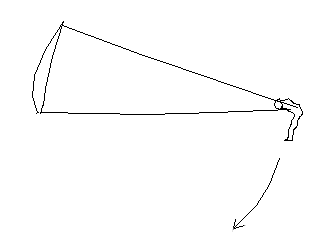
Paraglider stall following sudden gust.
...Recall the official FFVL manual, page 37, concerning paraglider stall:
...If we act decisively we feel the sail “freezes” in midair; we swing forward, feel the lines rising toward our sternum; the sail suddenly bows down to regain speed. A nervous beginner might be tempted to brake; this is precisely what mustn’t be done, since it prompts the same phenomenon: the sail climbs abruptly, stops, then bows down even more energetically, possibly causing frontal closure. Moderately applying brakes during descent helps counter low incidence and closure; this “dynamic second stall” must absolutely be avoided since it renders the wing totally unmanageable. We must learn not to use “big brake strokes” but brief, decisive actions. ...The other possibility is locked or stabilized parachute descent, also called dynamic stall. Basically, when a wing enters its parachute zone, we simply release controls so it returns to cruising incidence on its own. Certain poorly designed or badly adjusted models don’t behave this way; the pilot then suffers severe injury or death.
...Ultralight accidents involve ankles, legs, pelvis, spine; they correspond to vertical falls.
...Delta wing accidents mostly involve hard landings at high speeds (possibly with tailwind). Hands, arms, shoulders get damaged.
...Recently helmets have become widely used to protect the jaw; they’re specially designed for ultralights. Harnesses also almost always feature wheels measuring 20–30 cm in diameter, allowing pilots to recover from poorly executed landings.
...I don’t want to stir controversy, just report facts. Delta wings have a rigid tubular frame to which their sails are attached; paragliders lack this. We can compare these two types of sail to a ship’s Marconi sail, fixed to its mast, versus an unfixed spinnaker. Everyone knows a spinnaker can roll up at the slightest gust. It’s far less stable than a sail fixed to a mast. But what mechanism leads to a paraglider’s closure?
...We’re now past the stage of primitive box parachutes (which, besides enabling considerable gliding, must also open during freefall; this excludes overly long deployment times). A paraglider’s profile is carefully designed; a complex system of suspension lines maintains its shape. The leading edge consists of a flexible mesh through which air freely enters, ensuring inflation of the cells. As long as the point where airflow stops lies on this mesh serving as air inlet, the sail retains its shape.
Below: normal airflow pattern:
...Gray areas indicate slightly pressurized air. But what happens if turbulence or “shear” changes the direction of “relative wind”, like this:
...That portion of the sail then folds up, as shown. This results in immediate loss of lift and tendency toward autorotation.
...Thus the dangerous configuration for a paraglider is low incidence (as was the case for “Manta” wings formerly). Yet “high-performance”, fast wings have flat profiles and narrow tolerance regarding incidence.
...When a glider pilot wants to “cover distance” he must move from one updraft to another. Between two updrafts he must fly as fast as possible to make his “transition”; some delta models feature “overdrive” systems. These consist of a rope linked to pulleys that extend and flatten the sail, boosting penetration speed. Some wings can thus reach nearly 100 km/h (maximum speed). For a paraglider this is impossible. Thus, to boost performance manufacturers sacrifice safety.
...The problem of paraglider closure is discussed on page 38 onward in the federation manual, chapter 1.28.2, reproduced below:
1.28.2. Closure.
...Closure results from low incidence. We can visualize what happens by pulling the front of an inflated sail on the ground on a windy day. From one standpoint this ability of the sail to “fold up” during sudden gusts is good; it prevents breakage due to stress on a rigid structure or inversion of the wing at negative incidence. But this isn’t what pilots think when they’re a few meters from a slope and half their sail closes, causing a sudden dangerous turn. Some sails are more prone to closure; however this doesn’t mean they’re more or less dangerous. What matters most are:
-
Trajectory when asymmetric closure occurs; a healthy sail only deviates a few degrees from its original path; many modern high-aspect-ratio sails are not healthy in this regard, since they undergo autorotation; the pilot can escape only by staying calm, braking and shifting weight to the side opposite the rotation; a beginner’s wing (Level 1 ACFPUL) theoretically shouldn’t experience such situations.
-
Ease of reopening: a beginner’s wing (Level 1 again) theoretically reopens on its own; still it’s advisable to help it by braking (up to halfway) on the side opposite closure, then pumping one or two times on the other control if it hasn’t reopened; note again how useful “countering via the harness” is in cases of one-sided departure and how dangerous it is to fly using “big brake strokes”; closure isn’t fatal and reopening rarely means life-or-death; we should allow ourselves time to think about what to do rather than worsening the situation via inappropriate maneuvers.
...The best remedy against closure is obviously preventive. Simply keeping brakes pressed down 30% of the time greatly reduces risk. Configurations favoring closure include:
-
Pilot pulling forward on front suspension lines to gain a few extra km/h in penetration (airspeed actually rises, but rather downward).
-
Lateral gust at takeoff (asymmetric closure).
-
Sudden drop upon leaving a thermal updraft.
-
Crash after dynamic stall (symmetric closure).
-
Sharp turns at high speed (external asymmetric closure).
-
Gliding without braking in gusty wind (symmetric or asymmetric closure).
...Obviously at final approach, just before rounding, when gradient dictates maximum speed, this last scenario arises. Safer to keep braking, even if landing somewhat roughly, without surprises.
End of quote.
...A second characteristic of paragliders is how violently they react to stall. An airplane wing stalls when incidence becomes excessive. This can happen in two ways: either pilot flies at “too large angles” or a sudden strong updraft triggers stall. Lift is then lost; the wing “bows down”. In airplanes or delta wings the movement is fairly gentle (provided we counteract it promptly by easing back on controls for planes or pulling back on the bar for delta wings). I noted earlier that early delta wings, “Manta” types, didn’t stall but transitioned smoothly to a sort of soft parachute descent. I did my first gliding training in the late 1950s on C 25-S gliders; these were rather poor performers compared to today’s models yet could perform such descent. That’s how Didier Favre and his friends took off in the film “La Grande Vadrouille”.
...Box parachutes or paragliders react very sharply to stall. On many sails a violent stall can raise the sail to pilot height or higher. Regaining normal flight posture requires pendulum-like motion which can prove dangerous if the machine is very close to ground.
Paraglider stall following sudden gust.
...Recall the official FFVL manual, page 37, concerning paraglider stall:
...If we act decisively we feel the sail “freezes” in midair; we swing forward, feel the lines rising toward our sternum; the sail suddenly bows down to regain speed. A nervous beginner might be tempted to brake; this is precisely what mustn’t be done, since it prompts the same phenomenon: the sail climbs abruptly, stops, then bows down even more energetically, possibly causing frontal closure. Moderately applying brakes during descent helps counter low incidence and closure; this “dynamic second stall” must absolutely be avoided since it renders the wing totally unmanageable. We must learn not to use “big brake strokes” but brief, decisive actions. ...The other possibility is locked or stabilized parachute descent, also called dynamic stall. Basically, when a wing enters its parachute zone, we simply release controls so it returns to cruising incidence on its own. Certain poorly designed or badly adjusted models don’t behave this way; the pilot then suffers severe injury or death.
...Ultralight accidents involve ankles, legs, pelvis, spine; they correspond to vertical falls.
...Delta wing accidents mostly involve hard landings at high speeds (possibly with tailwind). Hands, arms, shoulders get damaged.
...Recently helmets have become widely used to protect the jaw; they’re specially designed for ultralights. Harnesses also almost always feature wheels measuring 20–30 cm in diameter, allowing pilots to recover from poorly executed landings.
...I don’t want to stir controversy, just report facts. Delta wings have a rigid tubular frame to which their sails are attached; paragliders lack this. We can compare these two types of sail to a ship’s Marconi sail, fixed to its mast, versus an unfixed spinnaker. Everyone knows a spinnaker can roll up at the slightest gust. It’s far less stable than a sail fixed to a mast. But what mechanism leads to a paraglider’s closure?
...We’re now past the stage of primitive box parachutes (which, besides enabling considerable gliding, must also open during freefall; this excludes overly long deployment times). A paraglider’s profile is carefully designed; a complex system of suspension lines maintains its shape. The leading edge consists of a flexible mesh through which air freely enters, ensuring inflation of the cells. As long as the point where airflow stops lies on this mesh serving as air inlet, the sail retains its shape.
Below: normal airflow pattern:

...Gray areas indicate slightly pressurized air. But what happens if turbulence or “shear” changes the direction of “relative wind”, like this:

...That portion of the sail then folds up, as shown. This results in immediate loss of lift and tendency toward autorotation.
...Thus the dangerous configuration for a paraglider is low incidence (as was the case for “Manta” wings formerly). Yet “high-performance”, fast wings have flat profiles and narrow tolerance regarding incidence.
...When a glider pilot wants to “cover distance” he must move from one updraft to another. Between two updrafts he must fly as fast as possible to make his “transition”; some delta models feature “overdrive” systems. These consist of a rope linked to pulleys that extend and flatten the sail, boosting penetration speed. Some wings can thus reach nearly 100 km/h (maximum speed). For a paraglider this is impossible. Thus, to boost performance manufacturers sacrifice safety.
...The problem of paraglider closure is discussed on page 38 onward in the federation manual, chapter 1.28.2, reproduced below:
1.28.2. Closure.
...Closure results from low incidence. We can visualize what happens by pulling the front of an inflated sail on the ground on a windy day. From one standpoint this ability of the sail to “fold up” during sudden gusts is good; it prevents breakage due to stress on a rigid structure or inversion of the wing at negative incidence. But this isn’t what pilots think when they’re a few meters from a slope and half their sail closes, causing a sudden dangerous turn. Some sails are more prone to closure; however this doesn’t mean they’re more or less dangerous. What matters most are:
-
Trajectory when asymmetric closure occurs; a healthy sail only deviates a few degrees from its original path; many modern high-aspect-ratio sails are not healthy in this regard, since they undergo autorotation; the pilot can escape only by staying calm, braking and shifting weight to the side opposite the rotation; a beginner’s wing (Level 1 ACFPUL) theoretically shouldn’t experience such situations.
-
Ease of reopening: a beginner’s wing (Level 1 again) theoretically reopens on its own; still it’s advisable to help it by braking (up to halfway) on the side opposite closure, then pumping one or two times on the other control if it hasn’t reopened; note again how useful “countering via the harness” is in cases of one-sided departure and how dangerous it is to fly using “big brake strokes”; closure isn’t fatal and reopening rarely means life-or-death; we should allow ourselves time to think about what to do rather than worsening the situation via inappropriate maneuvers.
...The best remedy against closure is obviously preventive. Simply keeping brakes pressed down 30% of the time greatly reduces risk. Configurations favoring closure include:
-
Pilot pulling forward on front suspension lines to gain a few extra km/h in penetration (airspeed actually rises, but rather downward).
-
Lateral gust at takeoff (asymmetric closure).
-
Sudden drop upon leaving a thermal updraft.
-
Crash after dynamic stall (symmetric closure).
-
Sharp turns at high speed (external asymmetric closure).
-
Gliding without braking in gusty wind (symmetric or asymmetric closure).
...Obviously at final approach, just before rounding, when gradient dictates maximum speed, this last scenario arises. Safer to keep braking, even if landing somewhat roughly, without surprises.
End of quote.
...A second characteristic of paragliders is how violently they react to stall. An airplane wing stalls when incidence becomes excessive. This can happen in two ways: either pilot flies at “too large angles” or a sudden strong updraft triggers stall. Lift is then lost; the wing “bows down”. In airplanes or delta wings the movement is fairly gentle (provided we counteract it promptly by easing back on controls for planes or pulling back on the bar for delta wings). I noted earlier that early delta wings, “Manta” types, didn’t stall but transitioned smoothly to a sort of soft parachute descent. I did my first gliding training in the late 1950s on C 25-S gliders; these were rather poor performers compared to today’s models yet could perform such descent. That’s how Didier Favre and his friends took off in the film “La Grande Vadrouille”.
...Box parachutes or paragliders react very sharply to stall. On many sails a violent stall can raise the sail to pilot height or higher. Regaining normal flight posture requires pendulum-like motion which can prove dangerous if the machine is very close to ground.

Paraglider stall following sudden gust.
...Recall the official FFVL manual, page 37, concerning paraglider stall:
...If we act decisively we feel the sail “freezes” in midair; we swing forward, feel the lines rising toward our sternum; the sail suddenly bows down to regain speed. A nervous beginner might be tempted to brake; this is precisely what mustn’t be done, since it prompts the same phenomenon: the sail climbs abruptly, stops, then bows down even more energetically, possibly causing frontal closure. Moderately applying brakes during descent helps counter low incidence and closure; this “dynamic second stall” must absolutely be avoided since it renders the wing totally unmanageable. We must learn not to use “big brake strokes” but brief, decisive actions. ...The other possibility is locked or stabilized parachute descent, also called dynamic stall. Basically, when a wing enters its parachute zone, we simply release controls so it returns to cruising incidence on its own. Certain poorly designed or badly adjusted models don’t behave this way; the pilot then suffers severe injury or death.
...Ultralight accidents involve ankles, legs, pelvis, spine; they correspond to vertical falls.
...Delta wing accidents mostly involve hard landings at high speeds (possibly with tailwind). Hands, arms, shoulders get damaged.
...Recently helmets have become widely used to protect the jaw; they’re specially designed for ultralights. Harnesses also almost always feature wheels measuring 20–30 cm in diameter, allowing pilots to recover from poorly executed landings.

...I don’t want to stir controversy, just report facts. Delta wings have a rigid tubular frame to which their sails are attached; paragliders lack this. We can compare these two types of sail to a ship’s Marconi sail, fixed to its mast, versus an unfixed spinnaker. Everyone knows a spinnaker can roll up at the slightest gust. It’s far less stable than a sail fixed to a mast. But what mechanism leads to a paraglider’s closure?
...We’re now past the stage of primitive box parachutes (which, besides enabling considerable gliding, must also open during freefall; this excludes overly long deployment times). A paraglider’s profile is carefully designed; a complex system of suspension lines maintains its shape. The leading edge consists of a flexible mesh through which air freely enters, ensuring inflation of the cells. As long as the point where airflow stops lies on this mesh serving as air inlet, the sail retains its shape.

Below: normal airflow pattern:
...Gray areas indicate slightly pressurized air. But what happens if turbulence or “shear” changes the direction of “relative wind”, like this:
...That portion of the sail then folds up, as shown. This results in immediate loss of lift and tendency toward autorotation.
...Thus the dangerous configuration for a paraglider is low incidence (as was the case for “Manta” wings formerly). Yet “high-performance”, fast wings have flat profiles and narrow tolerance regarding incidence.
...When a glider pilot wants to “cover distance” he must move from one updraft to another. Between two updrafts he must fly as fast as possible to make his “transition”; some delta models feature “overdrive” systems. These consist of a rope linked to pulleys that extend and flatten the sail, boosting penetration speed. Some wings can thus reach nearly 100 km/h (maximum speed). For a paraglider this is impossible. Thus, to boost performance manufacturers sacrifice safety.
...The problem of paraglider closure is discussed on page 38 onward in the federation manual, chapter 1.28.2, reproduced below:
1.28.2. Closure.
...Closure results from low incidence. We can visualize what happens by pulling the front of an inflated sail on the ground on a windy day. From one standpoint this ability of the sail to “fold up” during sudden gusts is good; it prevents breakage due to stress on a rigid structure or inversion of the wing at negative incidence. But this isn’t what pilots think when they’re a few meters from a slope and half their sail closes, causing a sudden dangerous turn. Some sails are more prone to closure; however this doesn’t mean they’re more or less dangerous. What matters most are:
-
Trajectory when asymmetric closure occurs; a healthy sail only deviates a few degrees from its original path; many modern high-aspect-ratio sails are not healthy in this regard, since they undergo autorotation; the pilot can escape only by staying calm, braking and shifting weight to the side opposite the rotation; a beginner’s wing (Level 1 ACFPUL) theoretically shouldn’t experience such situations.
-
Ease of reopening: a beginner’s wing (Level 1 again) theoretically reopens on its own; still it’s advisable to help it by braking (up to halfway) on the side opposite closure, then pumping one or two times on the other control if it hasn’t reopened; note again how useful “countering via the harness” is in cases of one-sided departure and how dangerous it is to fly using “big brake strokes”; closure isn’t fatal and reopening rarely means life-or-death; we should allow ourselves time to think about what to do rather than worsening the situation via inappropriate maneuvers.
...The best remedy against closure is obviously preventive. Simply keeping brakes pressed down 30% of the time greatly reduces risk. Configurations favoring closure include:
-
Pilot pulling forward on front suspension lines to gain a few extra km/h in penetration (airspeed actually rises, but rather downward).
-
Lateral gust at takeoff (asymmetric closure).
-
Sudden drop upon leaving a thermal updraft.
-
Crash after dynamic stall (symmetric closure).
-
Sharp turns at high speed (external asymmetric closure).
-
Gliding without braking in gusty wind (symmetric or asymmetric closure).
...Obviously at final approach, just before rounding, when gradient dictates maximum speed, this last scenario arises. Safer to keep braking, even if landing somewhat roughly, without surprises.
End of quote.
...A second characteristic of paragliders is how violently they react to stall. An airplane wing stalls when incidence becomes excessive. This can happen in two ways: either pilot flies at “too large angles” or a sudden strong updraft triggers stall. Lift is then lost; the wing “bows down”. In airplanes or delta wings the movement is fairly gentle (provided we counteract it promptly by easing back on controls for planes or pulling back on the bar for delta wings). I noted earlier that early delta wings, “Manta” types, didn’t stall but transitioned smoothly to a sort of soft parachute descent. I did my first gliding training in the late 1950s on C 25-S gliders; these were rather poor performers compared to today’s models yet could perform such descent. That’s how Didier Favre and his friends took off in the film “La Grande Vadrouille”.
...Box parachutes or paragliders react very sharply to stall. On many sails a violent stall can raise the sail to pilot height or higher. Regaining normal flight posture requires pendulum-like motion which can prove dangerous if the machine is very close to ground.
Paraglider stall following sudden gust.
...Recall the official FFVL manual, page 37, concerning paraglider stall:
...If we act decisively we feel the sail “freezes” in midair; we swing forward, feel the lines rising toward our sternum; the sail suddenly bows down to regain speed. A nervous beginner might be tempted to brake; this is precisely what mustn’t be done, since it prompts the same phenomenon: the sail climbs abruptly, stops, then bows down even more energetically, possibly causing frontal closure. Moderately applying brakes during descent helps counter low incidence and closure; this “dynamic second stall” must absolutely be avoided since it renders the wing totally unmanageable. We must learn not to use “big brake strokes” but brief, decisive actions. ...The other possibility is locked or stabilized parachute descent, also called dynamic stall. Basically, when a wing enters its parachute zone, we simply release controls so it returns to cruising incidence on its own. Certain poorly designed or badly adjusted models don’