Text updated on July 12, 2007
Can one risk one’s life?
...Obviously, one runs more risks when flying a hang glider or a delta wing than on a tennis court. What attitude should one adopt toward sports and activities where a certain level of risk simply cannot be eliminated?
...Forty years ago, my friend Jean-Claude and I were at the Refuge du Plan. We were both only twenty-three years old, yet we already had solid climbing experience under our belts, gained in the Belgian Ardennes and the Calanques of Marseille. The summer before, Jean-Claude had climbed the North Face of the Drus in Chamonix, together with our mentor and friend Jean Lecomte, an excellent mountaineer. The following summer, we decided that we might both attempt a relatively easy classic climb in the Chamonix Valley: the Grépon. We couldn’t afford a guide, but at least we had excellent gear well-suited for high mountains: good down jackets, sturdy boots, “Charlet” ice axes, bivouac hoods, reliable crampons, helmets, and good woolen clothing. This route isn’t known as particularly difficult. But the approach from the Refuge du Plan involves crossing the Nantillons Glacier. One must go to bed early in the mountains—around six in the evening—to set out while it’s still dark, using headlamps for illumination. ...We were about to crawl into our sleeping bags when we heard screams coming from that massif. From such a distance, there was no way to make out what was being said, but one thing was certain: people were shouting. We went to see the famous guide Raymond Lambert, who was staying at the refuge and was scheduled to lead a climb the next morning with a client. He was easily recognizable thanks to the custom-made size of his mountain boots; as a young man, he’d suffered frostbite on all his toes, so his bootmaker had had to take that into account. “If they’re climbers in trouble,” he told us, “it’ll be easy to tell. Since it’s impossible to understand anything at such a distance, these people will shout at regular intervals—say, once every minute. All you have to do is record their shouts, noting those moments on your watches. If there’s no periodicity, it’s just folks yelling ‘pass me the bag,’ ‘pull the rope,’ or something similar. In the mountains, one often has to shout when one’s climbing partner isn’t directly visible; sound doesn’t carry well.” ...That’s what we did for about half an hour. But we found no periodicity in the shouts, which eventually stopped. So we went to bed. The next day we set off under the stars. Dawn broke as we crossed the Nantillons Glacier. There was a path through the ice, beneath a large barrier of seracs.
“– Guide Vallot says there’s an average of one serac falling per day,” Jean-Claude told me.
...So, beneath those serac barriers, one doesn’t dawdle. With rope loops in hand, we jogged along to minimize risks. We were halfway across when I heard a sinister crack. Then hundreds of tons of ice swept over the spot where I’d been just ten seconds earlier.
“– One can slow down the pace: the daily serac has fallen...”
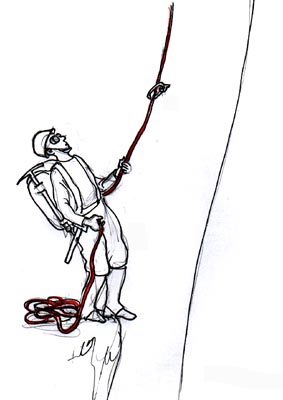
...Then began the ascent of the Grépon. We had excellent glacier goggles, which protected our eyes well, with leather flaps on the sides. The straps wrapped around our ears. But we’d forgotten to add a thin nylon cord running behind our necks. Near the start of the route, a clump of snow struck my face, flung by my partner, taking my sole pair of goggles with it. I then risked getting snow blindness. We hadn’t anticipated this risk—that tiny detail that can turn a trouble-free climb into a tragedy. ...I tried to protect my eyes as best I could. At the summit, a drama awaited us. Alerted by other climbers, a mountain rescue helicopter had already arrived, carrying, wrapped in two rubberized bags, the bodies of two Swiss climbers who’d died of hypothermia during the night. It was they who’d shouted in vain the previous evening. But they didn’t know. Otherwise, a rescue team would have reached them within hours, or the Chamonix helicopter, alerted from the refuge. The weather was lovely. ...One of those two climbers had fallen off a slab. His partner, who was belaying him, stood on a small ledge.
...
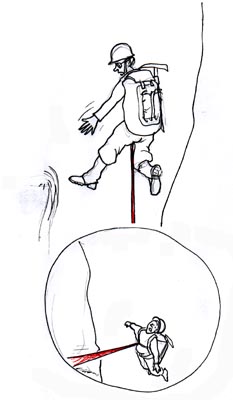
When the first climber, weighed down by his pack, plunged into the void on that overhanging section, he dragged the entire rope along with him; his partner couldn’t hold on, and then, carried by his accumulated kinetic energy, he flung the latter off, leaving him dangling, feet in the air, belly pressed against the rock.
...
There was no way he could pull his partner back up by hand. The other didn’t know how to climb back up a rope either. They could do nothing but scream. Then night fell and the cold finished them off. ...Yet they could have saved themselves. Every climber carries “rope loops” with them. Back then, these were three-strand nylon ropes, spliced together. Nowadays, sewn webbing is also used. With such a loop, even in such an awkward position, the person on top could easily create a link between a carabiner attached to the piton holding them both and the rope, using a “Prusik knot”:
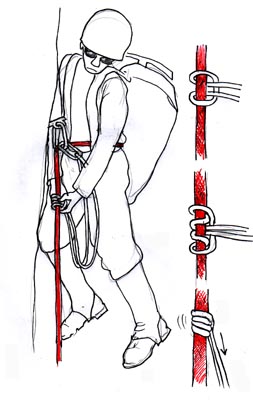
...After that, he could cut the rope using the Opinel knife he should have had around his neck, tied to his sweater with a lanyard. His partner would have gotten away with just a scare and a brief fall of a meter or so. Prusik knots don’t slip, and it’s easy afterward to secure everything by tying the rope. Once that maneuver was done, the second climber would have regained control. He could have stood on “foot loops,” reinforced his position by driving in another piton, then taken a thinner, shorter rescue rope from his pack to help his companion, perhaps lowering equipment to him.
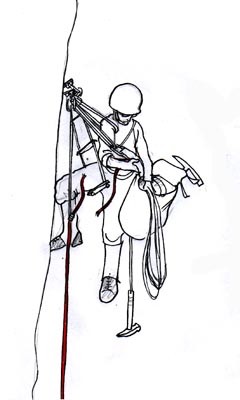
...That person would then have had to climb back up the main rope using two or three Prusik loops (back then, “Jumars” hadn’t been invented yet). In an hour everything would have been resolved. Barring a fright, both could have rappelled down, bivouacked, or completed their ascent. Anything but ending up frozen to death.
...But those two didn’t know. Just as I didn’t know it was imperative to fasten one’s glacier goggles.
...That summer, I decided to limit my activities to climbing. A matter of choice. High mountains are sublime. Up there, one sees “stars at noon.” Above, there’s the Moon; a completely mineral world where everything is oversized: dihedrals, ridges, crevasses. Fascinating, but it’s like walking on the back of a sleeping giant. Should he decide to turn over in his sleep, we’d be dead, flattened, pulverized, even if we’re very strong. That summer, I read Walter Bonatti’s book “To My Mountains.” Among other things, he recounts an attempt to climb the “Red Pillars of Mist” on the Italian side of Mont Blanc, overlooking the Brenva Glacier. I believe there were four of them. A French climbing team joined them, and they agreed to tackle this “first” together. Bonatti was a force of nature. He’d spent a whole day alone at 7,000 meters on K2 in the Himalayas, without a tent, and survived. He’d soloed the Drus, self-belaying with his pack.
...Bad weather caught them less than a hundred meters from the summit. The four decided to bivouac in the storm. Well-equipped, they felt capable of handling such a situation. But it lasted longer than expected. On the fourth day, they decided to descend. Two of them died of exhaustion; they had to be left behind on the trail—a Frenchman and an Italian. Yet these four counted among the most experienced climbers in the world.
...High mountains mean this too: an unavoidable margin of risk, even with experience and top-notch gear. Having a season in the Chamonix Valley with zero deaths, even if everyone behaved perfectly sensibly, is impossible. The mountains have their unpredictabilities, their mood swings, their unforeseeable serac falls. And then there are all the other risks—those faced by the ignorant, the poorly equipped, like the four teenagers we rescued from the Géant Glacier two days after that tragedy; they’d been strolling there in light anoraks, inadequate shoes, and a short rope. Those aren’t places for leisurely walks. The Géant has crevasses a hundred meters deep. They were glad to meet us. Thus, despite limited experience, we managed to play “guides” by bringing back the reckless, in the manner of “in the land of the blind, the one-eyed man is king.”
...Mountain rescue services deal each year with many imprudent people who, out of ignorance or carelessness, find themselves in dangerous situations. There are fatalities. Some rescuers lose their lives too. So, what should be done? Officials waste their breath every year warning these reckless folks via the media. Often, those needing rescue haven’t reported their plans beforehand. First, they must be located. Rescue operations cost a lot of money too; each intervention runs into tens of thousands of francs.
...What to do? Ban high mountains or populate glaciers with snowmobile police who’d ask for IDs, inspect gear, check qualifications? What worries people most is that their wallets might be touched—more sensitive than their bodies, which they’re willing to expose to risks that could leave them disabled for life.
In all risky sports, there are libertarians—lots of folks who loudly claim the right to risk their lives however they wish, without helmets, without parachutes, without technical checks, without any safety measures, “provided,” they add, “they don’t endanger others’ lives.” But what do we do with them when they’re broken, crippled, helpless, costing society a fortune in medical care and operations for the rest of their lives? ...Whenever constraints are mentioned in the ultralight world (as in many others), enthusiasts cry out “they want to police these sports.” My wife believes that if our “libertarians” were told that in case of accident, if minimal safety measures weren’t taken, they’d be required to pay part of their medical or treatment costs, they’d be less eager to claim their glorious freedom. ...When one’s robbed, insurers balk if the property wasn’t properly secured. Same if a motorcyclist lacks a helmet or a vehicle has no seatbelt. Pressure could thus come from insurance companies. Unfortunately, in ultralight sports, there’s little hope, since it’s the federations themselves that insure their members.