Mapping of Dark Matter in the Cosmos

Battle stations!
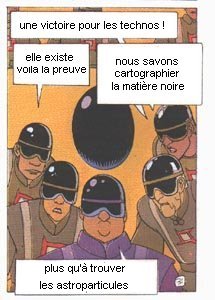
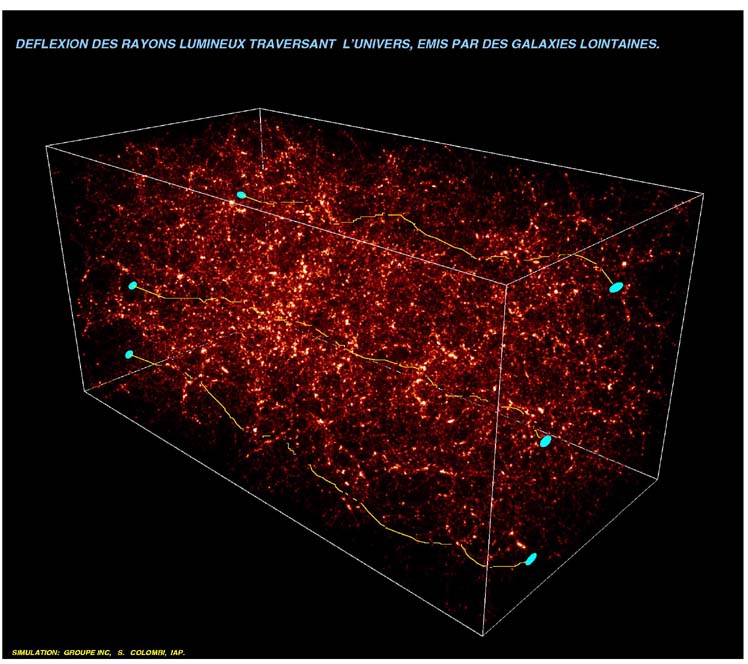
All the press has covered it: the invisible has been mapped. Yannick Meillier and his team, based on the effects of gravitational lensing affecting galaxy images, assuming these are due to matter currently escaping observation, have drawn the first 3D map of a part of the cosmos. As a result, there is a lot of excitement in the laboratories. Astrophysicists, encouraged by this approach, are ready to include dark matter in all their models. Theoretical physicists find an unexpected outlet for the most exotic particles emerging from their imagination, such as "neutralinos." All of them will meet on June 13, 14, and 15 at the University of Montpellier to discuss the possibility of creating a laboratory dedicated to astroparticles, which would be sponsored by the INSU (Institute of Universe Sciences, CNRS department).
...................Below is the famous map:
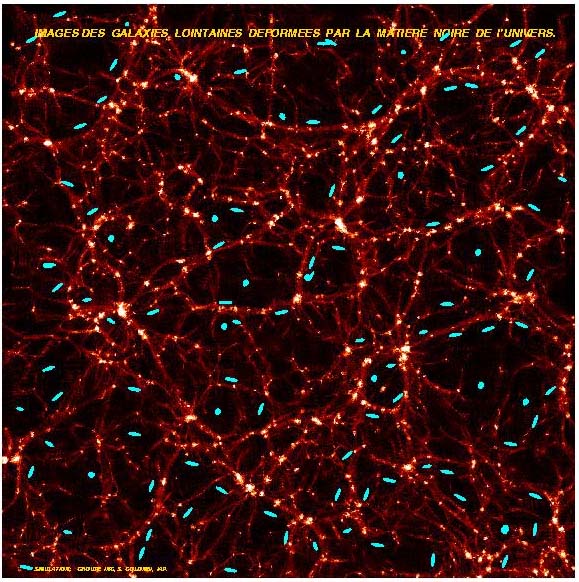
The same, in cross-section:
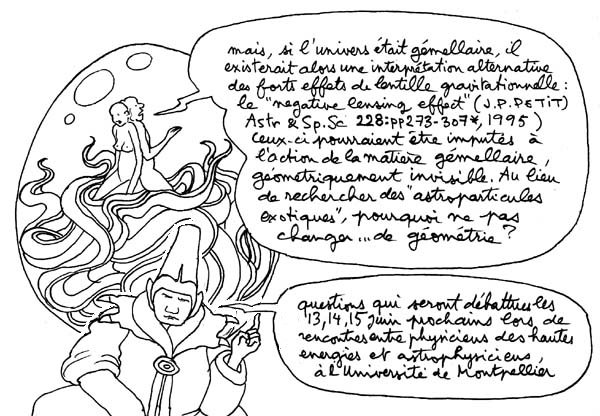
The article by J.P. Petit, cited.
The popular version and the book.
But, vox populi, vox dei, the reproduction of the article from Le Monde of Friday, March 17, 2000
If dark matter bends the course of light, it must exist
The distortion of images of distant galaxies proves the existence of immense invisible objects.
For years, astronomers have been trying to detect dark matter (90% of the matter in the universe). Many hypotheses have been proposed to explain the nature of this medium that escapes telescopes: massive objects (brown dwarfs) and elementary particles (neutrinos). But the count doesn't add up. Hence, it is thought that this matter could be made of theoretical particles yet to be discovered.
Astronomers are certain: 90% of the matter in the universe escapes the objectives of their telescopes. Only galaxies and the billions of stars that compose them, dark or bright nebulae that dot the sky, and giant flashes of energy whose production mechanisms are not fully understood appear on the photographs (...). Thanks to technological advances, new windows have opened in the infrared, ultraviolet, X-rays, and gamma rays. More recently, astronomers have opened up neutrino astronomy, particles that would contribute significantly to the mass of the universe.
...But the theorists know well that, despite this, the majority of the universe escapes the astronomical community, which cannot be satisfied with the limited experimental ground -10% of everything- that is offered to it. This is why it has been trying for many years to detect this famous dark matter, the major component of our universe. A team from the Paris Institute of Astrophysics, associated with French astronomers (CEA Saclay, Canada-France-Hawaii Telescope (CFHT) and the Marseille Space Astronomy Laboratory and foreign (Canada, Germany, United States), has just opened a window on this world. Just before a British team led by Richard Ellis (Cambridge and Caltech) and an American team led by Tyson (Bell Labs, New Jersey), which both partially confirm these results. ...How have researchers overcome the invisible and confirmed the existence of this dark matter? By using a principle that says light bends near a massive object (the Sun, galaxy clusters), due to gravity. This hypothesis has been repeatedly verified. But astronomers have wondered if the same effect could be observed with dark matter, which is supposed to be sparse and exist in large quantities. If so, this dark matter would betray its presence without being visible.
"Cosmic astigmatism".
*"In 1991, explains Yannick Mellier, of the Paris Institute of Astrophysics, the theory predicted that distant objects like galaxies could, due to the presence of large masses of dark matter on the path of their light, appear slightly distorted and show elongated elliptical shapes. But this cosmic astigmatism effect was, according to calculations, so weak that detecting it was a challenge." In addition, researchers lacked a theoretical model to validate potential measurements, as well as sufficiently powerful cameras to perform them. Since then, the CFH 12K camera has been developed and Canadian Ludovic Van Waerbeke has developed appropriate processing tools for this research program. After five years spent analyzing the approximately 200,000 distant galaxies photographed by the Canada-France-Hawaii Telescope, researchers have finally succeeded. Today, after an appropriate treatment, hundreds of small greenish ellipses appear on the images of the sky's background taken by the CFHT, which are galaxies. ...Can we therefore conclude that this phenomenon is indeed the result of a gravitational effect on the light emitted by the galaxies? "Certainly (...), answers Yannick Mellier. In the absence of matter on the path of the light rays -therefore without gravitational effect- even elliptical galaxies appear as small round points. In the opposite case, the image is covered with small ellipses. Moreover, the gravitational effect tends to organize these galaxies. A bit like a magnet that directs iron filings according to the lines of the magnetic field applied to it".
Unknown particles.
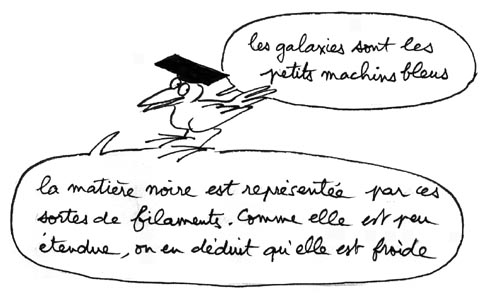
**These imperceptible distortions and the reorganization of galaxies allow us to assert that the light has been deflected from its trajectory by filaments of diffuse and invisible matter. A matter whose density is low (unlike that of the Sun and galaxy clusters)., but whose effects are perceptible due to their considerable extent: 100 million to a billion parsecs (1 parsec equals 3.36 light-years). For comparison, our galaxy measures only 34,000 parsecs in its longest dimension. ..On the three-dimensional model that the French team reconstructed on a computer, the effect is striking. In its journey towards us, the light constantly changes direction near these filaments, which form like a sort of cheese in the space they occupy. A structure that tells the story of the universe and reveals the initial conditions of its formation. Because the dark matter that escapes our gaze is not of the same nature (baryonic) as that from which stars and we ourselves are made. According to theorists, it would be composed of particles - weakly interacting massive particles (WIMPs), axions, supersymmetric particles, etc... still to be discovered. ..A new door has just opened, for astronomers to rush through. They should soon do so with the installation, in two years at the CFHT, of a four times larger camera, the MegaCam, developed by Saclay's CEA. In the more distant future, a network of about a hundred one-meter diameter telescopes is planned, as well as the launch of an American satellite, Snapsat, dedicated to explosive stars (supernovae), but also capable of tracking the effects of dark matter.
***Jean-François Augereau. ***

It is not as obvious as it seems. In 1985, Bernard Fort, accompanied by students, including Yannick Meillier, discovered at the three-meter sixty in Hawaii, with one of the first CCD cameras, a gravitational arc in the galaxy cluster Abell 370. It took the team three years to convince the astronomical community that this type of formation corresponds to a "gravitational lensing effect." Calculations based on this hypothesis concluded that this invisible mass must be located very close to the center of the cluster. In 89, Fort and Meillier imagined a method to reconstruct the map of the invisible matter supposed to produce this phenomenon, always within this hypothesis. But as early as 94, Fort and Meillier discovered near the center of another cluster an "object" that cast doubt on the validity of their method. It was a "concentration of invisible matter," located and "weighed" thanks to distortions affecting the images of neighboring galaxies, which was not associated with any concentration of "conventional" matter emitting light. Perplexed, they put this image aside. But three years later, Yannick Meillier noticed the same phenomenon near the cluster Abell 1942 (see the images below). The object was analyzed with other instruments, and in other frequencies, as well as its environment. This time, there was no doubt: the Meillier-Fort method concluded to the existence of a fantastic concentration of invisible matter (5 x 10^14 times that of the Sun, equivalent to the largest galaxy clusters observed), and this in a perfectly dark region.....
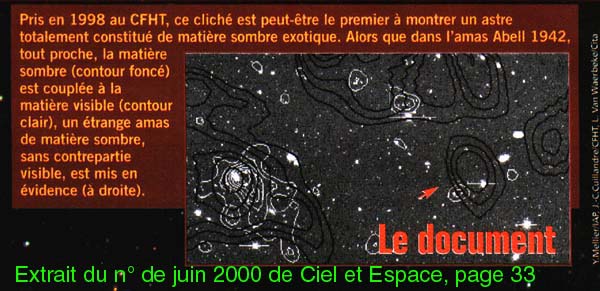
Here is the comment of Bernard Fort, regarding this phenomenon (excerpt from Ciel et Espace, June 2000) :
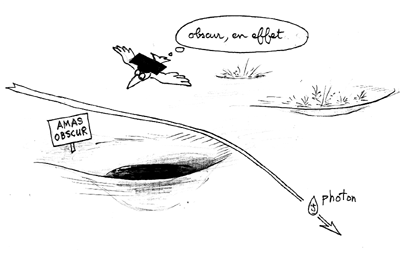
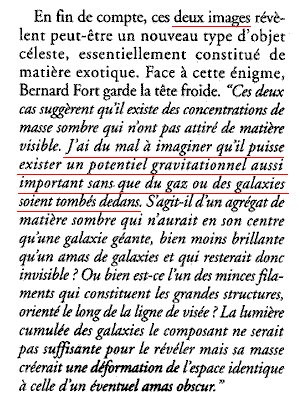
....What is problematic is that, by performing observations in sectors that represent barely 0.01% of the celestial dome, the observers have already discovered two objects of this type. It would therefore be very likely that the multiplication of observations, while providing a 3D map of this famous dark matter, would also bring to light hundreds of "dark clusters" or "dark concentrations," as Bernard Fort has decided to call them. It would then be hard to see why and how concentrations of matter equivalent to the richest known clusters could influence photons passing nearby gravitationally, but not the surrounding galaxies or the gas that lingers everywhere. ....Unless there are two types of matter that are "in their own way," completely separate. By attributing the "anomalous gravitational lensing phenomena" to the effect of the twin matter, one arrives at completely different interpretations, mentioned in our book "We have lost half the universe," Albin Michel, 1997. Thus, the arcs would be due not to concentrations of dark matter but to voids in the distribution of twin matter. Conversely, these "dark clusters" could reveal the presence of "agglomerates of twin matter," primordial formations, hot and "geometrically invisible." To see more clearly, it would be necessary to carry out a study similar to the one carried out for years by Meillier and Fort, to re-examine this "mapping of the invisible," but assuming that the effect is not due to dark matter, exotic or not, but to twin matter, which simply behaves, with respect to ours, as if it were made of conventional particles, with negative masses and energies. A nice thesis topic for a kamikaze student (a term applied at the CNRS to any student who goes off the beaten track).
Below is a recent manifestation of the supporters of dark matter:

and a manifestation of the supporters of twin matter: