Joseph Davidovits, Egypt, and Reconstituted Limestone
Davidovits
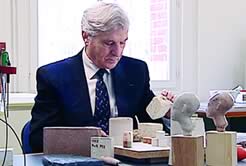
To watch his video on the reconstitution of limestone blocks (3 MB)
http://fr.wikipedia.org/wiki/Joseph_Davidovits
http://www.geopolymer.org/fr/science_archeologie/pyramides_egypte/video_faire_blocs_calcaire.html
August 15, 2005
I have somewhat lost touch with Egyptology for over a year, regretting not having been able to publish my work in this field at a specialized conference held in Grenoble in 2004, and in the Bulletin de l'Institut Français d'Archéologie Orientale.
I came across the August 2005 issue of Science et Vie. On page 10, in the section "On en parle" ("In the News"), there is a headline: "Official analyses are finally about to begin." This concerns analyses of stones taken from the pyramids of Giza and other sites. It mentions "the serious work of Joël Bertho, a specialist in composite minerals, and Suzanne Raynaud, a geologist at the technophysics laboratory of Montpellier II." We read:
The Egyptians built part of their pyramids with stones cast and molded on site.
Joël Bertho's book, "Pyramide reconstituée" (Reconstituted Pyramid), published by Unic, is cited. I have not read it, but here is how you can obtain it:
http://www.pyramide-reconstituee.com/pyramide/commander.htm
The Science et Vie article specifies that "funded by the CNRS, these studies will span three years."
Let us in turn cite Joseph Davidovits' book:
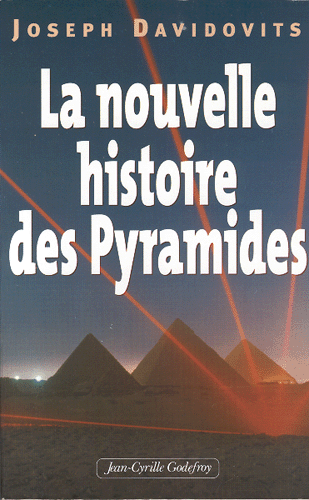
August 18, 2005: Davidovits asks me to direct readers to his previous book: "They Built the Pyramids." Indeed, the cited book is out of print and will not be reissued before September 2005.
I will not go over all the fascinating and solidly supported theses presented in this work. Those who have read my work know that I have constructed a method for building the Great Pyramids that does not require molding the stones. But this does not mean that I am completely right or completely wrong. Egypt poses a set of problems that constitute genuine headaches, and which official archaeology simply feigns to ignore. We must understand why. By tradition, an Egyptologist is first and foremost a decipherer of hieroglyphs. Now, these are present on two types of supports:
- On monumental works
- On papyri
In the first case, the inscriptions could be likened to "billboards." Most of these inscriptions tell us: "I, Pharaoh So-and-So, did this or that, and I defeated the people of Such-and-Such at such-and-such a place, thoroughly..."
There is also another aspect to monumental inscriptions: their magical character. The ancient Egyptians believed that by depicting scenes on walls or bas-reliefs, these acted as pictorial or sculptural incantations. This is why scenes of domination or submission are found repeated tirelessly for centuries and centuries in Egypt (one thousand five hundred years). Those who have visited the country will remember this scene, present on the pediment of every temple, reproduced identically, showing the pharaoh holding the hair of his traditional enemies: the Semite and the African, about to crush their heads with his raised mace. In the minds of the priests and sculptors, this image with a magical character was there to reinforce the pharaoh's power, if only by imprinting itself on the minds of visitors. And it is to achieve this reinforcing effect that it is tirelessly reproduced identically, in a stereotyped manner. It is not, as Caratini believes (who develops this idea in his book "L'Egyptomanie, une imposture" [Egyptomania, a Fraud], Albin Michel, 2002), a simple "lack of imagination." This former schoolteacher, whom I knew well, endowed with phenomenal memory and self-proclaimed encyclopedist, is primarily what my friend Jacques Vasselin called an "encyclopedant," with singularly limited views.
This book is the most grotesque and pretentious thing I have ever read concerning Egyptology. Caratini's Egypt is "problem-free." One of his chapters is titled "The Non-Mystery of the Pyramids."
He is wrong, this good man. Science, the knowledge of ancient Egypt, was largely lost because of the medium on which it was recorded: papyrus, which is perishable by nature and... combustible, in a country where there is no wood! Thus, documents concerning medicine and mathematics are limited to a few miraculously preserved papyri. The majority have disappeared. This is not the case for cuneiform tablets, made of fired clay, absolutely impossible to reuse and totally indestructible. This is why we know so much about Babylonian civilizations (for example, the cubic meters comprising the library of Nineveh).
As a general rule, archaeologists tend to praise civilizations that have left written traces. Currently, we are realizing that if we prioritize this criterion, we are very likely missing out on undocumented ancient knowledge, histories that were transmitted through oral tradition. The Egyptians did write, certainly. But what does that represent? This knowledge was secret. One should not expect to find details about construction methods on the walls of a temple or a pyramid. It is as if people tried to decipher our modern era by reading the billboards posted on Morris columns, subway corridors, or electoral posters at town halls.
There remain the mysteries, incredibly numerous, which Davidovits catalogs and which people like Caratini and many other archaeologists prefer to feign ignorance of. On page 21 of the former's work, there is a photograph of an anorthosite gneiss cup, exhibited at the Louvre in 1999, part of the immense collection of "hard stone vases" found in the tombs of Saqqara (Old Kingdom).
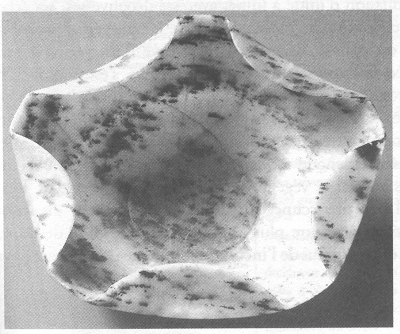
Anorthosite gneiss cup, No. 99. Catalogue of the exhibition "Egyptian Art in the Age of the Pyramids." Réunion des Musées Nationaux, 1999
If you go to Egypt, your guide will take you to a workshop for carving "stone vases." But this will involve a soft stone: alabaster. No one today could carve a cup like the one you see in the photo, especially using the carving materials of the Egyptian Old Kingdom. However, its shape evokes folding. It would be extremely easy to make this cup in clay, then fold the edges. But how did the ancient Egyptians proceed? Did they know how to reconstitute a stone as hard as this anorthosite gneiss? The feat defies imagination.
Yet people like Davidovits have shown that it is possible to reconstitute objects that are true stone by mixing certain ingredients. This is what we do with our cements, in a very primitive way. Indeed, the longevity of cement is very limited. Half a century at most. Our cements are porous and undergo internal chemical degradation, not just surface degradation. They lose their mechanical characteristics. Thus, all monuments erected in the current era, from American skyscrapers to the Arch of La Défense, are fundamentally perishable constructions. We tend to forget this.
Can we recreate true stones by resuming the long work carried out by nature? Petrification (from petra, stone) is a metamorphic phenomenon. Regarding limestone, shells form sediments. Then, over very long periods, these undergo high pressure and transform. Depending on the time elapsed, one will find all stages of this natural evolution. Conversely, limestone is soluble in water. This is what creates underground rivers and karst landscapes, which do not form through erosion but primarily through dissolution. On the Giza plateau, there are different limestone veins, corresponding to different states of transformation and metamorphism. Davidovits showed that one of them lends itself easily to disintegration in an aqueous environment. Hence his thesis. To transport imposing limestone masses, one solution is to disintegrate them first. This powdery material is then transported in simple baskets. The task then remains to re-agglomerate everything. Davidovits demonstrates the feasibility of this operation both in his book and in the video shown above. See this diagram extracted from his book, page 58.
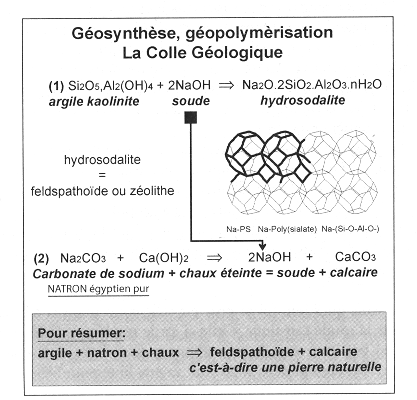
All this works very well, and geologists agree that this synthetic limestone is totally identical to natural limestone. I suggested to Davidovits, to support his theories, that he mold large masses of this synthetic limestone to create, for example, lintels weighing one hundred tons. But, by his own admission, he does not know how to mold this material into volumes larger than one meter without risking cracking. That is a shame. It simply means that an ingredient is missing, one that the Egyptians must have known.
Take the example of Portland cement and "prompt cement." The former is just the latter with a "setting retarder." If we only knew prompt cement, we would be incapable of creating large blocks. The speed of setting and the accompanying thermal and chemical stresses would make the operation impossible. Davidovits can thus mold synthetic limestone blocks one and a half meters long, but no longer. This suggests that we are faced with knowledge that may have been lost.
I visited the Grand Gallery of the Pyramid of Khufu. There, one finds blocks weighing twenty tons whose joint planes do not even allow one to slip in... a nail file. You have to see it to believe it. The fit (in both horizontal and vertical planes) is on the order of a tenth of a millimeter. Why? Mechanically, it has no interest. In horizontal planes, it would make sense (to prevent any slipping), but not in vertical planes. So? Were these blocks molded? If not, how could such perfect joints have been achieved? I admit I was dumbfounded by such an observation. One could never finish listing the oddities, visible to the naked eye, that visitors can find at the Giza site. There are huge blocks resting on one another according to joint planes that are not horizontal. Below (from Davidovits' work, page 29) is a "limestone inclusion" in the Pyramid of Khafre:
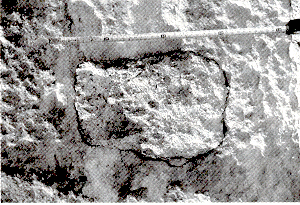
Limestone inclusion in the Pyramid of Khafre (1999)
In a construction supposedly built without mortar, what is this inclusion doing there?
In support of his thesis of molded stone, Davidovits shows traces located inside hard stone vases, page 147:
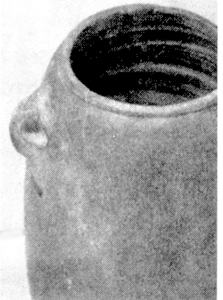
Traces inside a hard stone vase, indicating "string-cut" molding
I am well familiar with the "string-cut" molding technique, which was used, for example, to create elements of amphorae: the potter quickly forms the interior shape by winding a fairly coarse string around a stick stuck in the ground. Then he applies the molding substance using the "coil technique" and smooths everything. Demolding is easily achieved by unwinding the string. These are the types of traces detected on the vase above, not those of interior machining. Moreover, one cannot see how potters could have, starting from extremely hard stone blocks, produced objects like those visible in the image below, and which are found by the thousands at the Saqqara site (2700 BC). Extract from Davidovits' book, page 146.
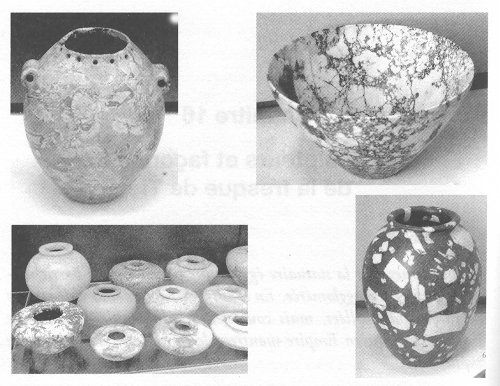
Hard stone vases, 3500 BC, Louvre Museum (2003)
These anomalies are not the only ones. One could never finish listing them. There is the existence of statues made of quartzite, a terribly hard stone, for which one really cannot see how they could have been carved with... copper chisels. There is the enormity of the Colossi of Memnon, which weigh several hundred tons. How were these transported and put in place? Why is there no trace of the place where these blocks could have been quarried, in nearby or distant quarries? One must be bulletproof in one's naivety or blindness, like Caratini, to overlook all these puzzles that populate Egypt. The answer given by Davidovits since the early 1970s is called "geopolymers." What scientists have difficulty swallowing is that these achievements could be based on techniques 5,000 years old, the secrets of which they would not be able to unravel.
Davidovits does not attribute all Egyptian techniques to synthetic stone. According to him, the two techniques coexisted, corresponding to different religious symbolism.
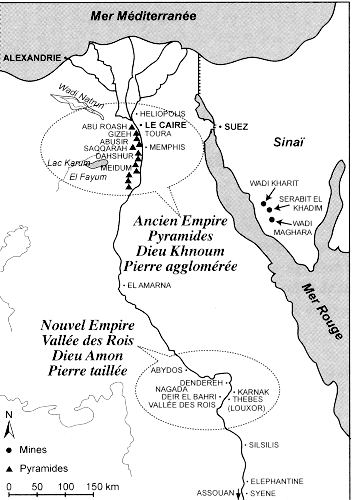
In the north, the technique of agglomerated stone: the cult of the god Khnum, with the head of a ram.
In the south, the reign of the god Amun and the technique of carved stone.
I reproduce below a photograph sent by a reader, but I do not know where it was taken. Someone might be able to inform us.
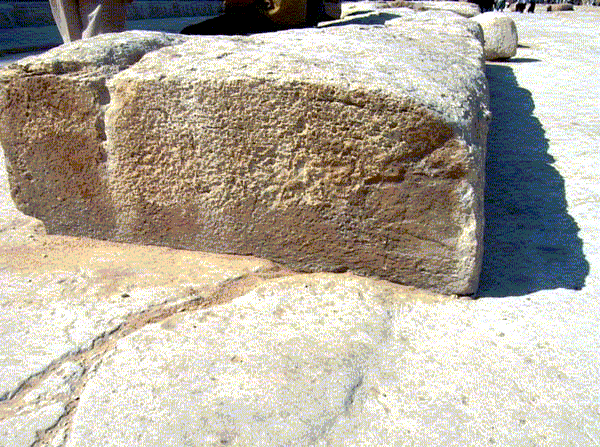
It had been a while since I planned to write a reading dossier on Davidovits' fascinating book, which I cannot recommend enough (as well as Caratini's, but this time to complete your "collection of absurdities," as it is a model of the genre). I do not know if the magazine Science et Vie dedicated a dossier to Davidovits. In the previous issue, the magazine presented a 19-page dossier titled "Before the Big Bang, scientists wonder." Vague remarks by people like Thibaud Damour (member of the Academy) and Veneziano (recently promoted to a professorship at the Collège de France, pioneers in the field of... superstrings). But not a word about the theses of the Bogdanoff brothers, nor about their book, sold in 250,000 copies, precisely titled "Before the Big Bang."
Within the "scientific community," a sort of consensus has been established, the conclusion of which is "the work of the Bogdanoff brothers is not serious." Let us add that not one of those who spread this rumor has read a line of their scientific writings, nor do they know about quantum groups or groupoids. This amuses me because those same people are preparing to make a return to the scientific scene "with new balls." We will see that, far from being scientific frauds, their work could, on the contrary, represent a major breakthrough in understanding the structure of the cosmos.
August 17, 2005. Letter from a reader, Mr. Stéphane Roussel:
Reading your text about Mr. Davidovits and the hard stone vases reminded me of a magical thing I had read a long time ago
in Mr. Lyall Watson's book "Nature's Supernatural," published by Albin Michel in 1974:
"In the Mayan city of Chichén Itzá in the Yucatán, there are dozens of meters of bas-reliefs, many of which are sculpted almost in the round by a people without metal tools. In the walls of the Inca city of Cuzco, in Peru, there are vast blocks of stone of
irregular shape that have been so perfectly cut that they fit together without leaving room to insert a knife blade between them. Engineers and architects are struck with amazement before these feats that, with all our technical talents, we find difficult to repeat today. It is possible that they are due to a scientific progress since lost. The Incas might have known the means to soften stone. Colonel Fawcett, the British explorer who eventually disappeared in the Amazon jungles, reports in his journal that during a walk along the Perené River in Peru, a pair of large Mexican-style spurs were corroded to the core in one day by the juice of a bush with red, fleshy leaves. A local ranch owner called them 'the stuff the Incas used to shape stones.' There is also talk of a small bird resembling a kingfisher, probably the white-capped dipper, Cinclus leucocephalus, which nests in spherical holes in the Bolivian Andes, holes it drills into hard rock on the banks of mountain streams by rubbing a leaf against the stone until it becomes soft and can be removed with its beak. It seems that the Incas had enough knowledge of chemistry to extract and distill this substance. The excavation of a burial ground in central Peru uncovered an earthen jug containing a black, viscous liquid which, when spilled on the ground, transformed the rocks it fell upon into a soft, malleable mastic."
To make a stone ashtray:
- Take a small pebble.
- Soften it.
- Flatten it like a sheet of papyrus.
- Cut it into a square.
- Fold up the sides while hollowing it out slightly.
And there you have it! Amazing, isn't it?
My comment: What is amazing in South America is finding stone joint surfaces that are not only irregular but... completely skewed. This excludes any mechanical machining. Chemical machining, or chemo-abrasion, was then considered (note that it is by chemo-abrasion that lithographic stones are polished).
There is a common denominator between Egypt and Inca lands: both regions experience high seismic activity.
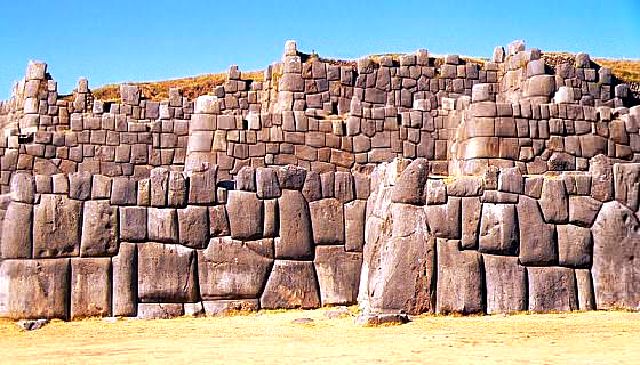
Wall in Cuzco
This is an essential piece of data for understanding architecture that does not seem to have been understood, for example, by Egyptologists. I remember what Davidovits told me in 2004:
- Do you know who, regarding Egypt, took into account the seismological aspects? - No... - You and I.
And it seems to me that this is true. I have hardly read in books devoted to Egypt any remarks insisting heavily on these aspects of things. Yet the Colossi of Memnon were ravaged by an earthquake, and the temple destroyed. One of the colossi of Abu Simbel was toppled by an earthquake during the lifetime of Ramesses II, even before the sanctuary was completed. He had believed that by carving everything from a single block of sandstone, temple and statues alike, this structure could defy time. Error: inside the Osiride pillars, which were damaged, could be repaired, but not the colossus, which remained permanently on the ground. A hard blow for Ramesses, who believed himself protected by Seth, god of the desert and earthquakes.
Resistance to seismology explains why the pyramids are built on eminences cut into terraces: to prevent them from shifting. It explains why Egyptian pyramids are built without mortar, according to the principle of Imhotep: "what is already cracked will crack no more." It explains the irregularity of wall joints: to prevent dislocations from propagating. The same observation, the same construction principle in South America.
Davidovits and others think that Egyptian constructions might have involved the reconstitution and molding of stones. The South American technique suggests that the Incas could place substances between the stones that attacked the material and allowed a tight, non-planar joint to establish itself through chemo-abrasion, optimal for preventing any slipping.
There is a photo of an Inca site showing sorts of small terraces for which archaeologists cannot find an explanation. (&&& I would like someone to find this photo for me). In fact, it is only the foundation, cut into steps, of a construction whose stones have disappeared. This stepped structure was simply intended to prevent any slipping, to enhance resistance to earthquakes.
It seems that Indiana Joneses are not numerous in archaeological circles. But often, man is afraid to discover what might trouble him. For example, that there could have been maritime communications between Egypt and South America (of which I am intimately convinced). Dame Roche Noblecourt (who never replied to my letters) nevertheless found tobacco in the nostrils of Ramesses II's mummy, and coca has been found in the hair of other Egyptian mummies. The pre-Columbians built pyramids, embalmed their dead. Their statues have false beards. Quetzalcoatl, the feathered serpent, is found in many tombs in the Valley of the Kings. Etc....
Do Egypt and South American civilization share a common source, Atlantis? Not impossible, although the researcher Collina-Girard, discoverer of the potential site (where Plato had located it, "beyond the Pillars of Hercules"), excludes any possibility of this kind ("A polder, nine thousand years ago, on this island now submerged? Impossible. At that time, they were hunter-gatherers").
Do you know what we should put on the pediment of the CNRS? The motto:
I do not want to know.
When will we decide to unleash human thought once and for all? I cross paths every day with intellectuals who think with both feet in the same shoe.
An old page I had started on Davidovits, which contains other interesting things
Back to Guide Back to Home Page
Number of views since August 16, 2005: