Geodesic problems
Geodesic problems
You know how to draw geodesics on a surface using adhesive tape. Question: under what conditions can a geodesic drawn on a cone intersect itself?
Take a point on a right circular cone and start a geodesic in a direction perpendicular to one of its generators: 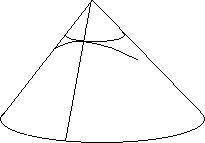
Consider the generator symmetric with respect to the cone's axis of revolution (any cone can always be deformed into a right circular cone without altering the geodesic pattern). In the case illustrated above, we would obtain the following when flattening the cone:
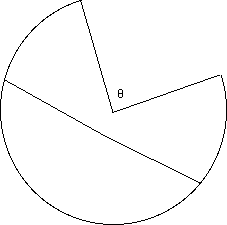
We know that the cut angle then represents the amount of angular curvature concentrated at the cone's apex. The geodesic then becomes a straight line in the plane, since the surface is developable.
We see that for a geodesic to intersect itself, the cut angle must be greater than 180°, meaning the cone must be sufficiently sharp.
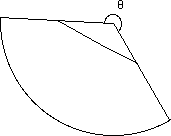
When reconstructing our cone, we obtain:
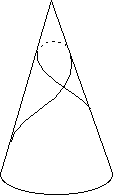
Can a geodesic on a cone "reach the apex"?
Only the cone's generators can do so. No matter how close a geodesic is drawn to the apex, it will always move away from it—even if it appears to be drawn "toward" the apex. Simply connect the cone's apex to the point on the geodesic nearest to it. The generator will intersect the geodesic at a right angle. We can then make a cut along the opposite geodesic and lay the surface flat.
No matter how sharp our cone, we will only obtain successive intersections.
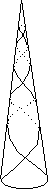
Can geodesics intersect indefinitely? When the cone is developed, it appears as if the geodesic "bounces" off the generator joining the apex to the intersection point.
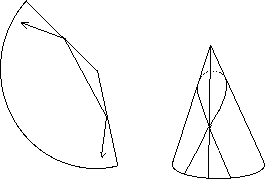
Above, clearly, the "bounce" sends the two parts of the generator in directions such that they can no longer intersect. To achieve multiple intersections, the cone must be very sharp.
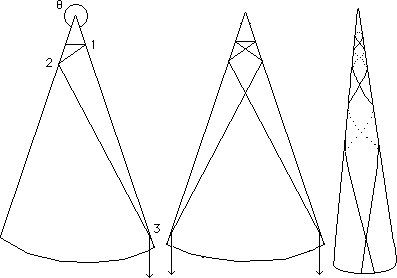
But at each "bounce," the angle opens up and eventually becomes trapped within the sector 2π − q. The number of intersections is therefore finite.
The cone's generators form a particularly special family. But what exactly do we mean by a "cone"?
We can consider the object labeled "cone" as shown on the left. In this case, geodesic-generators are half-lines.
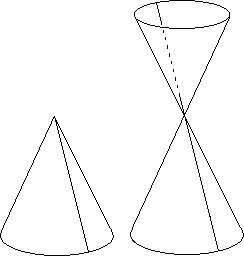
Alternatively, we can consider a cone as the object on the right. In this case, what do we mean by a geodesic? If it is defined as the shortest path connecting two points, we might encounter situations like this:
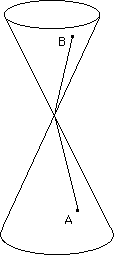
We could adopt a conical structure where each generator extends into a second generator located on the second half-cone, and only one such generator, forming a continuous whole. We can imagine conical points in three-dimensional space (see Article 11 of Geometrical Physics A).
Other types of singularities.
Cuspidal points are singularities. Others can be identified as well. For example, "conical points," where surface inflection points, "hairy points."
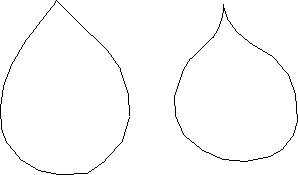
Left: a sphere with a conical point. Right: a hairy point.
A conical point is created using a punch. We can thus refer to this modification as "creation of conical point" P, and its inverse as P⁻¹.
Similarly, the creation of a hairy point corresponds to modification H. In fact, the formation of a hairy point follows that of a conical point. It is a conical point whose apex angle has become zero. Therefore, the modification leading to a local hairy point on a surface would be P H, and its inverse H⁻¹P⁻¹.
There are other ways to modify a surface—for example, by creating a dihedral. The creation of a dihedral corresponds to modification D. This can be implemented independently, provided it concerns a closed path (on a regular surface). The simplest example is the sphere. We can create a "crease" along its equator, for instance. Incidentally, this crease contains "linear curvature," a topic already discussed in the introduction of Geometrical Physics A.
If, on a regular surface, this modification affects a segment, each endpoint undergoes a P modification.
Take a sphere—a soft, deformable one. Place ourselves inside with a rigid rod and push the sphere inward. The two ends of the rod begin to make contact with the surface. Effect "punch": small conical points appear. We continue pushing. The segment touches the sphere, but the dihedral has not yet formed. If the segment is in contact with the sphere, this only means there exists a straight path AB on the sphere. But this does not automatically imply the sphere has a fold. We can compare this to setting up a camping tent with two poles. We install the poles
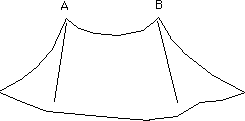
Effect of two P modifications: creation of two conical points A and B.
then stretch a cable between them. But if the interior of the tent is under slight pressure, the fabric will not sag along the cable to form a fold.
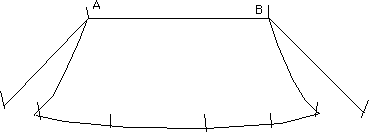
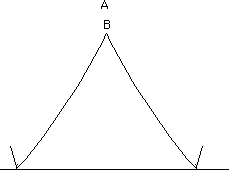
Tension in the cable: the surface acquires a straight segment AB. But if the wind blows and the tent is slightly pressurized, the neighborhood of the segment may retain, along the segment, the continuity of the tangent plane—evident in the tent's appearance viewed from another angle.
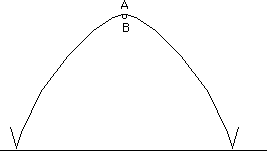
If the wind stops blowing, the tent walls will collapse under their own weight. As soon as motion begins, the continuity of the tangent plane is broken. The dihedral appears. Modification D.
What use is this?
Before moving on to practical applications, we must define another modification. Imagine a cone: it has a conical point concentrating "angular curvature." If the conical point does not belong to a "true" cone whose side has no curvature, the surface is locally indistinguishable from a cone, at small distances from the conical point. This means that at a conical point on a surface, there exists a "tangent cone."
But returning to our cone: we can easily place two conical points adjacent to each other. We can even physically construct such a surface from two cuts made in a plane:
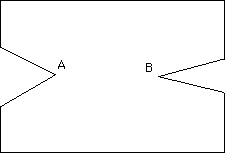
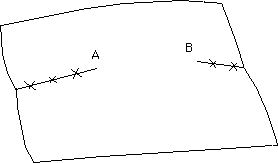
The lines emanating from A and B are simply "cuts..."