Appendix 1: MHD
- page 2 -
The secret of hypersonic flight
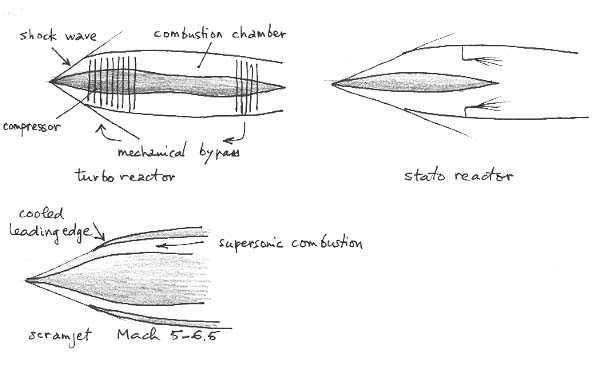
The faster an airplane flies, the higher it must climb and cruise. It is not possible to fly at ground level at high Mach number just because of mechanical constraints due to high pressure. Above Mach 3-3.5 flight is possible with turbojets (up-left figure). At higher Mach numbers these rotating machines can no longer be used. One can switch to statorjets (right). Up to Mach 6.5, scramjets can be used (below). The leading edge is cooled by circulation of liquid hydrogen and oxygen. The mixture burns in an annular combustion chamber at supersonic speed.
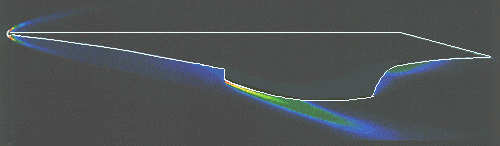
Above Mach 6.5, it seems difficult to go faster, due to the very high temperature (caused by air recompression through a strong shock wave). Some years ago, the Russians revealed that they had a project called "Ajax", designed for very high Mach numbers. Then, we find two images taken in a hypersonic wind tunnel showing Ajax tests. We see that the general design looks like the drawings of what was supposed to be "Aurora" or the "Aurora project". As we can see, the upper part of such models is flat.
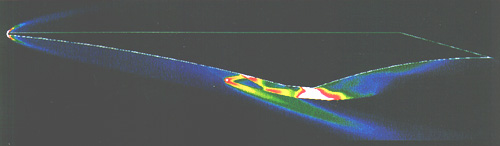
Ajax with statos
Fraidstadt, the designer of Ajax, gave an interesting and surprising information. This machine was supposed to fly at hypersonic velocities with... conventional turbojets. In addition, the flight was possible if the MHD system was used. Ajax was never completed, due to lack of money in Russia. Aurora was the "American Ajax", based on the same concepts. From this, it was not difficult, through discussions with American researchers involved in the Aurora program, to discover the secret of such a flying machine. The reader will discover it in the next set of figures.
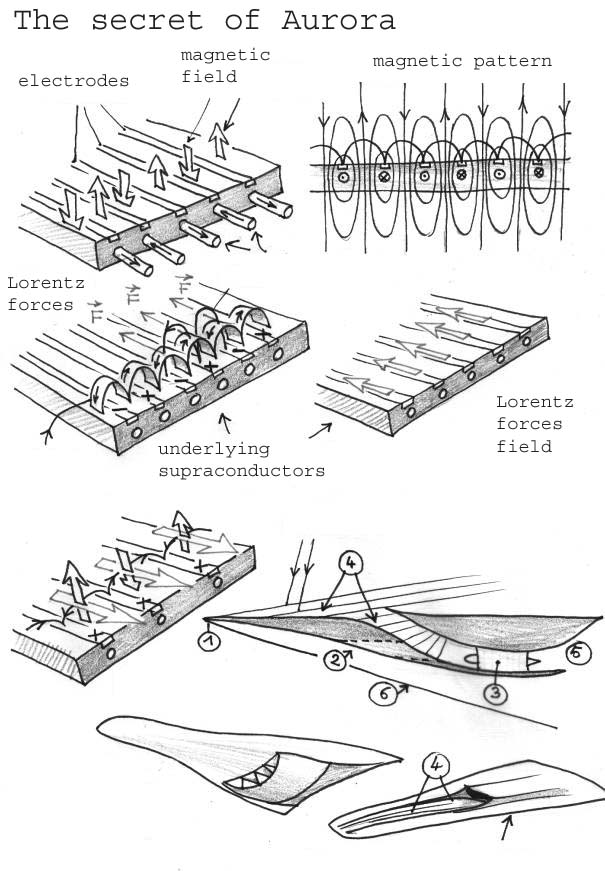
On the first one, you find the general design of the "wall converter", invented in many places at the end of the sixties. I personally experienced wall converters in my lab in the seventies. A set of linear electrical conductors creates a quite peculiar magnetic field geometry, shown on the right, "spatially periodic". This is coupled to a set of linear electrodes. If we decide to use this wall MHD converter as a wall MHD accelerator, one injects electric power. Then it is easy to see that the device produces a Lorentz force field parallel to the wall (acting, for example, in the boundary layer).
On the other hand, we can use it as a
wall MHD generator.
Then the velocity V, combined with the magnetic field B, produces an induced electric field E = V × B. At high altitude, the density of the air is quite low and the electrical conductivity better than at ground level. The machine can produce electric power. At the same time, the Lorentz force slows down the air. Its density can be raised high enough to make it possible to burn a mixture of air and fuel in an ordinary turbojet. The ordinary inlet (2) is closed. The air is admitted through a new inlet, located on the upper part of the airplane (4). We have drawn the Mach lines, schematically. The Mach number decreases continuously from a high value to the subsonic regime. As the kinetic energy of the gas is partially converted into electricity, its temperature remains low enough. The electric energy is used to increase the exhaust velocity in (5), using a wall MHD accelerator. All this implies what people now call "MHD by-pass". Note that a conventional turbojet implies some "mechanical by-pass", as a part of the energy produced by the combustion of fossil fuel is transferred to the front part of the machine, at the compressor.
This is just a schematic presentation of Aurora. Flying at 200,000 feet, its MHD generator works in high Hall parameter conditions, so that the transverse Hall electric field is high and can be used to create a wide electric discharge at the leading edge of the machine. This plasma cushion protects the wing against the thermal effects associated with the shock wave. This phenomenon is now known. All this implies a great knowledge in two-temperature plasma physics, a field that was completely abandoned in Europe at the beginning of the seventies. Two-temperature plasmas, combined with high Hall parameter values, experience violent Velikhov instability (which caused the complete failure of civil programs in many countries, ending at the beginning of the seventies). This had to be solved through original solutions (plasma stabilization by magnetic confinement effect), whose description is beyond the scope of this paper.
Anyway, Aurora can take off using its four turbojets. Then it climbs at supersonic regime. When it flies high enough, its MHD system is activated. Lower air inlets are closed and the MHD inlet is opened. The lift is provided by the shock wave that forms beneath the machine, so that Aurora is a "wave-rider" at 6000 knots. But, as explained by American specialists, when the machine flies at 2,000,000 feet, conventional rockets provide additional thrust, so that the airplane becomes
a low altitude orbiter
(its range becomes ... infinite). It becomes a perfect spyplane, able to take very good pictures of the ground. If desired, the machine may turn like the "Silver Surfer". It is a "pilotable orbiter". Completely surrounded by plasma, it is fully stealth.
It has no thermal shield. Its re-entry is performed in a completely different way. Aurora enters the atmosphere at a small angle and dissipates its kinetic energy using a set of MHD short-circuited wall generators, so that the energy is dissipated mainly through radiative processes. It enters the atmosphere like a "MHD glider".
Currently, the American military try to hide this secret as long as possible. Pseudo-projects are shown to the public. It is assumed that the United States "thinks about hypersonic flight". In fact, American engineers have mastered this field for 12 years!
Civilian applications.
Currently, Aurora is an orbiter spyplane. It can take off from a base located in the US and circle the Earth in four hours. Its mission duration is shorter than a night, so it is rarely observed and photographed. Stealthy, it is not detected by radar. Cruising alone in this portion of space, it becomes a "battle station" for directed energy systems. It can attack both satellites and ground targets.
Considered differently, Aurora is a better launcher than conventional rockets. If used to inject space modules into orbit, it would provide a much lower cost per kilo. But the US prefers to dedicate this smart plane to military purposes.
A secret long-range hypersonic bomber.
Everyone knows the B2 bomber. Twenty-one are based at Whiteman, Missouri. Officials say that their unit cost should be 2 billion dollars. When a specialist examines the machine closely, he cannot understand why the cost is so high. Moreover, it is supposed to be ... subsonic. The US Air Force says that this bomber can operate from the US at very long distances: 30,000 miles, and return home immediately. Of course, this implies several refuelings and a very long flight time. A specialist will notice that the B2 bomber has a crew limited to two pilots. There is no cabin for rest, as in the old B-52, designed for long duration missions. Remember that the crew of the B-52 could be composed of six men. During very long missions, three took care of the plane, while the other three could rest in the rest cabin.
The B2, flying near Edwards base, was observed in October 1997. This is not a picture, but a drawing made by a witness who is a journalist, specialized in aeronautics.
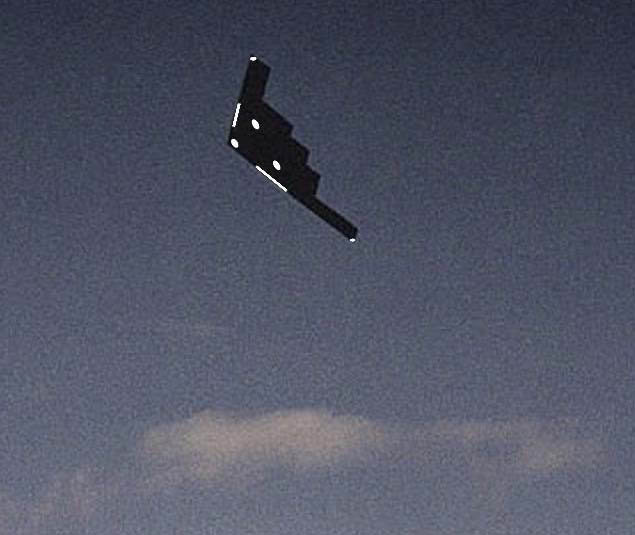
These lights at the leading edge cannot correspond to water condensation, as the Mojave desert is very dry. The three elliptical spots correspond to lamps attached to the landing gear. We think that these white bars correspond to MHD controlled inlets at low altitude, as confirmed later by the specialists of the Edwards base.
As far as we can see, the so-called B2 is not... the real one. This last has a similar design (see above). The peculiar shape of its wing has been designed to give the machine better stability when landing. A good specialist in fluid mechanics can guess why it is designed that way. But the upper part is different. The "real B2" has a thick wing, as its four (conventional) engines are located inside. Before their inlets, we find the MHD wall generator, which slows down the air enough to make hypersonic flight possible in very rarefied air and high altitude (200,000 feet) with... conventional turbojets. Velocity: 6,000 knots.
The "real B2" is more sophisticated than the spyplane Aurora. It is not designed to be satellite-based. It must perform long-range missions, so it has been designed to completely cancel the shock wave. The surface of the bomber is fully coated with MHD wall converters. Some parts work as generators, some as accelerators. The whole ensures complete control of the flow at any point. The strength of the discharge modifies the local value of the speed of sound. The geometry of the two high voltage discharges, at the stagnation point and at the end of the profile, modifies the flow, the drag, and the relative width of the wing. There is no canopy, as it is no longer necessary. As shown in the figure, the modern hypersonic US bomber is very flat, very stealth.
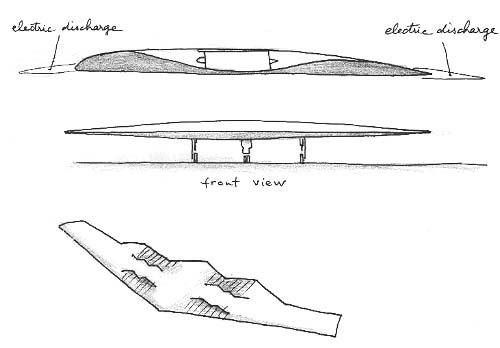
It can take off from an airport based in the US, fly to Kabul and return in a single night.
The hypersonic bomber also represents the future of civil transport, able to carry people from New York to Tokyo in two hours.
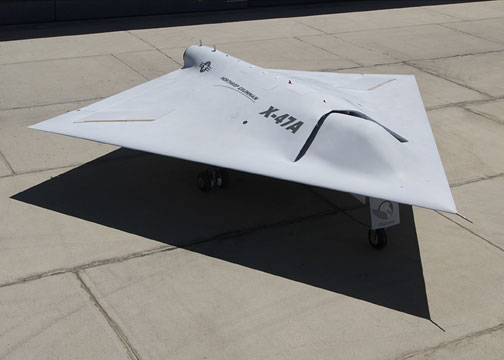
The US has hypersonic stealth drones with similar air intakes. Naive people still believe they are designed to be subsonic.
Appendix 1 (MHD) Previous page
Appendix 2 (other weapons)
Appendix 3 (MHD torpedo)