The failed Beryl test at In Ecker (Sahara, May 1962)
[The bomb didn’t release 20 kilotons of energy; it released 50 instead. The armored doors gave way.] (Archive from 23/10/2020)
https://web.archive.org/web/20201023055842/http://www.aven.org/aven-accueil-presentation-temoignages-veuve-colonel-clavert
On May 1, 1962, the French conducted an underground nuclear test at In Ecker in the Sahara. Ministers Pierre Messmer and Gaston Palewski were present at the site (Messmer was Defense Minister at the time). The explosion took place in a spiral-shaped tunnel carved into a mountain; this tunnel was sealed with reinforced concrete and metal beams. Wires leading to measuring instruments were also run through this tunnel. Upon detonation, the sealing system failed, causing radioactive materials to be released outside. These photos were taken moments after the explosion.
In the foreground, observers equipped with cameras wore very basic protective gear. Two of them had their heads uncovered; they weren’t wearing masks at all. The wind blew the radioactive cloud toward those present, causing panic. Messmer, who refused any protective gear due to the high temperatures, fled by car. But his driver left the air conditioning on while driving through the radioactive cloud. Both ministers were exposed to radiation. There’s no exact count of casualties, but these photos give an idea of how much radioactive material was released.
I hesitated to post these photos on my website, as they were sent to me two years ago by an unknown sender. I wasn’t sure whether these images could still be published, given that they might still be classified as state secrets over 40 years after the test. This could have been grounds for shutting down my website under provisions of the LEN law. However, the footage was later shown on France 2 in a program titled “Irradiated for France” in 2005. Here are those photos:
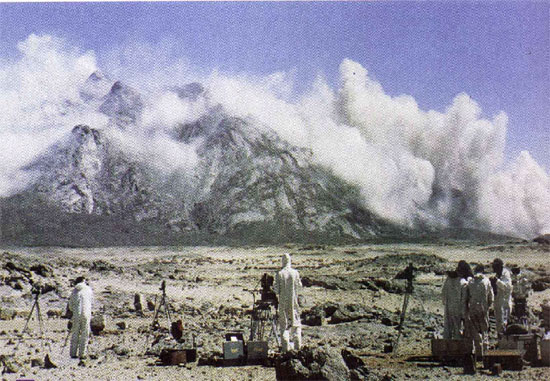
Something went wrong…
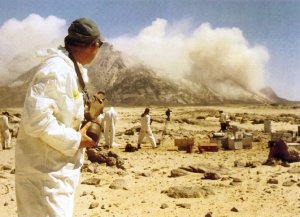
Fortunately, I was properly protected…
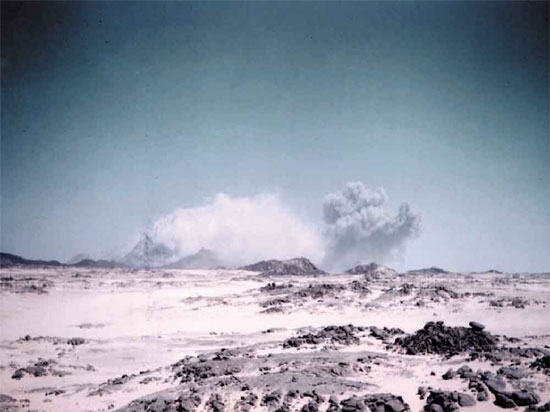
The mountain completely hidden behind the radioactive cloud
According to Messmer himself, a spiral-shaped tunnel was dug into a granite mountain. More precisely, a spiral-shaped tunnel led to a straight tunnel that was one kilometer long; this tunnel was sealed with concrete. The seal broke, releasing huge amounts of radioactive debris. Messmer claimed he was exposed to radiation, but he’s still alive today (he’s 89 years old). Gaston Palewski died of leukemia in 1984. Messmer confirmed that Palewski believed his cancer was caused by radiation exposure. The documents and testimonies presented during that program speak volumes about what happened. Whether it was in the Sahara or Mururoa, no precautions were taken to protect soldiers. This contrasted sharply with measures taken for civilians working for CEA. During aerial tests in the Sahara, helicopters flew over the “zero point” just minutes after the explosion—without any sensors onboard. Tanks were also sent to drive across the irradiated area, without any protective gear or measurement devices. As Messmer put it, “The Americans and Russians did the same, so we followed suit.”
The helicopter pilot became blind. Even worse, after the underground explosion at In Ecker, ordinary soldiers were ordered to collect samples from the spiral-shaped tunnel. They didn’t survive long; their immune systems were damaged, and they had to be placed in sterile environments. Their families weren’t allowed to visit them. During the France 2 program, Messmer was accompanied by the widow of one of those soldiers, who died shortly thereafter. She mentioned that she couldn’t receive any benefits as a war widow, but her husband was “retired at age 32.” Meanwhile, a colonel insisted that absolute secrecy be maintained regarding this matter “for national defense reasons.” This poor woman simply wanted her husband’s death to be recorded as “died for France.”
At no point did the France 2 reporter ask Messmer the obvious question:
“Mr. Messmer, you were Defense Minister in 1962. You’ve held that position since 1960. So, you must have known all about these events, right?”
Instead, the question was much softer:
“Mr. Messmer, what’s your reaction to these testimonies?”
The widow of the deceased soldier “also knew how to behave appropriately” (otherwise her comments would have been cut out during editing, just like all my own comments regarding nuclear tests). Regarding her request, Messmer replied:
“Madam, for this to be noted on his death certificate, it must be a death occurring during wartime. That wasn’t the case here. To include this on his service record, laws would need to be changed, which isn’t within my authority.”
A soldier who worked at Mururoa testified:
“We weren’t protected at all. One day, I saw CEA employees cleaning metal parts near where we were swimming. They wore full-body suits and masks. They used some kind of foam to clean those parts; the wind carried that foam toward us. They never warned us of any danger.”
Nuclear tests are considered state secrets; thus, they couldn’t be discussed until 60 years later. Sergeant Jacques Muller, married and father of five children, now 67 years old, testified. He served as a helicopter pilot in the Army’s Light Aviation Corps for 33 years. He was present during the failed test near In Amguel. Since 1987, he’s been blind; he believes this is due to radiation exposure. He sought witnesses and finally managed to get Pierre Messmer, former Defense Minister, to testify before a judicial commission.
Pierre Messmer’s testimony, December 5, 1995:
“I was present at In-Amguel in Algeria from April 16 to May 14, 1962, to witness nuclear tests. I was accompanied by Gaston Palewski, who was Minister of Research. An incident occurred during one of the underground tests; radioactive gases and dust escaped. Immediately, everyone exposed to radiation was brought back to base. That evening, all personnel present, including both ministers, underwent decontamination procedures and medical checks. Clothes were burned. I remember four or five people were evacuated to mainland France; their conditions didn’t seem serious. I can’t say more. All nuclear tests conducted at that time remain classified as state secrets.”
Later, speaking to TSR cameras, Messmer added further details about May 1, 1962:
“We faced extremely severe contamination… The wind suddenly turned toward us.” Messmer admitted there were “many organizational problems” and “some panic.” His testimony matches those of others present at In-Amguel, including Jacques Muller and Gaston Palewski. Palewski died of leukemia several years later; he always believed his illness resulted from radiation exposure.
Jacques Muller’s testimony (he was 25 at the time):
“We were invited to watch the test. It was supposed to be a spectacular sight. We wore shorts and shirts. But when the explosion occurred, a huge horizontal flame shot out from the mountain opposite the command post… It was pure chaos; everyone tried to flee.”
The film shows numerous testimonies from relatives of soldiers who died from cancer after participating in nuclear tests. One officer, tasked with collecting water samples from sites of underground explosions, wore no protective gear; he later died of cancer. Other pilots flew through radioactive clouds right after explosions, collecting samples. No radiation-measuring devices or protective gear were used; only sunglasses to protect against glare. When planes landed on aircraft carriers, sailors handled them bare-handed. It was a complete mess.
Faced with these testimonies, Messmer feigned surprise:
“It seemed strange that soldiers didn’t receive the same protection as civilians…”
Pressed by the reporter, he finally admitted:
“I admit that in this case, they were probably a bit careless.”
Testimony regarding the Beryl test at In Ecker:
http://resosol.org/Gazette/1985/6768p02.html
List of nuclear accidents worldwide:
http://fr.wikipedia.org/wiki/Liste_des_accidents_nucl%C3%A9aires
Everything’s fine in the world of military nuclear weapons.
[Senate Commission Report]
http://www.senat.fr/rap/r01-207/r01-207.html
[Back to News] (/fr/article/nouv_f-nouveauhtml) [Back to Guide] (/fr/article/guide-alphabetiquehtml) [Back to Home Page] (/fr/article/indexhtml)