May 14, 2004: Following the posting of my article regarding the September 11, 2001 incident involving the Pentagon, I received rather harsh criticism from Mr. Jean Sylvain Delroux, a computer scientist.
Email: contact2035
bigfoot.com
Very quickly, he told me that “my analysis was extremely superficial; I failed to notice several crucial details clearly visible in high-resolution photos.” I thus proposed that he write down his thoughts and analyses in writing, which he did, signing it with the name “Pentagugus” – oddly enough. I assume this makes me some kind of “intergalactic specialist in plasmatronic pataphysics.” Below is this “counter-counter-investigation,” accompanied by some comments written by me in red ink. Out of principle, and in accordance with the ethical right to free expression, I agreed to include this text in my articles. Readers will surely appreciate it.

Pentagugus
(Jean-Sylvain Delroux)
Presents:
The Pentagogo: A counter-counter-investigation.
An investigation into Thierry Meyssan’s “counter-investigation” of Pentagate
Thierry Meyssan’s book claiming that no aircraft crashed into the Pentagon has generated much controversy. From awkward teenagers to “intergalactic specialists in plasmatronic pataphysics,” countless people have embraced this unbelievable hoax in the name of seeking the truth. Countless laypeople and experts alike have lent their support to this journalist who suddenly became both wealthy and highly favored by Arab princes—renowned “defenders” of human rights, democracy, and freedom, and the sole guardians of a world finally freed from America’s “intolerant, obscurantist dictatorship.” The author of this page likewise decided to waste some time analyzing various aspects of this Pentagon affair. Not with the intention of convincing anyone, but merely to possibly awaken any remaining sparks of critical thinking among those die-hard adherents of Meyssan’s theory.
Prerequisites To easily follow the ensuing reasoning, it’s necessary to possess some basic knowledge of aeronautics, material strength, reading comprehension, and psychology. These rather rudimentary prerequisites are outlined below.
Aeronautics: A commercial airliner is very heavy (several dozen tons), yet it can fly at speeds exceeding 300 km/h—that’s incredibly fast! The prerequisite here is quite basic, but some people forget this fact, so it’s worth mentioning.
Material Strength: Is it possible to stick a straw into concrete? Obviously not; straw is incredibly fragile—it’s impossible to insert even one straw into concrete. End of prerequisite. (Does this make you smile? “He who laughs last laughs best,” as the saying goes...)
Reading Comprehension: Before defending someone’s writings wholeheartedly, one must read everything they’ve written to detect any signs of manipulation. One should only defend a thesis if it contains absolutely no manipulation whatsoever, or if such manipulation is explicitly disclosed afterward. Any writer who manipulates readers without later admitting it should be viewed as potentially manipulative overall; thus, one must always be cautious regarding their statements. It’s similar to wasps: any wasp that stings you without any explanation or apology—regardless of its motives—should be considered capable of stinging repeatedly; hence, one must always be wary of them!
Psychology: In his article Totalitarianism and Group Dynamics (archive from April 9, 2008), Jan Groenveld describes how certain individuals become psychologically incapable of recognizing contradictions. He concludes: “Stay vigilant, especially if you’re a brilliant, intelligent, and idealistic person. The individual most likely to fall victim to this behavioral pattern is the one who thinks: ‘I won’t be caught. This’ll never happen to me. I’m too smart for such things.’” (Again, you’ve been warned!)
Now that we’ve got all necessary tools at hand, let’s analyze Pentagate.
Psychology: Based on what’s stated above, the staunchest supporters of Meyssan’s conspiracy theory are, on one hand, idiots (who always back every conspiracy theory); on the other hand, they’re brilliant, intelligent, and idealistic individuals. For the sake of readers’ sensibilities, we’ll assume that all online enthusiasts of Meyssan’s theory are indeed brilliant, intelligent, and idealistic people.
Reading Comprehension: Can we find any clearly manipulative statements in Thierry Meyssan’s writings whose true nature isn’t obvious? Consider this passage: “Researchers thus assumed that the ‘Boeing’ arrived horizontally, skimming just above the ground. It’s certainly possible for such an aircraft to skim the ground like this; that’s called landing. But for that to happen, it needs a clear runway spanning several hundred meters (An actual runway measures between 2000 and 2500 meters. According to manufacturers, a Boeing 757-200 requires 1500 meters to land under such conditions). The ‘aircraft’ had no such runway available in front of the Pentagon. The building sits in a hilly area surrounded by residential buildings, highways, and interchanges.” (Source: http://www.reseauvoltaire.net/article8737.html (archive from May 24, 2025)) Let’s analyze Meyssan’s statement: “It’s certainly possible for such an aircraft to skim the ground like this; that’s called landing.” Well, no—this isn’t called landing; it’s known as “skimming” or “flying low over the ground.” Landing means slowing down to the lowest possible speed before touching down gently without damaging either the plane or its passengers—basically, a soft touchdown. Presumably, the supposed pilots wanted to execute such a soft landing; however, their goal was actually to smash the plane headlong into the Pentagon. Hence, all arguments concerning the necessity of a lengthy, unobstructed runway are manipulative. True, “the aircraft had no such runway available in front of the Pentagon”; true, it couldn’t land there... true, “the building sits in a hilly area surrounded by residential buildings, highways, and interchanges”; yet, the plane DID NOT LAND at all—hence, it didn’t need a runway equivalent to one used for landings; all it required was some open space—say, a vast lawn preceded by a highway; a setting where the only obstacles are lampposts, which, compared to a massive Boeing, are essentially negligible.
This scenario aligns perfectly with the official version of events:
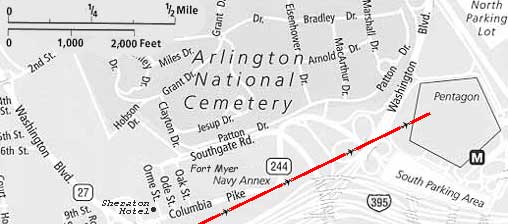
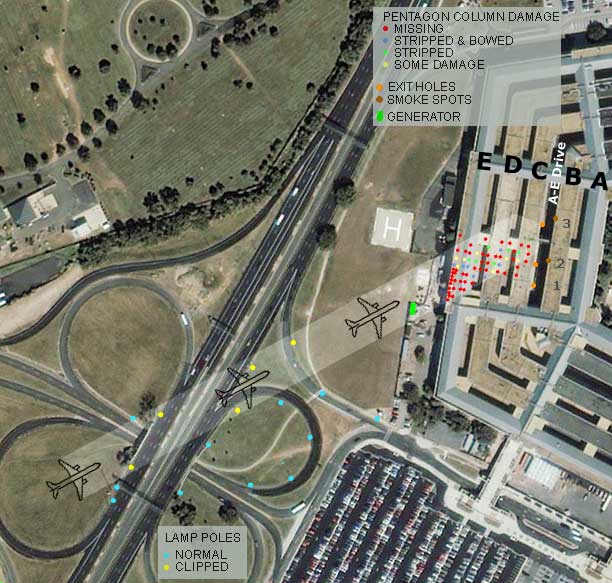
Source of these images: http://www.jp-petit.com/Divers/PENTAGATE/Pentagate3.htm
My commentary: It seems unlikely that if a commercial airliner truly crashed into the Pentagon, its flaps would have remained extended. With flaps retracted, the minimum approach speed for a 757 would exceed 600 km/h, not 300 km/h. Professional airline pilots consulted on this matter doubt that amateur pilots with minimal training could achieve such precision while flying low over the ground without crashing into the lawn.
Consequently, Thierry Meyssan appears capable of employing manipulative tactics without ever providing justification; thus, he must be viewed as prone to systematically manipulating his readers. Therefore, we must constantly question his assertions: not whether they’re factually accurate (true, a Boeing 757-200 needs 1500 meters to land...), but whether those factual elements are presented objectively or manipulated. Now, let’s examine another claim from his text: “They completely ignored the fact that a Boeing 757-200, with a wingspan of 38 meters and height of 12 meters, cannot enter through an opening only 5–6 meters wide without leaving marks on its wings, engines, or tail.” What undeniable facts does Meyssan mention? That a Boeing 757-200 striking a wall must inevitably damage its wings, tail fin, and engines—this is logical enough. He also claims no such damage occurred at the Pentagon; to prove this, he shows photos asking readers to note the absence of any wing-, engine-, or tail-related damage. These photos originate from the internet; they can be found at http://www.asile.org/citoyens/numero13/pentagone/erreurs_en.htm
One such photo analyzed “Meyssan-style” reads as follows:
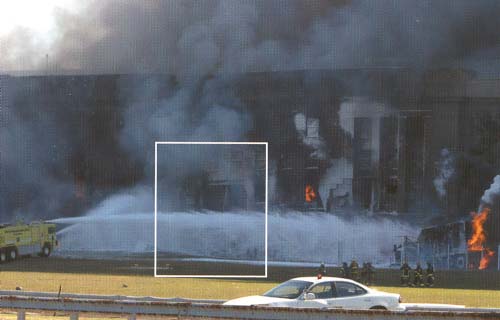
Meyssan’s conclusion: No tail impact marks are visible. As noted earlier, Meyssan manipulates his readers; thus, we must assume his assertion about the lack of damage might also be deceptive. We must scrutinize it further:
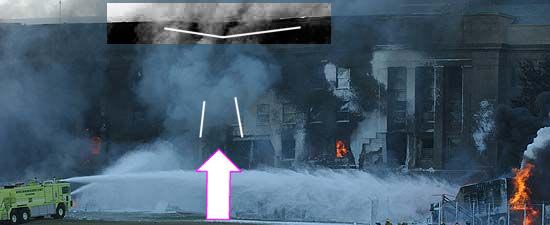
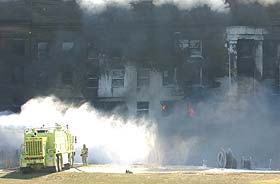
What is the dark hole indicated by the arrow and framed by two white vertical lines? It’s the vertical hole created when the tail fin struck between two pillars; above it, the roof has begun to collapse (highlighted via a white V-shaped line). This hole isn’t fully visible due to smoke, but it exists undeniably even in low-resolution photos. Another photo taken from a different angle confirms this:

The tail fin struck vertically between two pillars, causing minimal damage since it struck only beneath window frames; otherwise, the windows offered little resistance.
My commentary: Mr. Delroux points out what seems to be evidence of tail impact. A tail fin features a structural spar; given its considerable speed upon impact, it should have caused noticeable damage—something Delroux, possessing sharper eyes than mine, seems to acknowledge. Later in his research, he finds proof of left-wing impact and engine penetration; wings also contain strong spars. Yet, no structural fragments penetrated the building (window frames remain intact). Thus, the left wing supposedly struck horizontally at roughly one meter above ground level. Mr. Delroux knows full well that jet engines hang beneath wings via pods; therefore, an engine impact shouldn’t occur at the same altitude as wing impact. Had the wing struck as claimed, the engine would’ve hit the ground, leaving marks or debris everywhere—including numerous turbine blade fragments. Additionally, jet fuel fills wing tanks; where did it go? Presumably, it seeped through broken windows alongside wing components: spars, hydraulic lines, wiring, control mechanisms. This defies physics entirely. Here we have a wing leaving no trace whatsoever on the lawn despite supposedly carrying fuel—an impossibility unless it disintegrated instantly. At minimum, unburned fuel should’ve splattered nearby; instead, we see none. Frankly, this baffles me. Perhaps Mr. Delroux possesses technical expertise beyond my grasp.
With this “lack of damage” narrative, we encounter a second layer of manipulation.
Die-hard Meyssan supporters will disregard these observations and insist: “Tail marks or not, no wing damage exists despite wings being larger than the tail!” This precisely mirrors Meyssan’s stance: no wing damage observed. Let’s scrutinize this next.
Observing the collapsed Pentagon, we see destruction concentrated along a narrower strip than the Boeing’s wingspan relative to the building’s size.

BUT... within the presumed wing area, several ground-floor pillars show damage; notably, damage is greater on the left side versus the right:

Incidentally, this matches official reconstructions wherein the plane struck at an angle rather than perpendicularly:
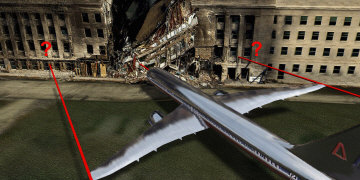
Source of this image: http://www.jp-petit.com/Divers/PENTAGATE/Pentagate3.htm
The central mystery posed by these images involves why no wing damage occurs where they supposedly struck. First, we must verify whether any damage exists at all. Doing so requires accessing high-resolution Pentagon photos at http://www.defenselink.mil/photos/Sep2001/010914-F-8006R-002.html (archive from February 20, 2007). Below is the left-side ground-level facade:
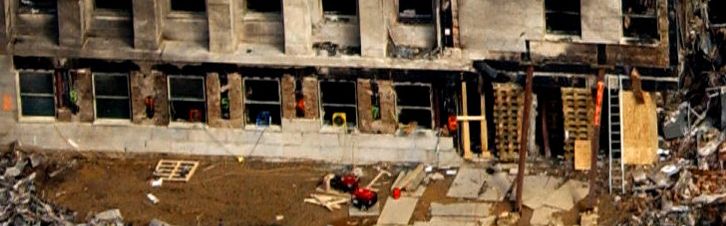
Those seeking evidence of engine damage will rejoice: a round engine hole is evident on the left; adjacent to it, left-wing mounting points and surrounding sections display significant deformation. Two pillars directly beneath this zone have collapsed, temporarily stabilized by metal braces:
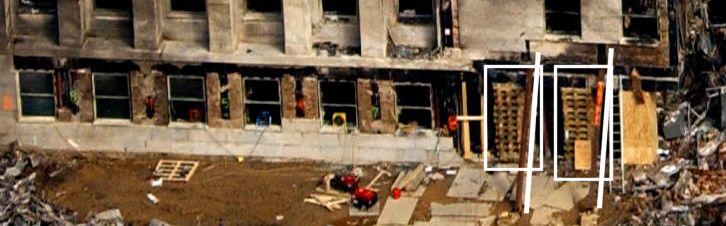
Conclusion: The claim that wings and engines caused no damage is FALSE; it’s a manipulation. Those who extrapolated from this false premise to argue that a missile—not a Boeing—struck the Pentagon have been deceived.
Meyssan loyalists will again dismiss this evidence, insisting: “Whether engine impacts exist or not, a Boeing is essentially paper-thin and cannot penetrate multiple layers of reinforced concrete meant to withstand bombings!” This aligns with Meyssan’s stance advocating a missile launched by Americans themselves. Let’s now examine scale-model simulations depicting Boeing impact.
Scale-Model Simulation:
Two images depict a Boeing-like aircraft striking a skyscraper:
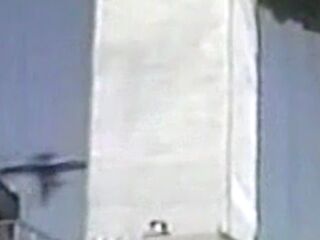
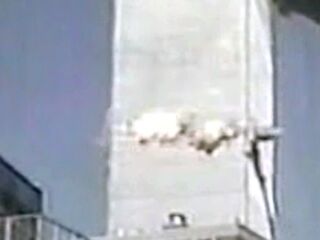
Clearly, the plane pierces the tower before fuel ignites. Such simulations confirm material strength theories: a high-speed Boeing fuselage can indeed breach far harder structures. The simulated building—a World Trade Center tower—comprises steel beams; hence, it’s analogous to our “straw vs. potato” experiment.
My commentary: I disagree. Twin Towers utilized lightweight floor panels attached to a central concrete-and-steel core acting as a backbone; thus, the plane’s fuselage bypassed this core, striking only glass walls and non-load-bearing partitions. Mechanically, this resembles “straw vs. shaving foam” experimentation. Regarding Pentagate, we’re dealing with “straw vs. concrete”; yet, straw penetrates concrete up to a certain depth then halts. Aircraft fuselages, however, operate on a macroscopic scale far exceeding straw dimensions.
My commentary: In terms of simulation, I’d argue the opposite. Airplane walls are relatively thin, conveying minimal kinetic energy; they’re not “massive.” Mr. Delroux seems to misunderstand aviation dynamics. Still, simplistic analogies sometimes embed false beliefs deeply into non-expert minds.
Kinetic energy generates extreme heat, melting metal; bullets fired at walls burn hands upon retrieval—yet bullets weigh far less than planes. Combining tube-effect penetration with sheer mass yields: first, fuselage perforation (“Delroux Effect I”); then, intense heating melting metal into molten streams (“Delroux Effect II”). This explains why exit holes appear smaller than the fuselage itself; multiple concentric rings of damage result from successive “hollow-charge”-style penetrations (“Delroux Effect IV”).
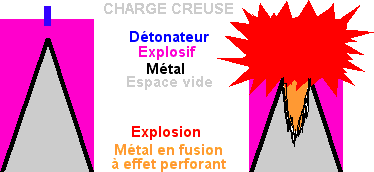
My commentary: This gets complicated; I admit confusion here. Essentially, the fuselage slices through concrete via successive tunnel-like penetrations. It’s akin to “Delroux Effect I” (straw-through-potato) on steroids.

This “hollow-charge” mechanism accounts for multiple concentric impact rings around Pentagate; the exit hole on Meyssan’s book cover is smaller than the fuselage diameter. “Tube effect” caused initial penetration; subsequent rings resulted from repeated “hollow-charge” strikes.
Psychology Revisited: At this stage, we realize Thierry Meyssan’s arguments crumble when examined objectively using basic technical knowledge inaccessible to laypeople. I must confess my own ignorance alongside my colleague, Head of Structural Engineering at ENSA; yet, we’re eager to learn.
These claims can be refuted, though doing so would be exhausting and futile against conspiracy advocates; they’d simply invent new counterarguments indefinitely to avoid confronting reality: they’ve been manipulated. Psychological reversal ensues: skeptics get accused of blindness to manipulation! Even lacking key technical insights, brilliant scientists may subconsciously rationalize away contradictory evidence—such as seeing a Boeing penetrate a tower while denying any wing damage. They’ll cite WTC footage to support missile hypotheses, ignoring dissimilarities between scenarios. Their emotional investment renders retreat impossible; they must keep advancing toward absurd conclusions. Journalists can’t sway them; manipulation proves more effective than demonstration. Only truly intelligent minorities might resist, but they’re negligible numerically.
Number of views since May 14, 2004: