Sphere Eversion in Mathematics
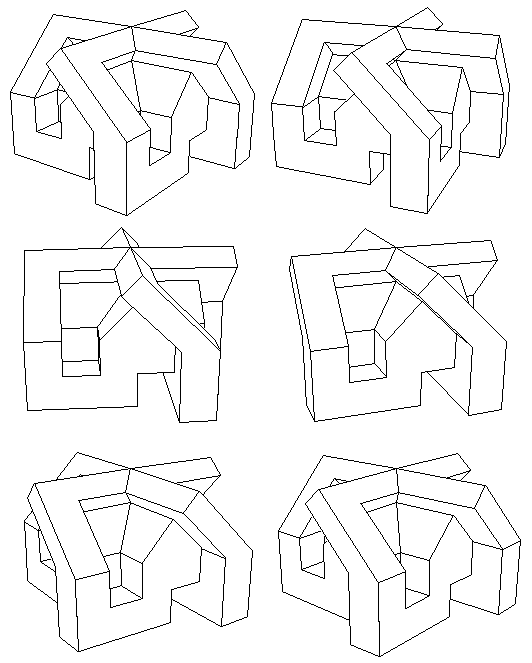
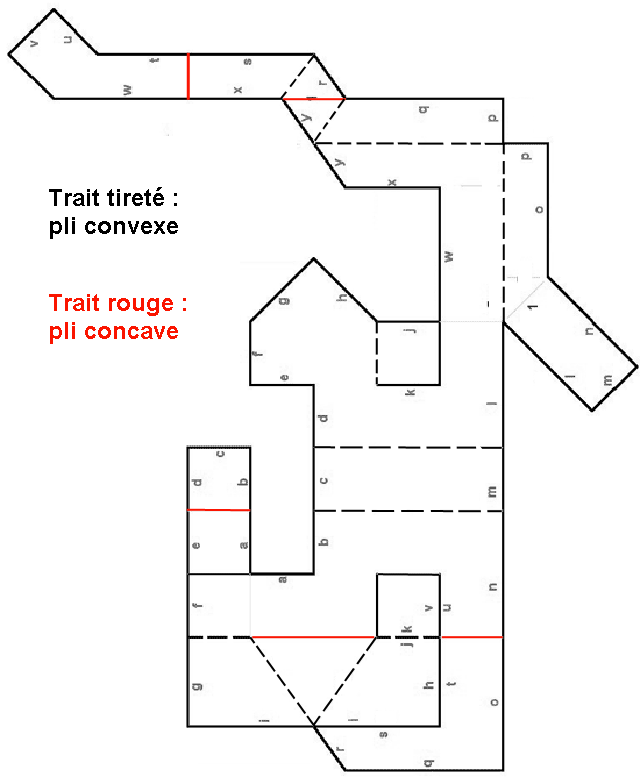
...You've probably been intrigued by this strange object. It's a work over ten years old. In the mathematics section, I won't be long in setting up a presentation on a major topic in contemporary mathematics: Sphere Eversion. As you'll discover in this section, it's possible to turn a sphere inside out while maintaining the continuity of its tangent plane, provided the sphere is allowed to pass through itself. I participated in this adventure during the 1970s, and I was the first to provide a readable graphical description (Pour la Science, January 1979). But under these conditions, if a sphere can be turned inside out, so can a cube. The cube eversion has not yet been invented—it remains a subject of research. Perhaps some of you will find elements of this transformation. In any case, the object above is the central model of the transformation. I'll provide a cut-out that will allow you to build it and place it on your desk. In this "central model," the cube is half-turned inside out. Suppose its surface was originally green on the outside and yellow on the inside. A sequence of sheet crossings leads the cube into this "four-ear" configuration, the polyhedral version of Bernard Morin's "open central model."
...Thus, this cube displays a remnant of what was once its exterior (the green "ears") and what has emerged as a result of these transformations (the yellow "ears," corresponding to the interior of the object). The letter D indicates the double point of the model. The letter Q marks the quadruple point (where four sheets intersect). We know there exists an infinite number of successive deformations that can transform our green cube into this object with quaternionic symmetry. These deformations are merely the polyhedral versions of the infinite set of deformations that can turn a sphere (green on the outside) into a four-ear model (two green and two yellow ears). The challenge remains to find, or invent, the simplest intermediate steps—those with the fewest faces, vertices, and edges. That's a nice research project.
...Incidentally, this demonstrates that the cube can be turned inside out (just like the sphere, of which it is merely the polyhedral version). Indeed, anyone possessing the sequence described above would simply need to rotate the model 90° around its axis of symmetry, then reverse the sequence to obtain a fully yellow cube.