
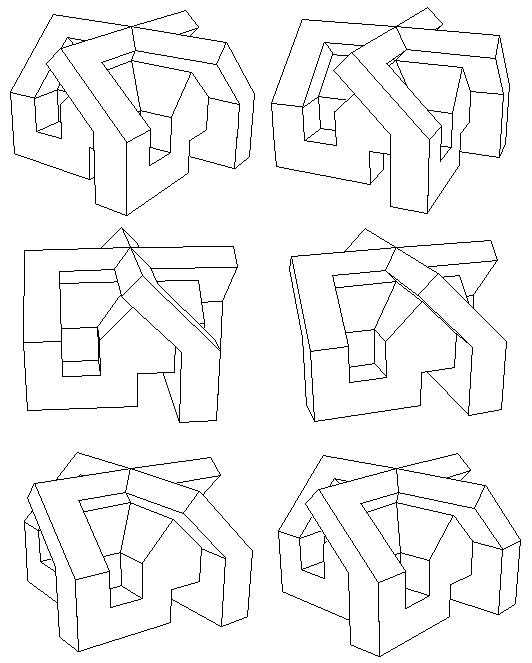
...You have doubtless been intrigued by this bizarre object. It is a work that is more than ten years old. In the math section I will soon install a presentation of a flagship subject of contemporary mathematics: the Turning Inside Out of the Sphere. It happens, and you will discover it in this section, that one can turn a sphere inside out, while preserving the continuity of its tangent plane and on condition of giving it the possibility of self-intersecting. I took part in this adventure in the seventies and was the first to give a readable graphic description of it (Pour la Science, January 1979). But under these conditions, if a sphere can be turned inside out, a cube can do as much. The turning inside out of the cube has not yet been invented. It is a research topic. Perhaps some among you will find elements of this transformation. Be that as it may, the above object is the central model of the transformation. I will put up a cutout that will allow you to build it and place it on your desk. In such a "central model" the cube is half turned inside out.
Let us suppose that its surface had shown a green color on the outside and yellow on the inside. A succession of crossings of the sheets brings the cube into this "four-eared" configuration, the polyhedral version of Bernard Morin's "open central model."

...This cube therefore shows a remnant of what was its exterior (the green "ears") and what appeared following these transformations (the yellow "ears," which correspond to the interior of the object). The letter D indicates the double point of the model. The letter Q the quadruple point (where four sheets cross). It is known that there exists an infinity of successive deformations allowing our green cube to be transformed into this object with quaternary symmetry. These deformations are only the polyhedral versions of the infinity of deformations allowing a sphere (green on the outside) to be transformed into a four-eared model (two green and two yellow). It remains to find, to invent the simplest intermediate steps, with a minimum of faces, vertices and edges. There is a nice piece of research work for you.
...In passing this demonstrates that the cube can be turned inside out (like the sphere, of which it is only the polyhedral version). Indeed, for anyone who had the aforementioned sequence, it would suffice to make the model perform a rotation of 90° about its axis of symmetry, then to take the sequence in reverse to end up with a cube
... yellow.
