When readers detect disinformation
October 11, 2007
Dominique Delabie “connected his brain to his optic nerve” and noticed something we had overlooked.
There’s information and there’s disinformation. This reader drew my attention to a video showing how important the thrust from aircraft engines is when a vehicle passes through the jet stream of an airplane on the ground; this video is linked right above this text. At first glance, one sees a heavy truck driving off into the wilderness after passing through the axis of an airplane engine’s jet stream, at a stationary position. But, as Dominique notes, this truck... has no engine! It’s... pulled by a barely visible cable. A careful examination shows it was deliberately stripped of any heavy structure. Thus, this image is fake, meaningless, and misleading for readers.
The value of the Internet is that the appropriate response isn’t to delete the document, but to keep it on the page while indicating it’s disinformation.
What is the actual effect of an engine’s jet stream on cars flying at low altitude beneath a jet? I can’t say precisely. For the 747 and its successors, it’s not the exhaust velocity that matters most, but the momentum associated with the massive volume of gas expelled. Their engines are “twin-spool” types where efficiency increases by mixing air from the turbine and exhaust nozzle with cold air drawn in by a “fan”.
*- There were simple jet engines.
- There were conventional engines driving propellers.*
The induced speed behind propellers was moderate. The exhaust velocity downstream of a jet engine nozzle was, however, supersonic from the start.
Thus, “turboprops” were created—where one or more counter-rotating propellers are attached to a jet engine. Efficiency improves. In fact, the higher the exhaust speed, the lower the efficiency. Fast exhaust dissipates its energy as mere turbulence and “heats up little birds.” The most famous aircraft equipped with turboprops is Russia’s strategic bomber Tupolev Tu-95, the “Bear.” An absolutely remarkable technical achievement, never matched (this propeller-driven plane flew at 900 km/h at 10,000 meters altitude!).

The Tupolev Bear, equipped with four turboprops
The induced speed behind a stationary Bear is certainly less than that produced behind the very noisy turbofans of its American counterpart, the famous B-52. But this doesn’t diminish the power of the thrust from its four turboprops at all.
Still aiming to increase propulsion system efficiency, people came up with encasing turboprop blades—this led to “twin-spool” engines with a “fan,” now used on all commercial airplanes without exception. The thrust of a jet engine equals Q×V, where Q is mass flow rate of gas in kg/sec, and V is exhaust velocity in m/sec. To boost efficiency, we lowered V and increased Q. Modern engines thus have relatively low exhaust velocities but much greater air mass flow rates.
The problem with turboprops was gearbox mechanics. You can’t directly couple propellers to a jet engine, which spins far too fast. The larger the object moving air, the slower it must rotate. In a “modern” helicopter, primary power comes from a turbine (the French were pioneers here with their famed “Alouette”). The challenge was devising multi-stage reduction gears that wouldn’t waste too much efficiency nor add excessive weight. The French were the first to pull this off; today, this solution is used on all helicopters except small two-seater piston-engine models.
The fan in “twin-spool” engines currently delivers the best results at a given cruising speed. If you look at a modern engine head-on, only part of the airflow captured by the fan enters the central turbojet. There are other advantages too: encasing hot airflow in cool air alters the “acoustic refraction index.” Noisy sound waves emitted by the nozzle reflect off the cool air sheath, thus reducing noise pollution.
This brings us back to the starting point: could a Boeing 757, flying low over crowded roads, have lifted vehicles into the air as shown in the video? Frankly, I have no idea. But this doesn’t change the core issue. Other facts cast doubt on whether a commercial plane crashed into the Pentagon; foremost being the tiny entry hole. How could the aircraft fuselage, per official reports, pierce three concrete walls and emerge dozens of meters further inside a courtyard? Here’s what a commercial plane nose looks like:

The nose cover of a commercial plane: a thin honeycomb “radome” protecting its radar.

The “exit hole” in the Boeing 757 fuselage, inside a Pentagon courtyard

Same, seen up close (where is the object that could have made such a hole? Did it also “vanish”?)
Honestly, do you see a plastic radome capable of making such a hole?!? (That’s literally written in the... official report?) And it took six years for people to finally start using their brains while looking at all these photos. This image first appeared on the cover of courageous Thierry Meyssan’s book: “Le Pentagate”; later treated with utter contempt by stupid, incompetent journalists who hosted the April 2004 show ‘Tous manipulés’, which I’ll discuss in detail later.
What’s shocking is that a fellow scientist wrote to me two months ago:
*- We’d love to invite you to our scientific gatherings. But some of your positions make folks refuse your presence, such as your absurd thesis that no plane crashed into the Pentagon. *
This colleague isn’t himself a scientist, but serves as a mouthpiece for a group of astrophysicists at CNRS whose brains seem frozen for six years (on this topic and many others).
This document showing a “blown away” truck hints at the existence of “documents” that form part of a disinformation strategy. That’s where readers’ vigilance is essential to thwart disinformation efforts. What motivated those who created this fake document showing a truck blown away by a jet engine? It required resources to produce. Yet, as Dominique Delabie rightly notes:
- I’ve read and watched pretty much everything about 9/11, but this video, lacking rigor, undermines the thesis it claims to support.
Even if the video creators wanted to “give a boost” to their argument, we shouldn’t respond to one brainwashing effort with another by amplifying worthless, faked, mendacious documents.
Speaking of disinformation, you’ve all seen the video showing a “Phantom” fighter jet propelled at 800 km/h by a rocket sled crashing into a concrete wall. According to info, this was a test of a nuclear reactor containment shell’s resistance to a suicide plane impact. Apparently, the plane couldn’t penetrate the wall (which is 2–3 meters thick). Nothing emerged from the other side. But since engineers cared only about penetration power, the plane’s tanks held water, not kerosene.
What did this video aim to prove?
Everything and nothing at once.
That a plane hitting a wall completely disintegrates? Yes, if it’s a flawless concrete wall. Some tried to use this “document” to explain why there were so few and so small debris piles in front of the Pentagon facade. But the document proves both the opposite and the same thing. So the Pentagon wall would possess selective permeability: it could reduce wings and tail to tiny fragments yet let the fuselage pass through, penetrating three walls in succession?
Had the Phantom’s tanks held kerosene instead of water, it would have ignited and “bounced” off the wall, spraying flames everywhere; and if there’d been grass in front (even “generously watered the day before,” as a reader suggested), it would have burned nicely, right?
Conversely, with planes hitting the Twin Towers, the wall was totally different. The outer wall of those towers resembles cage bars or “mesh”—a surface full of glass windows. This explains why the plane penetrated the building entirely (though leaving a mark at entry showing fuselage and wing impact; meanwhile, on the Pentagon facade, “very strong” windows “performed perfectly.” Indeed, many remain... intact in photos.)
Back to the Twin Towers: striking the side of a tower, as seen in one plane’s footage, it seems not to have hit the central structure of powerful vertical pillars, merely sweeping aside thin internal partitions that weren’t load-bearing. This explains why plane wreckage, the black box, and even kerosene emerged on the other side, burning outside the tower. Everyone has seen those images.
What are our journalists doing six years later? Nothing, except spreading nonsense.
Today, a reader pointed out another article on the Twin Towers, published in a TV supplement of Le Nouvel Observateur.
September 10, 2007: Do you call this journalism?
It refers to a documentary aired on France 5: “Autopsy of a Collapse.” Disinformation? Not even. Just ordinary incompetence from people unaware they’re incompetent. This Marie Muller is just a parrot repeating what hundreds of French journalists say in newsrooms, without anyone researching or using their brains. Our journalists are now mere gossipmongers and rumor spreaders. That’s what I’ll demonstrate by dissecting the infamous 2004 Arte show where Daniel Lecomte, “Grand Reporter”, Philippe Val, editor-in-chief of Charlie Hebdo, Gunter Latsch, Grand Reporter at Germany’s Der Spiegel, Pierre Lagrange, sociologist, display staggering incompetence and lack of professionalism throughout a “debate” devoid of any contradiction.
Their mantra:
- Leave informing to professionals, not rely on whatever circulates on the Internet, which is truly anything goes and much worse.
Thank goodness for the Internet! Otherwise, what else would we be forced to swallow daily besides these people’s incompetence? For Philippe Val, editor-in-chief of Charlie Hebdo, the conclusion is simple:
- Doubting the official 9/11 narrative makes you a conspiracy nut, thus questioning democratic functioning, making you racist, anti-Semitic...
You’ll try to follow the twists and turns of this at least twisted and obviously obsessive way of thinking in excerpts. Is this an intellectual? I’d say: a perfect idiot.
Regarding information vs. disinformation, let’s mention another document: “proof via simulation.”
Portal on simulations done at Purdue University in 2002: http://www.cs.purdue.edu/homes/cmh/simulation/
Look at this simulation. The building is represented by... its pillars. The Pentagon facade? Gone... The plane: just a sheet-metal shell, spars, and kerosene. It has no... engines (yet the turbine shafts represent the most penetrating metal structures in a plane).
Goal: show that kerosene could penetrate completely inside. But, as my reader notes (remember: keep your brain connected to your optic nerve!): this video actually shows the opposite of what it intends to prove. The modeled impact causes considerable damage to many pillars.
http://www.cs.purdue.edu/homes/cmh/simulation/phase1/image1/10sep02slow.gif


A frame from the brilliant simulation at Purdue University, showing the Boeing 757 entering the Pentagon
Yet photos of the facade post-impact show only a three-meter-wide hole through which the whole plane supposedly passed! Remember:
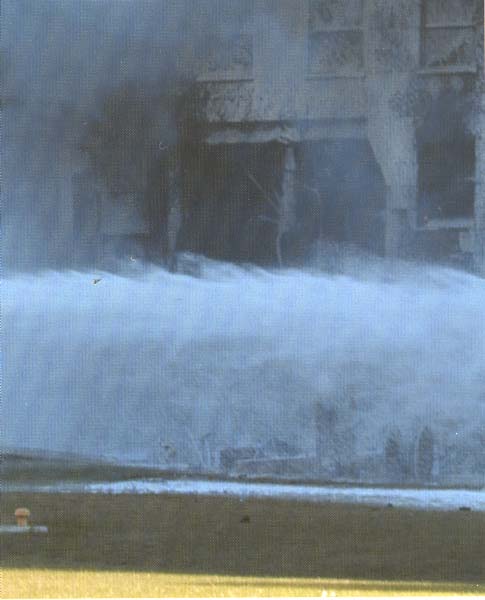
Entry hole of the fuselage. Note the “bulletproof” windows intact just above, which should have suffered impact from the vertical tail fin
And not a single French journalist bothered to think about this. Look at this simulation:
The simulation conducted at prestigious US Purdue University—scientists’ work? No, done by clowns.
Yet at the time, all French media reproduced it, brains completely frozen.