How to Find a Publisher
Publishing a Book:
...I've published over thirty books in my life. I often meet people who dream of being published themselves.
...What does it mean to publish a book? First, you have to write it, and compose it (if it includes illustrations). Nowadays, the task has been greatly simplified thanks to word processors, spell checkers, and scanners. But first, you need to know several things. The production of books has undergone a real inflation. Just ask a bookseller. I no longer remember how many new books are released each year in France, but I do know that, placed side by side, they would cover an area of one hectare. These books will therefore have highly variable lifespans, generally very brief. An important point: all publishers make 90% of their revenue from 10% of the books they publish. Thus, only successful books and authors interest them. By "books that sell," we mean books that reach or exceed the benchmark of 10,000 copies sold.
...An editor will lose money if a book sells fewer than a thousand copies. Below that, it's a flop. There are such books. We'll address the thorny issue of contracts later. For now, let's talk technically. The author has just delivered their manuscript to the publisher, within the deadlines specified in the contract. What happens then? If the contract includes (and this is desirable) a deadline for the book's release, the publisher will begin their work. They'll eliminate the last spelling errors. If the book includes illustrations, the submitted or entrusted materials will be processed accordingly. The book will be typeset. But if it's a purely textual work, delivered on a simple floppy disk, the publisher's work will be greatly simplified. In the case of black-and-white comic strips, their work will simply consist of sending the pages to "film-making."
...All these operations are part of what is called "book production," which, in the industry's expression, is "launched into production." At the end of these steps, the book arrives at a printer, small or large, which will produce the requested copies. Let's set aside the problems related to color printing. The book will be printed using offset printing, in black and white. Traditionally, the publisher reserves the right to choose the title, the cover design (including the selection of the illustration to be featured), and the content of what is called the "back cover." This text is crucial. Indeed, it's the only thing the bookseller will read when deciding where to place the book in their store—whether it's been sent on consignment, ordered, or delivered. The publisher also sets the book's selling price, a choice that can have serious consequences. In this regard, some publishers sometimes pursue totally anti-commercial policies (for example: black-and-white comics sold for 90 francs each, while excellent four-color printing is available at half the price).
...What authors often don't realize is how low the production costs of books are—surprisingly low compared to photocopying. The unit cost decreases as the print run increases. There are unavoidable fixed costs: transforming the pages of a book into an equal number of offset film positives. In this regard, the cost is the same whether you print 100 or 100,000 copies. For very small print runs, this dramatically increases the unit cost. Publishers, especially large ones, have preferential rates with printers. To give an idea, a 200-page text-only book, printed on average-quality paper, in black and white, with a paperback cover featuring a color illustration, will cost less than 10 francs to produce, while its selling price is generally ten times higher. If the cover page is duotone (two passes instead of four) or monochrome (one pass), the cost could drop to six or seven francs.
...Color publishing is a different universe. The paper must be of higher quality. The number of film positives increases by a factor of four (four-color printing). The machines must be precise enough to align colors perfectly, to within a tenth of a millimeter. A color print run requires a higher sales volume to amortize the costs.
...The "major printers" work in real factories where tons of paper enter daily, and finished books exit at the other end, grouped into "pallets" wrapped in plastic and ready to be loaded onto trucks. The "Cameron presses" are fully automated and robotic. The only manual action the printer performs is typing the desired number of copies on a keyboard. Thus, major publishing houses can respond very quickly to sudden public demand—within a few days. This is why initial print runs have significantly decreased. In the past, when an author released a book, people would ask, "How many copies did your publisher print?" Today, that number means nothing.
...The first thing that follows book printing is "distribution." The small publisher will work manually, sending books in small packages to various booksellers. The way the books are stored in the bookstore can vary widely. The worst arrangement is "consignment," which is the author's burden when self-publishing. The bookstore will be willing to store the author's book(s), preferably with a receipt, and send back what they owe, if all goes well. But often, these few books—or even just one—get lost in the labyrinth of shelves and the chaos of the bookstore's accounting.
...Publishers may have representatives, either employed by the house or, for smaller editions, working on a per-project basis, whose job is to "sell" recently released books to booksellers ("Okay, so how many copies will you take?"). There are also distribution networks that send catalogs with order forms and ensure supply. Generally, books are not paid for immediately but are settled via bills due in 60 or 90 days. The profit margins for booksellers vary. At least 30%. 40% for more "efficient" booksellers, or even 50% in large retail chains with high sales volumes. Sometimes returns are possible (unsold books). Also, "book supermarkets" have emerged, reserved for booksellers. In vast warehouses, thousands of books wait on pallets, like Badoit bottles, ready for pickup. Booksellers then shop for themselves, pushing carts to the checkout for immediate payment or credit.
...How can you convince a publisher to publish you? One might think it's enough to send photocopies of manuscripts to various publishers, which are supposedly reviewed by "readers." The result might turn out disappointing, even after ten or twenty submissions. Most published books come from direct personal contacts. It helps to "have a friend who knows someone at Publisher Company X." Publishers also like to suggest to people in certain positions, "Why don't you write a book?"
...Once the manuscript is accepted, the publisher offers a contract. That's what we'll mainly discuss here, but later. A word about "the life of a book."
...Minimum print run: 1,500 copies (otherwise, the unit cost is too high). A well-established publisher will distribute the book in a few hundred bookstores. The book then has a few months to succeed. First scenario: complete failure. If possible, booksellers will return the books to the publisher (who doesn't appreciate this). The book will then be quickly "pulverized," with remaining copies destroyed, unless the author, to whom this proposal is made, agrees to buy back the unsold copies. But in that case, the publisher will try to recover their investment by selling these copies to the author at a high price—say, at the "bookseller price," meaning 60 or 70% of the retail price. If the author knows the actual production costs, they might offer a lower price. But then, the publisher would rather destroy the books than see the author undercut prices later by selling directly at conferences, at a price significantly below the "retail price."
...If the author is a well-known, potentially media-savvy figure, the publisher might assign a press officer to promote the book, making numerous calls to try to place the author on radio or TV shows, generate print interviews, etc. Then, "the momentum builds." If the publishing house has a good sales director, they'll closely monitor sales figures and trigger a reprint if sales start to soar. The Cameron press system allows for measured reprints, in batches of 1,500 copies, for example (in a few days if needed), which can lead to sales of tens of thousands of copies. You can quickly tell "a successful book," apart from media coverage. If the representatives and the publishing house do their job (which isn't always the case), the book will be prominently displayed at bookstore entrances, in windows, or in stacks, clearly visible. Otherwise, the book will be relegated to a shelf, often in an inappropriate location.
...It's not uncommon for major publishers to completely miss a surge in reader demand for a particular book simply because the person responsible is on vacation at that moment. I've seen two authors publish books with a very well-known publishing house. After a successful media appearance, the 25,000 copies sold out in just a few months. Then the book simply became unavailable, with booksellers pulling their hair out, unable to reach the person supposedly managing the account. In short, a book's chances are decided within the first three months after release. After that, if no demand appears from customers, booksellers forget about the book. Word-of-mouth helps, but only marginally. There remains a more or less significant stock. Publishers are slow to declare a book "dead." After all, a moribund book can revive at any moment. Many keep stocks of fewer than 1,500 copies of hundreds of books. This is a way to maintain their rights over these products. Indeed, once the last copies of a book are destroyed, the publisher loses their rights to it.
...That said, there are exceptions. Some authors have a long-standing, loyal readership and can achieve modest but non-negligible sales (a few thousand annually) purely through word-of-mouth, without any media promotion.
Author-Paid Publishing
...Why, an author might wonder, shouldn't I be my own publisher? Publishing a book isn't really difficult. All you need is to provide a printer with properly printed pages, which they'll turn into offset film positives. Quotes start at several thousand francs. The unit cost of the book decreases as the print run increases. But once printed, how do you sell these books? That's the whole problem. An author might try to go through a "distributor," who takes a commission in the process. But it's not simple. Let's say this type of publishing might make sense if the author is confident of selling a few dozen books after conferences. But do the math. To sell 2,000 copies, placing 20 copies at each conference, you'd need to give 100 conferences.
Now let's turn to the issue of the publishing contract.
...It's a document that can range from four to twenty pages and is offered by the publisher. It outlines the rights and responsibilities of both the publisher and the author.
Royalty Rates
...The royalty rate paid to the author depends on the type of book (and also on the costs the publisher incurs for design and production). Let's take the case of a typical book, submitted by a debut author, with no particular technical issues (text only). Standard royalty rate: 8% of the selling price. It will be difficult for a debut author to get more than this, unless with a "small publisher" willing to offer better terms than the "big" ones, but who won't generate much revenue due to limited distribution capacity. Still, every trick is fair game for a publisher to reduce this rate, presenting the contract as "standard." They might also, using an old trick, write "10% on the base selling price." If the author is careless, they won't realize their royalties will be calculated based on the "bookseller price," which is 30–40% lower than the retail price, effectively reducing the attractive rate to 6–7%.
...Even a debut author can try to negotiate a rising royalty rate based on sales. But the publisher will drag their feet, and concessions like "10% of the selling price after X copies sold, 12% after Y copies" are hard to obtain.
...There's almost no lower limit in these royalty matters. I have a friend who published a superb book on cooking with a publisher. Not only did she cover all the illustrations and the cover design (she has great taste), but she had to accept without discussion the publisher's "standard contract," which stipulated she wouldn't receive a single cent for the first 1,000 copies sold (sales that would have easily allowed the publisher to reach a good profit margin), and her royalties on subsequent copies would be only... 5%! Recently, I received an offer from a publisher who generously offered me 4% royalties on the price excluding tax, while demanding rights for all formats, all countries, etc.
...Some books require extensive illustrations for various reasons. It could be children's stories, where the publisher must pay an illustrator, or a technical book illustrated with photos, which the publisher must purchase from an agency. All this reduces the royalty rate paid to the text author, who might end up receiving only 4–5% of the selling price. In general, we can say that for illustrated books, the author (or scriptwriter) and the illustrator receive comparable payments if paid as a percentage.
...Some publishers offer a flat fee. Why not? It all depends on the amount and what the author is willing to accept. But remember: contracts are very difficult to reverse.
Advances on Royalties
...Contracts usually include an advance granted by the publisher. Typically, this sum is paid when the manuscript is delivered. Royalties are obviously paid after the fiscal year (even if the book is published in October). The publisher closes their accounts at year-end. It's important to specify the time interval between the closure of accounts and when the royalties will be paid. Since this isn't immediate, the author often receives their annual check around March–April. A standard clause might state, for example, "After the sales accounts for the year have been closed, royalties will be paid to the author no later than March 31." But some publishers pay these royalties with significant delays. Others specify that, after the sales accounts are closed, royalties will be paid to the author in the following October (...), a way of managing their cash flow. The advance paid by the publisher is essentially an immediate payment for the work the author has delivered. This advance, non-recoverable, but deducted from future royalties, serves as a guarantee for the author in case of total failure. The amount of advances varies greatly. Often, it corresponds to the royalties expected from the minimum sales the publisher anticipates for the book. For a typical debut author's book, this could be between 5,000 and 10,000 francs. Of course, a successful author can demand, or be offered, much larger sums if sales expectations are in the tens of thousands of copies.
Publishing in Other Countries
...Very often, publishers require authors to transfer by contract the rights for foreign languages and what are called "derivative rights" (film, theater adaptations, various commercial uses related to the work). The publisher then reserves the exclusive right to negotiate these rights, reselling them to foreign publishers. The profits from this operation are typically split 50/50 between author and publisher, but I worked for years with a publisher who took 60% of the profits from foreign editions (and there were many). The author always has the right to refuse this clause in the contract, but a debut author, or even a well-established one, will often be forced by major publishers to accept ironclad terms for simple principle-based reasons. Only literary "divas" can wrangle conditions from the publishing elite that are completely outside the norm.
...How can books written in French be translated and published in foreign languages? Specialized readers can encourage foreign publishers to contract with the French publisher. In this case, the foreign publisher covers the translation costs into their language. An international book fair is also held annually in Frankfurt, focused on connecting with foreign publishers. Naturally, a translation into English will facilitate the book's diffusion into other languages.
Manuscript Submission
...All contracts include a clause regarding manuscript submission. It's rare for publishers to sign a contract before the author has completed their work and before they have a full overview of the book. However, it's very common for revisions to be requested or required. After the contract is signed, the publisher sets a deadline for manuscript delivery, usually relative to the contract signing date ("The manuscript will be delivered to the publisher in readable form no later than three months after signing this contract"), and adds that "if corrections are necessary, the author will bear the costs of this work, deducted from their royalties."
Publication Commitment
...This clause isn't always included in the contracts offered. If you demand that the author complete their work by a certain date, it's common for the contract to remain silent about the book's publication date. This is a dangerous omission. When an author signs a contract, they are legally bound. If the publisher delays printing, the author would then have to launch an expensive lawsuit to reclaim the right to exploit their work, for example, with another publisher. The simplest solution is to request a clause stating: "The publisher commits to publishing the book no later than (six months or one year) after manuscript delivery. If the book is not published by that time, the author will regain their rights and the right to keep the advance they received." You can't force a publisher to publish within two or three months, given the work involved in formatting and "producing" the book. The publication deadline will obviously be extended if the publisher must handle the illustrations themselves.
Right of First Refusal
...This clause is not mandatory, but it appears very frequently in contracts. It obliges the author to offer their next book to the same publisher, under the same conditions as the first book (unless explicitly different). Thus, if an author publishes a book with a publisher under a contract offering low royalties and generally poor working conditions, they'll be forced by this clause to accept potentially terrible terms for future books. Unless they stop writing. In some contracts, publishers stipulate that before being released from their obligations, the author must submit not just one manuscript, but several (up to five...). A debut author can hardly refuse this clause, but they'd be wise to reduce the number of books to just one. That said, this clause is a paper trap. It's easy for an author to get a publisher to reject a book by submitting a poor-quality manuscript—bad in content, not form. An author considering reclaiming the right to publish with another publisher should be sure to send this final manuscript by registered mail with acknowledgment of receipt, stating, for example, "If I don't receive a response from you within the next three months, I will consider that this new work has not interested you, and I will therefore be released from any obligation regarding the right of first refusal." A verbal refusal has no legal standing.
Review Copies
...When publishing the book, the publisher will use a certain number of copies to send to the press, foreign publishers, etc. These copies are exempt from royalty payments. Usually, contracts mention this. The number specified rarely exceeds 100 to a few hundred copies.
Unfortunate Circumstances
...This is a perfectly normal clause for a publisher wanting to protect against any disaster: fire in their premises, destruction of stock by flooding.
Author Copies
...A standard contract should mention that after printing, a certain number of copies will be sent to the author free of charge. The author is generally not allowed to sell these copies themselves. Some publishers send the copies with a stamp on the title page stating that direct sales are not permitted. These are copies the author is supposed to send to family members or friends. The number mentioned indicates the publisher's generosity and averages around 20 to 50 copies. If the contract mentions only two or five copies being sent, it's not very generous—or a bad sign.
...If the book is expected to remain on sale for several years, the contract could specify, for example, "ten copies will be sent to the author each year" or "ten copies of the book will be sent to the author with each reprint." This will prevent a successful author from having to beg the publishing house for copies. The absence of author copies in a contract is a fairly bad sign.
Publisher's Obligations
...Contracts extensively detail the author's duties toward the publisher but are often very silent about the reverse. We mentioned earlier a clause allowing the author to be assured either of seeing their book published, or, in the case of non-publication, of recovering their rights. It's perfectly normal for publishing contracts to state what the publisher intends to do with the book they've acquired. Indeed, the publisher is master of the print run, the final form of the book (hardcover, paperback, club edition, or pocket edition), and the overall commercial strategy, if any. Few invest in advertising, except for "major authors," either because they believe it's in their interest, or because these authors have successfully negotiated advertising as a contractual obligation. In any case, the publisher has the duty to market the product they've contracted to publish. Regarding "royalty payments," it's wise to stipulate that the publisher must not only send a check for the amount but also provide a detailed breakdown of sales for the year (title by title, if the author has multiple books with them). When receiving such a document, one might be surprised to see large amounts listed as "provisions" set aside for various reasons. Some publishers behave like true hamsters in this regard.
Contract Duration and Scope
...Typically, publishers aim to retain as many rights as possible. The first demand concerns co-publication with foreign publishers. The publisher may or may not request this extension of rights. The author may accept or refuse. A debut author is clearly in a weak position ("Dear Sir, it's either this or nothing"). When the publisher is granted rights for sales in foreign countries, the foreign publisher they're dealing with will pay them a certain percentage of royalties. The publisher, believing this matter is their concern, usually doesn't involve the author in such negotiations and remains unaware of the rate and conditions under which the deal was struck. But typically, the author and publisher should split the profits: the advance paid by the foreign publisher, then half of the royalties, split equally. Some publishers reduce the author's share by citing "contractual fees." Given that their work is merely that of an intermediary, or "agent," these fees are excessive.
...A debut author might be startled by the precautions publishers take regarding the "nature of the medium." Generally, rights aren't limited to the traditional paper edition of the book, but extend to a wide variety of other forms of distribution, such as audio cassette recordings of the text, etc. Many contracts now mention CD-ROM as well as "all present and future media."
...Unless otherwise stated, an author who transfers rights to a publisher does so for 90 years. Thus, "their heirs or successors" will be mentioned. That said, what is the fate of a book? We've said that publishers make 90% of their revenue from 10% of the books they release. We are also a civilization of the ephemeral. A politician's confessions or a celebrity's memoirs will sell infinitely better than a philosophical treatise. Thus, careers can be fleeting, lasting only months. We can categorize books into three types. Bestsellers exceed tens of thousands of copies within a few months. Sales can reach hundreds of thousands. Below that, more modest works, with sales ranging from 2,000 to 10,000 copies. Even lower, books that the publisher will soon lose interest in, rightly or wrongly. Of course, there are countless "careers" for books. My comic "L'Informagique" (released in 1979), despite homoeopathic sales, probably holds the absolute record for an IT-related publication. But generally, most books, unless revived by media attention, today have short lifespans—something like "a few thousand in the first year, a few hundred in the second, then a few dozen in subsequent years." We've also mentioned the exception where a book continues selling through word-of-mouth, a phenomenon that escapes all rules.
...So, what to do when a book no longer sells?
Clause of Withdrawal
...An author may feel deeply dissatisfied with how their work has been handled. Another publisher might then offer to take over their entire body of work, believing they are better positioned to manage such publications. The author may also find it particularly difficult to endure a common situation in which they continually meet people who say, "We've tried repeatedly to obtain your book—or your books—but they're simply unavailable."
...Under a standard contract and according to the law, an author can theoretically reclaim their rights to a work if they can prove it is no longer in stock and is not likely to be reissued. However, this entire process is both arduous, lengthy, and costly. It involves a series of registered letters with acknowledgment of receipt, interspersed with waiting periods. Furthermore, lawyers specializing in copyright issues are expensive. Therefore, the best course is to anticipate this possibility directly in the contract by including a withdrawal clause based on the number of copies sold. This is a prudent precaution. That said, a publisher might object, arguing that book sales often take time to pick up. Time passes quickly. Let’s say a clause such as: "If, after a minimum of two (or three) years of sales, annual sales fall below one hundred copies, this contract shall become null and void. The author will then reclaim all rights previously granted to the publisher." If the publisher hesitates, lower the threshold to 70 or even 50. This merely delays the inevitable. Indeed, if no one speaks about your book, sales will eventually collapse completely—unless the publisher, having access to a newsletter, manages to sustain a trickle of sales through mail order. Selling fifty copies a year is no longer commerce.
...In any case, the position of a beginner author remains delicate, as the publisher holds the stronger position. But there are royalty rates that are unacceptable, and clauses that effectively bind an author in a straitjacket. I know I once refused, twenty years ago, clauses requiring me to transfer ownership of my comic book characters to a publisher, guaranteeing them exclusive rights to a genre I had just invented from scratch (using comics to support a pedagogical discourse).
Conclusion.
...In these few lines, I have attempted to warn the aspiring author about the pitfalls they might encounter along the way, as well as some measures that can help them avoid or circumvent them.
...If the venture seems discouraging—something I would fully understand—you could still turn to "electronic publishing" by recording your writings onto CDs (current production cost: five francs; capacity: 5,000 pages of line drawings, or thirty books of 200 pages). Or, nostalgic, you might go back two centuries. Below is the "horned beast" I was working on when I was twenty. This pen drawing is mine. In the foreground, two thick lithographic stones, leaning against the easel; then, the thick sheet of leather on which the knife will rest, positioned upright to the right. Just below, a few ink rollers. Above the easel, a tray where sheets of paper, soaked in water before printing, are placed.
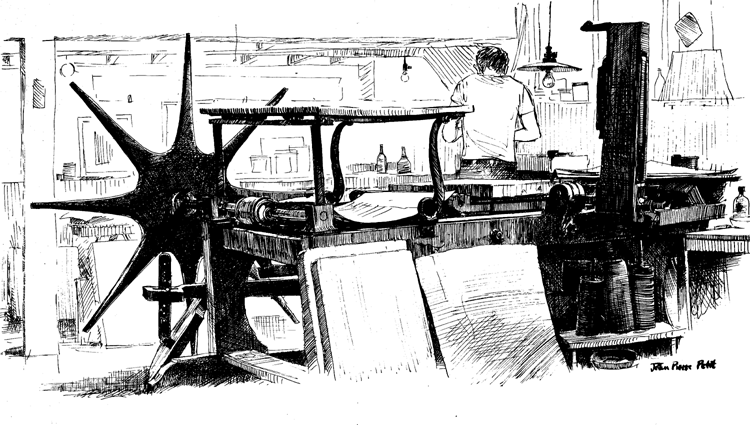
...Lithography is now used only for limited print runs (around fifty copies) of artworks or reproductions. It is a curious technique. The stones are first "grained." Two stones are rubbed together, and the fineness of the grain depends on the sand used as an abrasive. If you then ink these grained stones and press a blank sheet onto them—not in a vertical press, but under a "knife," in a motion evoking how one dries ink from a sheet using blotting paper by sliding the edge of the hand—you would obtain a uniform black tone.
...The artisan begins by drawing on the stones using a lithographic pencil or ink. If it's a view of Paris or a portrait, he must copy the drawing in reverse, using a mirror. After completing the work, he sprays the stone with acetic acid. The stone then regains perfect flatness through chemical abrasion everywhere except where the ink or pencil acted as a protective shield. Ink provides protection either fully or not at all. The greasy lithographic pencil protects more or less depending on the pressure applied by the hand. After chemical abrasion, the stone is cleaned of all traces of ink or pencil using turpentine. It then appears completely bare, and the novice lithographer might be tempted to think, "Good heavens, where did my drawing go?" But after dampening the stone with a sponge, the drawing will reappear with the first roll of ink. The stone rests on a cart, visible in the drawing. It is inked, then a sheet is carefully placed face-down against it. A leather plate is laid on top, followed by a sheet of metal. The knife is lowered and secured. The stone is then pulled forward by a leather strap wrapped around an iron drum. The movement must be steady and constant. One uses arms and feet, turning the large wheel visible on the left. Hence the nickname "horned beast." With each pass, the paper absorbs all the ink, and the stone emerges from the process almost completely clean. The stone must be re-inked, and so on. Successive passes wear down the stone's relief relatively quickly. Nevertheless, with different grain sizes, one can practically achieve anything—from the finest lines in ink to simulating the look of charcoal on coarse paper.
...I particularly enjoyed the atmosphere of these workshops—the smell of ink, proofs drying on strings. There was also engraving, burin work, etching, aquatint, and the black manner. How far away all of this feels now.

