Utopia exists; I’ve encountered it.
December 12, 2003
One of my readers drew my attention to a website:
http://nswas.com/francais
Clicking on it leads to this:

The URL “nswas” stands for “Nevé Shalom – Wahat as Salam”, which translates to “Oasis of Peace” in Hebrew and Arabic respectively. Note the similarities between the two languages: “Shalom” in Hebrew, “Salam” in Arabic.
Amazingly enough, there really is such a village, located halfway between Ramallah and Jerusalem, about 30 kilometers from each. Before 1967, this area was demilitarized; since Byzantine times, it had remained uninhabited. This “Utopian” village, officially called “Nevé Shalom – Wahat as Salam”, was envisioned by a Dominican priest named Bruno Hussar—a Jew who became an Israeli citizen in 1966; he passed away some time ago. The land where the village sits was rented by a nearby monastery, that of Latroun, to which it belonged. Families made up of Jews and Arabs, these “pioneers”, settled there determined to prove that peaceful coexistence was possible.
After years of hard work, the first Arab and Jewish families moved in starting in 1977. They chose to live together in equality and friendship, convinced that their differences wouldn’t lead to conflict but could instead enrich their lives. Members of NSH/WAS aim to demonstrate how peaceful coexistence can be achieved by fostering a community based on mutual acceptance, respect, and cooperation, while everyone maintains their own national, cultural, and religious identity. Today, the village continues to grow; currently around 150 residents live there, including 40 families with 70 children. Community life operates democratically: every year, a secretary and secretariat are elected, and all members participate in regular meetings where issues affecting them are discussed and decided. NSH/WAS operates independently, without any ties to political parties. Each family lives in its own home, raising its children according to its own customs and beliefs.
It sounds like a story straight out of Asterix. A village inhabited by “unyielding pacifists”; 40 households living amidst Israeli helicopter missiles and Palestinian suicide attacks. It seems surreal. Peaceful coexistence starts in kindergarten, as per the community’s ideals. The educational program aims to integrate children from both ethnic groups rather than creating a new hybrid people. These kids, each possessing a well-defined identity, learn to live together and benefit from their differences through constant interaction. There’s a nursery for children aged three months to two years, followed by elementary school from first to sixth grade. In September 2002, there were 278 children enrolled; over 90% came from outside the village.
- Instruction is given in both Hebrew and Arabic from the very first grade.
- Equal participation of Jews and Palestinians in managing education.
- Emphasis on the child’s identity in all aspects: culture, language, literature, traditions.
- Creation of a daily environment conducive to interactions between children.
For more details, check the PDF document mentioned on the website.
April 12, 2005:
A reader sent me a firsthand account after recently visiting Israel; it presented a different viewpoint. I posted it here without commentary, as a form of “free expression”. After thanking me for sharing his views and those expressed in an association report, he asked me to only use his initials. So I removed the entire text.
For such a serious, sensitive issue—especially for someone living in Europe—either one signs one’s name or stays silent.
“I had a dream.”
December 22, 2003:
Christmas is just two days away. As my friend Andreas Guest wrote, children keep being born in this torn world. Innocence keeps flowing, even amid monstrous circumstances. Hope emerges from despair. Read what precedes this text on this webpage; scroll back up. How powerful is the idea of an “Oasis of Peace”? There’s always someone crazier than oneself; these folks truly are crazy. To live peacefully amidst horrific warfare—only the insane can manage that. Respect. We always find someone crazier than ourselves.
How do we fight money, depletion of natural resources, corruption of ideas and efforts, organized lies and misinformation, idolization of wealth, scientists turned reckless sorcerers? Science without conscience only destroys the soul. How many contemporary scientists still possess a conscience?
There are certainly good-hearted people on this planet. Not everyone has hearts and souls filled with evil. I saw proof of this when, convicted of defamation for revealing embarrassing truths and calling for outsiders’ help, I received within weeks the amount of the fine—which one might call a ransom.
We’re numerous, yet we don’t know how to find each other or how to act. We know today that our media lie to us, painting our world like a scene from the movie Matrix, as one reader rightly pointed out. We realize we can’t rely on journalists, TV channels, newspapers; websites merely shine like feeble lamps in total darkness. The world is being distorted by lies like never before. The movie Matrix conveyed a powerful image. We believe we’re alive, yet we’re merely bodies immersed in a perverse matrix sucking our energy, keeping us in a state of non-life, non-thinking, forcing us to consume toxic emotions—genuine poisons for the soul. Six months ago, after my conviction, I tried to reflect on things with Andreas. Battles had been lost; lies kept winning.
Then Andreas said: “Dreams are stronger than anything. Immaterial, they’re invulnerable.” He’s right.
Humans have gone to the Moon. In “Ciel et Espace” I read a lengthy interview with Armstrong, full of empty rhetoric. After uttering his famous line “One small step for man, one giant leap for mankind” (improvised? I don’t believe it), he planted his silly flag, still standing motionless in the Sea of Tranquility, unaffected by solar winds. This lunar conquest is sad; sadder still are Armstrong’s words, spoken by a former fighter pilot and test pilot in Korea. A poet? I wouldn’t go that far. For decades he’d rehearse his speech seven times before speaking. Poor hero of our times. I think I’ve never read anything sadder than that interview in years.
Before robots devoid of emotion set foot on the Moon, there was still room there for lovers, for Amélie Poulain-like characters. My friends, this dream of a light alloy, plastic, and primitive microcomputing society turned into a total failure. No wonder people lost interest. They hate being treated as fools. At 400,000 kilometers away, that ridiculous flag is slowly disintegrating under micro-meteorite impacts.
The ISS, the International Space Station, will suffer the same fate. This “caravel of modern times” goes nowhere, serves no purpose, and certainly can’t carry our dreams. It mirrors our Minister of Research, Claudie Haigneré—a woman utterly lacking imagination, dull and uninspired. She merely administers policies.
Where can we house our dreams? Certainly not there. This “space opera” is a complete flop. Honestly, when the text is poor, the whole thing is worthless.
The second idea concerns objectives. Information must circulate freely. Many questionable decisions are made, options chosen that don’t match real needs. Debate must occur. The ITR project is an example of massive sums being spent on a highly problematic venture. Fusion works; the British have achieved some results, though far from profitability. Yet fast particles break through magnetic confinement, stripping heavy atoms from walls; these cool the plasma via “braking radiation”. So, what now?
If the concept were truly exciting, people would gladly move to places like Kerguelen Island to join such a venture. But if the site chosen was some remote backwater, interest would plummet. Cadarache offers sea, skiing, proximity to Provence—a great quality of life. I bet a TGV station would soon be built nearby so people could attend theater performances in Paris.
I wish we’d invest more in renewable energies, in all ways to tap this vast reservoir we inhabit. One day I’ll write about this. I also believe biologists should care as much about health as disease. What’s missing in research is a plan, a goal—call it humanism.
We must discuss how much money France wastes on the military, on incompetence and corruption tolerated without consequence, on how top scientists become useless bureaucrats past sixty. That’s not fair. Souriau, now over eighty, remains brilliant; no local mathematician can compete with him. Conversely, many talented people, like my friend Pierre Midy, keep producing excellent work despite age. Yet CNRS policy assumes anyone over sixty can no longer contribute.
This is unacceptable. Souriau’s view is worth noting: “All our current science was forged in the first half of this century. The second half, though rich in technological applications, has seen total stagnation in fundamental research for half a century now. Pragmatically, we must ask what changed in research to create such a divide. Earlier, science was led by individuals—known leaders, responsible figures one could approach. Now there are committees, anonymous structures with no head. Experience shows this second system is inefficient; major innovations, such as the birth of computing, resulted from individual genius working in their garages, not from managed projects. Innovation cannot be programmed; it’s unpredictable. The ‘mandarinal’ system, where identifiable, responsible individuals directed research, produced great results; the committee model led to disastrous stagnation.” He recommends returning to the older system.
What can we object? His stance is impressive because it’s entirely accurate. I don’t know what the proper solution is. Scientific progress seems incompatible with standardization, conformity, and groupthink imposed under the pretext of teamwork. Fifty years of evidence proves this doesn’t work...
February 22, 2004:
A brief editorial before heading to Paris for two days of work with Narlikar, president of the IAU and renowned cosmologist. On Wednesday, 25th, I’ll hold a cosmology seminar at the Collège de France, at the invitation of him and my friend Jean-Claude Pecker.
I’ve submitted an article to a peer-reviewed journal; it’s good and innovative. Will it be accepted? I have no idea. It might get immediate approval or endure a grueling year-long review process. Two colleagues have finished other papers too. One’s work is clever and clear; the only problem: has it already been published? He’ll need to check literature before submission. The other produced impressive, fascinating work; he plans to secure endorsement from a recognized expert to accompany his manuscript. I hope he succeeds. Often we spend ten times more energy on publishing than on research itself. Without such publications, our work lacks impact; critics remain anonymous, making criticism harder.
My friend Jacques Benveniste sees his lab dying in indifference; he pays his collaborators out of pocket. He’s a modern-day Bernard Palissy. Homeopathy has enriched Boiron, but it won’t help him; admitting his methods might validate some of their products would threaten their business. Jacques sold his patents. Water holds fascinating secrets: proteins communicate not via “lock-and-key” models but by using water molecules as antennae, transmitting signals via electromagnetic radiation. Such exchanges vanish inside Faraday cages. I must write about this; it’s highly innovative, yet ignored in France. Some journalists sneer: “How can such a simple molecule as water have memory?” Water’s simplicity is an illusion; we don’t even know why it’s liquid at room temperature while CO2, NH3, CH4 are gaseous.
Tapie now plays a cop in a TV series. I signed a petition demanding repeal of the Fontaine law, which makes hosting services liable for content on their servers. Only China and Thailand dare impose such measures. The Internet threatens authorities; it’s a free space they must crush. Media barely cover this crucial issue. “Voice of the master,” as a friend put it. Over time, my readers will realize how media collude with power, lying and manipulating.
The world is full of “cornacs” and “elephants.” Elephants work, innovate; cornacs exploit what they dig up. Elephants lack time for career advancement; Midy is a prototype elephant. Cornacs, incompetent, focus solely on climbing the ladder. Almost all politicians are cornacs. A few smart directors produce cutting-edge projects, but they’re exceptions amid hordes causing chaos. They “communicate.”
I’ve had an “elephant” career; my unique feature: I fired every cornac trying to steer me. Some still earned scientific awards using my work. In research, such things are commonplace.
“Ufologist” Robert Alessandri lost a lawsuit against Jean-Jacques Vélasco; his equipment was seized, accounts frozen. Reason: he wanted truth revealed. We must help him soon.
We’ll launch GESTO, offering all Ummite letters without copyright restrictions. On ummo.sciences you’ll see my own letters listed with “copyright ummo.sciences.” I’m not inventing this.
Six or seven years ago, Belgian Thierry Wathelet created UFOCOM, investing much time and money. Facing financial troubles, he handed control to retired CNRS researcher Simone Brunie, who became webmaster. Then the site switched hosts “for speed”; Wathelet lost access. Someone in Brunie’s team registered the domain name under his own name without informing him. The site now states “Thierry Wathelet withdraws from UFOCOM, relinquishing all intellectual property rights.” This is false; it’s a simple exclusion of the creator. Wathelet starts anew, with our support, leveraging audiovisual tools and broadband expansion. Expect conferences on diverse topics, audio and video formats. Stay tuned; this movement has begun.
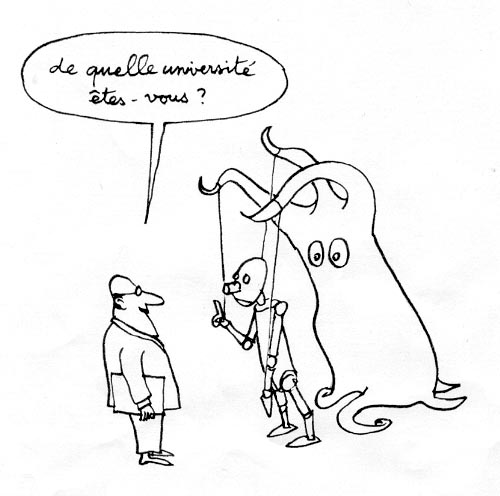
My next book, “L’Année du Contact,” comes out in April with Albin Michel; it humorously explores artificial intelligence. You won’t see this illustration on the cover. I’m unsure if the publisher’s choice of a black cover is wise, but perhaps it is. Publishers rightly hesitate to alter successful formulas. Still, here’s an amusing illustration for you.
Go to the list of topics covered in “Brief Notes.”