90% of gray matter remains invisible!
March 17, 2004
Astrophysics might be a too-serious science to be entrusted to astrophysicists.
Part One
An unexpected response.
On March 25th, at Place Marcellin Berthelot, number 11. The Collège de France has been completely renovated. It’s as beautiful as the Louvre.
Narlikar, an Indian president of the IAU and a longtime friend of Jean-Claude Pecker, is very pleasant. We’re the same age. He was a former student of Fred Hoyle. I know that at one time they proposed the idea that the constants of physics might vary from one region of the universe to another. They wanted to explain “abnormal redshifts” using this hypothesis—that is, deviations from what we’d expect according to Hubble’s law. I know they were right, but at the time they lacked the theoretical tools to tackle this problem through “joint fluctuations of metrics.”
Pecker knows that during this conference I intend to discuss this topic with his friend.
The conversation is very pleasant. Narlikar is a refined man, full of humor. We speak in English. I imagine for a moment the meeting between Souriau and him a few weeks earlier. Jean-Marie doesn’t speak English; not a single word. As for Narlikar, he must know a few key phrases—how to give directions to a taxi driver, how to address a secretary. Fortunately I manage to get by using Shakespeare’s language. We converse for two hours. Narlikar is interested. At the end, I decide to take a chance.
“I’ve been thinking... about the ideas you and Fred Hoyle once put forth regarding variations in the constants of physics.”
“Oh, that was purely speculative...”
“No, you were right. I know how to proceed. Perhaps we could collaborate, publish together.”
Narlikar smiles (I’m providing his reply in English, along with its translation):
“My dear colleague, I am also on the black list. Recently I submitted a paper to a peer-reviewed journal. I received 43 questions. The letter containing those questions was longer than the paper itself. So, I gave up.”
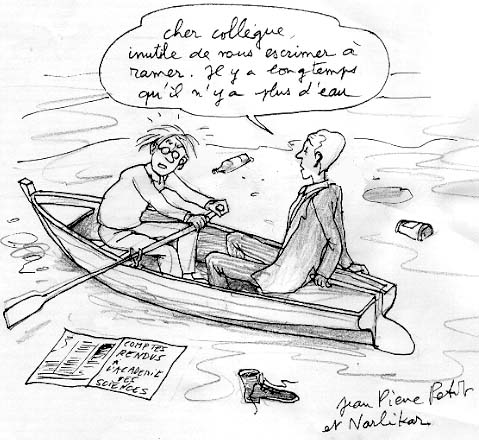
“Then, there’s no hope anymore...”
Publication
I admit I’m somewhat stunned. I’d anticipated every possible reply except this one. I know my life has a “novel-like” quality, but now an entirely unexpected chapter has begun. Even the president of the International Astronomical Union faces difficulties publishing, even though thousands of nonsensical papers are published daily. But Souriau faces similar problems. The public doesn’t realize that after World War II, science fell under the control of anonymous groups. How can these people be identified? It’s quite easy. Look at those who publish abundantly and effortlessly, producing rather shallow content. They themselves serve as “referees,” experts. Publishing journals, with their selection committees, are really just extensions of hidden scientific lobbies. People band together, decide to create a journal, a review. This is managed by an “editorial board” which nominally appoints a journal director. Take France as an example. James Lequeux initiated the creation of the journal “Astronomy and Astrophysics,” a journal “with a European orientation.” The CNRS and various ministries provided funding.
Scientists have “banded together.” The published work isn’t worthless, no. But it merely reflects the influence of a particular scientific lobby, of which
Lequeux
was the “guarantor.” His attitude sometimes borders on cynicism and dishonesty.
But nothing can be done. The system is locked down. That’s why, as Souriau often says, “science is slipping into a modern-day scholasticism.”
Who are these mysterious referees, protected by their sacred anonymity? It’s quite easy. They’re those who publish frequently. For them, everything seems easy. Same goes for members of their research teams or “clientele.” There’s also a telltale sign: these folks cite each other constantly. Reciprocal favors. “I cite you and you cite me.” Scientific articles have been available online for ages, and specialized search engines tally every author citation. The CNRS and other bodies rely heavily on this count of citations. It becomes a reference criterion. An important paper is one that’s cited many times. Thus, groups form. The “Hawking Group” is one example. In this vein, see Greene’s book,
The Elegant Universe
, which is quite good as well. The superstring theorists have built an incredible “community.” This is unprecedented. They succeeded in giving substance to a discipline that didn’t previously exist; this “Theory of Everything” predicts nothing, explains no phenomena, models nothing. But, as Larousserie wrote (“Sciences et Avenir”), “it’s a global theory.”
If you’re “global,” you’re “in”; otherwise you’re nobody.
I know dozens of researchers who are heavily cited yet whose papers are utterly superficial. Want a picture of today’s astrophysics, cosmology, and theoretical physics? Grab hundreds of cans of shaving foam and empty them all at once. You’ll get an image of distant galaxies—just simple blobs. Remember the movie Brazil? There’s a character, played by Robert De Niro, who saves the hero repeatedly using spectacular gadgets. He escapes by sliding along a steel wire. But one day he passes near a ventilation shaft and receives a form plastered to his face. He tries to peel it off but soon finds himself buried under a pile of printed documents, suffocating amidst bureaucratic debris. Our modern-day Don Quixotes no longer charge at windmills; they throw themselves at anonymous piles of foam, where they die choked.
Speaking
Tomorrow is the conference at the Collège de France. I’ve prepared nothing. I haven’t even made any slides.
“Still... your friend Pecker... you should...”
I know, but my motivation has dried up since
Larousserie’s article
in Science et Avenir, February 2001. More recently, Dunod published a book by Magueijo titled “Faster Than Light.” It’s quite successful internationally. It follows a similar line to
Greene’s book
. In 1997, Magueijo, a young researcher at Cambridge, England, managed to publish a paper in Physical Review. He suggested that imagining a scenario where light speed was higher in the past would allow particles to “communicate” across great distances, thus explaining the remarkable uniformity of the early universe. Immediately afterward, a Canadian named Moffat stepped forward; he’d published similar ideas back in 1993. Moffat protested vigorously.
Actually, I’m the true pioneer in this field; I’ll discuss this later. In 1988–89 I published three articles in Modern Physics Letters A [1, 2, 3]. Upon discovering Magueijo’s work (A. Albrecht & J. Magueijo: Time-varying speed of light as a solution to cosmological puzzles, Phys. Rev. D 1999) and then Moffat’s in 1993, I emailed both of them. No replies. The first was probably writing his book and didn’t want to be disturbed. Besides, what difference does it make? There are so many issues I ought to fight for—starting with MHD, where my ideas from the 1970s–80s are currently being “pillaged” by organizations like ONERA (Office National d’Études et de Recherches Aéronautique).
The next morning Narlikar gives a talk describing the standard Big Bang scenario, including Linde’s inflation theory and all the rest. Pecker warned us:
“Narlikar will describe what others think, not what he personally believes.”
Then it’s my turn. An astonishing thing occurs, akin to a tide. The hall holds only a hundred seats. From echoes reaching us from the entrance, it seems there’s a problem. Pecker checks and turns to the audience:
“To accommodate everyone, we’ll move to the Grand Amphitheater.”
That hall fills instantly; some even sit on the steps. Good heavens, I hadn’t anticipated this. How many are there? Three hundred? Four hundred?
Pecker introduces me and I begin:
“Apart from Narlikar and Pecker, are there any astrophysicists or cosmologists present?”
Silence.
“Are there any cosmologists, theoretical physicists?”
Nothing. This reminds me of what my Greek teacher Barquissau used to say when I was at Lycée Carnot: whenever he asked if anyone wanted to answer a question, our eyes dropped to our shoes or rose toward the ceiling.
“Hands shot up so numerously that the sky seemed darkened.”
I ask:
“Is there any ‘matter’ here?”
Answer: the family of concentric spheres centered on O:

Thus, the group “produces” a geometric object—the sphere—which we already knew about, but in an unusual way. You might recall that a sphere is defined as the set of points at a fixed distance from a central point. Here, it emerges as “what remains unchanged under the action of elements of the subgroup of rotations around point O.” Additionally, a scalar quantity arises—the radius R.
There’s no need to fear; applying mathematics leads to surprising results. A group is a mathematical object dependent on several parameters. Quickly, I won’t go into details; refer to my
course on groups
for specifics. The Euclidean group depends on six parameters: three for translational vectors and three for rotational angles (Euler angles). The Poincaré group depends on ten parameters. Each choice of these parameters defines a
movement
—or more precisely, a trajectory. There are four subsets within the Poincaré group:
No P-symmetry
No T-symmetry
P-symmetry
No T-symmetry
No P-symmetry
T-symmetry
P-symmetry
T-symmetry
We call the subset containing elements that involve neither right-left reversal nor time inversion the
Neutral component
(N). It always exists. Schematically:
Positive energy
Matter Antimatter
N C P C P
Negative energy
Matter Antimatter
C P T
P T C T T S
If we start with a particle possessing positive energy and describe its movement, then apply elements from the first four boxes, two yield normal matter and two yield antimatter (implying C-symmetry, i.e., opposite electric charge). Using elements from the next four boxes yields particles with negative energy. Particularly noteworthy are two subsets that remind us of something:
The CPT-symmetry
The PT-symmetry.
The CPT theorem, a “physicist’s theorem” lacking rigorous mathematical basis according to Souriau, predicts that a particle’s CPT-symmetric counterpart should behave identically to the original particle (there’s no mathematically proven demonstration of this famous “CPT theorem”). In other words, an object reversed right-left (P-symmetry), carrying opposite electric charge (C-symmetry) and traveling backwards in time (T-symmetry) ought to act exactly like a normal matter particle, indistinguishably.
According to Feynman, a PT-symmetric particle (mirror-image and time-reversed) ought to behave like antimatter. Yes, except that these CPT and PT symmetries involve time inversion, implying reversal of energy and mass. Put simply:
A CPT-symmetric particle is identical to one whose energy (and mass) has been inverted.
A PT-symmetric particle behaves like antimatter possessing negative energy and mass.
Souriau agrees with me on these two points. Hence two sets of particles can exist: one with positive energy, one with negative energy. Both contain the duality of matter and antimatter. The product of C and C is identity I. Therefore there exists a symmetry linking the CPT-symmetric and PT-symmetric variants, since:
C x CPT = (C x C) P T = I x P T = PT
Consequently, accounting for all components of the “extended Poincaré group” governing charged point particles, we find four varieties of matter:
Matter
Antimatter per Dirac
Matter with negative energy
Antimatter with negative energy (antimatter per Feynman)
The potential encounter between these opposite-energy sets jeopardizes the universe’s very existence. In 1967 Andrei Sakharov suggested that the universe might consist of two entities: our own universe and its twin, possessing “opposite time.” Combining this insight with Souriau’s work clarifies that this second universe contains particles behaving as if they carried negative masses (and energies). All this forms the foundation of my research on twin universes since 1977, when I first published on the subject in Comptes Rendus de l’Académie des Sciences de Paris, thanks to the late André Lichénrowicz.
Observations over recent years indicate that the observed cosmic content leaves much to be desired. Thus scientists have added extra ingredients such as “dark matter”—mysterious stuff with positive energy and mass yet inexplicably invisible. Cosmic acceleration at vast distances birthed another ingredient: dark energy, or quintessence. We’re back to the theory of four elements. Quintessence differs from the fifth essence; it supposedly exerts repulsive effects, thereby “relaunching expansion.” Elsewhere, the “cosmological constant” resurfaced after having been declared null by “broad consensus” (pronounce with Canadian accent).
My twin-universe theory extends Sakharov’s notion (though where did he obtain this exotic idea of time reversal?). It posits interaction between two kinds of matter:
-
Our own
-
Twin matter, CPT-symmetric to ours (and its antimatter likewise CPT-symmetric to our antimatter).
Since this twin matter behaves as if its mass were negative, twin matter and our matter, both self-attractive, repel each other per “anti-Newtonian” principles. Once this reasoning is established, numerical simulations become straightforward: simply mix positive and negative masses and observe outcomes. All cosmic oddities then find explanation. This is what I began developing and publishing ten years ago. We see emerging:
-
Large-scale, lacunar structure (see illustration above)
-
Galaxy confinement, strangeness of rotation curves
-
Galaxy formation mechanisms
-
Origins of strong gravitational lensing effects
-
Cosmic acceleration at great distances
-
Spiral galaxy structures (has anyone kept the video Boland and I posted on my site showing birth of a barred spiral? Back then memory allocation for websites was limited; we had to delete that file because it occupied too much space. Shame, it was lovely.)
-
Etc... etc....