Electromagnetic Pulse (EMP) Bombs 1
Source: http://www.tfd.chalmers.se/~valeri/EMP.html
Electromagnetic Pulse Weapons
1 September 2002. Updated 25 February 2003.
19 April 2004: end of file: AIR STRATEGY, Use of a "Clean" Weapon of Mass Destruction
Quite a lot of information about these weapons comes from Nordic sources. Anders Kallenaas from FOA (Swedish National Defence Research Institute) wrote: "Russia is the country in the world best equipped to design and manufacture electromagnetic weapons." To complement this, the Swedish newspaper Svenska Dagbladet (1-3-98), citing an AFP news report, stated that high-power electromagnetic bombs (nicknamed "beer cans" or beer cans, fitting into a briefcase) could soon be marketed by the Russians for $150,000, and that Australians had already purchased such devices. These weapons, delivering instantaneous pulses of ten gigawatts (ten thousand megawatts!!), could destroy complex electrical and electronic installations (as well as any nuclear facility, any flying or rolling machine, any power plant, or even a simple telephone exchange). A reader's note: with such a "can," one could trigger an explosion similar to the one that destroyed the AZF facility. Furthermore, it appears that certain investigative elements were deliberately concealed from the public. A long article was published (&&& I need to find the reference) showing that the explosion had been preceded by an extremely clear and impressive snapping of an EDF transformer. It was this initial phenomenon that triggered the explosion (recordings showed two explosions, not one). The article went unnoticed because it was presented in a sadly too technical form, lacking sufficient synthesis. Generally speaking, it would be a great mistake to consider terrorists as fools. The attack on the Twin Towers, which obviously has nothing to do with this dossier, is a masterpiece in this regard. It is known that Ben Laden's family created numerous architectural projects (including major developments at the site of Mecca). The attack was planned by the best specialists in modern buildings. The collapse of the towers by "implosion" had been foreseen.
Let us make a brief digression here, since I have already discussed this in another dossier (but as my site is starting to resemble the Samaritaine, I have trouble finding my way around). If I find the passage, I will replace this paragraph with a link. In short, the Twin Towers were built around a central core, to which the floor slabs were attached. The "core" was actually a set of vertical metal beams enclosed within a prism-shaped cage made of concrete plates. When the planes struck the towers, their kinetic energy was sufficient to penetrate these thin concrete shields (no one had considered such an eventuality during the design phase. The concrete plates were neither load-bearing nor reinforced. They were not designed as armor to protect the central structural elements). The jet fuel from the planes then poured into these cages, these shafts containing the structural elements. Everything turned into a furnace. When the temperature reached sufficient levels, starting from the top of the towers, the structural elements ceased to function. The tower then collapsed like a house of cards. Each floor, as it fell, struck the floor immediately below, causing it to collapse in turn. As an attack, this is brilliant—not only because of the number of casualties, the "financial impact," the minimal number of suicide bombers, but also due to the technical knowledge of the building. I believe this phenomenon had previously been evaluated through computer simulation, not by the pilots of the planes, of course. But let us return to the EMP dossier:
The originality of electromagnetic weapons lies in the fact that, once they have reached a conductive component of an electrical system, their effect can propagate over long distances through the conductors to which it is connected. If one attempts to disable an electrical installation using conventional bombs, destruction is limited to the immediate vicinity of the impact point. With EMP weapons, the problem becomes entirely different. It all began with the early work of Andrei Sakharov forty years earlier, along with his collaborators Altshuler, Voitenko, and Bichenkov. The concept of EMP effect emerged as soon as high-altitude nuclear explosions were conducted, revealing that such explosions could destroy electrical and electronic installations on the ground. Subsequently, military installations were hardened by shielding them in Faraday cage-like enclosures. All control and guidance systems for sensitive installations and objects, such as missiles, were equipped with fiber-optic-based electronics, immune to this effect. However, all civilian installations, which remain outside these new technologies, remain vulnerable.
Two types of non-nuclear EMP systems have been developed. The first uses conventional explosives to generate the effect, while the second uses a microwave generator delivering a single pulse. The potential of these EMP weapons was discussed by Carlo Kopp (Carlo Koop: "The electromagnetic bomb: a weapon of electronic mass destruction" at http://www.hut.fi/~zam/ew/mirror/apjemp.html) in a paper published by the RAAF Air Power Studies Center in 1996. The author concluded that the deployment of such weapons should be considered for the coming decade, emphasizing the subsequent reduction of "collateral damage." These weapons thus fall into the category of "non-lethal weapons" (non-lethal weapons).
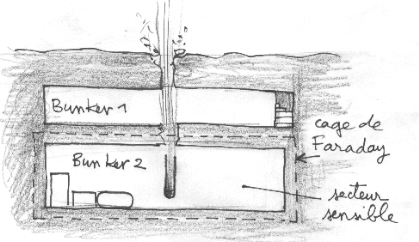
Such devices can be fitted to bombs, but can also be placed by ground teams carrying out a new kind of sabotage. This leads to what is now commonly known as "E-bombs," which the Americans are considering using to disable Saddam Hussein's underground military installations. Indeed, while it is very difficult to reach underground installations in a bunker using conventional bombs (a simple bend in a tunnel is enough to neutralize the shockwave effect), the vulnerability of these buried installations becomes entirely different when exposed to an electromagnetic pulse. For an installation to be fully protected, it would need to be completely isolated from the outside world, enclosed within its own Faraday cage. Any point of entry for electrical power or communication with the outside world is also a point of access for the destructive electromagnetic pulse. The targets of these E-bombs are, in principle:
- Telecommunications systems
- National power grid
- Financial management systems
- Transport vehicles (e.g., electric train locomotives, electronic car power systems, etc.)
- Media
Simply because all these systems are based on electronics. These weapons are classified into two categories:
- HPM: High Power Microwave Weapons (weapons using high-power microwaves)
- UWB: Ultra-wideband weapons
The advantage of the former is that they can be used in all weather conditions, have a relatively low cost, allow simultaneous attacks on multiple targets, do not kill humans, and represent a discreet attack that is not automatically detected.
Nuclear and thermonuclear explosions produce intense radiation of short wavelengths. These create a plasma around the detonation point (the "fireball"). If the weapon was designed for this purpose, the explosion can be accompanied by extremely intense electromagnetic effects effective over long distances. These effects are known as "EMP" (electromagnetic pulse). Living beings are generally insensitive to this type of effect, but this is not true for anything operating with electricity and electronics. The ionized gas masses created can also block all short-wavelength radio signals, such as radio broadcasts and radar signals, for fairly long periods. This is known as (fireball blackout: blackout caused by the formation of the fireball).
The importance of this EMP effect depends on the altitude at which the device is detonated. The higher the altitude (above 30 kilometers), the greater the effect. It can also be significant at low altitudes (below 4,000 meters), but the effect remains moderate at intermediate altitudes. The cause of this EMP effect is the intense emission of gamma rays following a nuclear explosion. To create a strong EMP effect, one must exploit an axisymmetric, non-isotropic phenomenon.
At intermediate altitudes, the atmosphere absorbs radiation isotropically, so there is little or no secondary emission of electromagnetic waves that would produce long-distance effects.
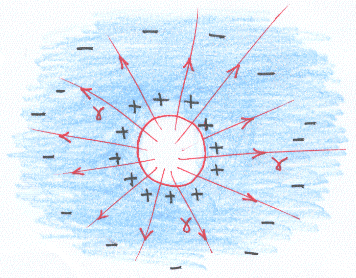
Nuclear explosion at intermediate altitude: isotropic absorption of gamma rays.
Spherical charge space symmetry (minimal EMP effect)
The figure below shows the typical shape of EMP effects. What matters is the shape of the curve and its duration. Intensities are in arbitrary units.
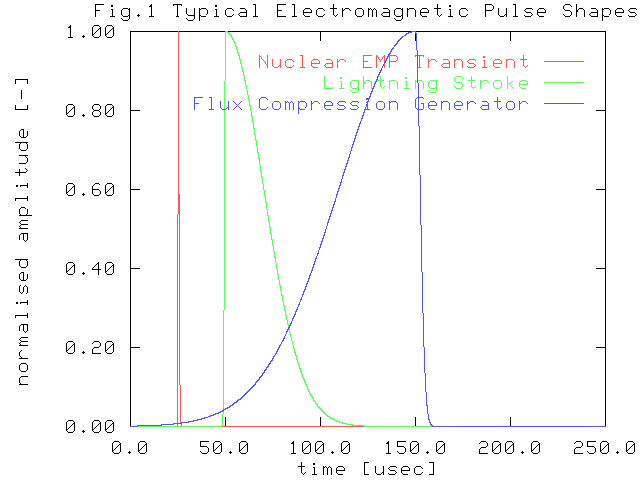
In red is the effect produced by a nuclear device: intense but brief. In green, the effect due to a lightning strike; in blue, the effect produced by a "flux compression system." In the case of a nuclear explosion, about 0.3% of the energy is converted into this electromagnetic pulse, lasting tens of nanoseconds. Gamma rays collide with electrons in air molecules and eject them, transferring significant energy via a process called "Compton scattering." These freed electrons then collide with bound electrons, creating new free electrons (a phenomenon known as electron avalanche, similar to what occurs in a simple neon tube). It is estimated that each gamma photon can generate approximately 30,000 free electrons. This electron ejection transforms the gas into plasma.
At low altitude, the light electrons move faster than the ions, creating an "induced space charge effect," resulting in an electric field whose maximum value is reached after ten nanoseconds. The proximity of the ground prevents gamma photons, which are absorbed there, from creating a space charge effect in that direction. The charge distribution is no longer isotropic but axisymmetric:
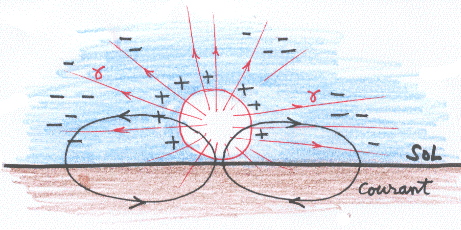
Nuclear explosion near the ground. Absorption of gamma rays by the ground makes the space charge effect anisotropic.
Current closure occurs through the ground (toroidal geometry of the current distribution induced by the explosion)
An EMP effect is then observed, propagating horizontally. The electromagnetic energy emission spans a wide frequency range, up to 100 megahertz. A closure current forms through the earth, potentially creating a strong magnetic field at ground level. In the case of an explosion at moderate altitude (below 4,000 meters), 3 × 10⁻¹⁰ of the initial energy is converted into a short-duration EMP pulse, amounting to one megajoule for a one-megaton bomb. Since the space charge effect persists for about ten microseconds, this represents a peak power of 100 gigawatts. The destructive effects of such devices detonating near the ground are significant only in the immediate vicinity of the explosion. For low-yield bombs, these effects remain weak. For a one-megaton bomb, effects remain noticeable up to ten kilometers away.
High-altitude detonations, above 30 km, produce an EMP effect of much greater scale and different nature. Their destructive effects are considerably more significant. About three thousandths of the bomb's energy are converted into EMP, amounting to 10¹¹ joules for a one-megaton bomb. The EMP effect occurs when gamma photons interact with atmospheric layers below the explosion. A layer of ionized gas forms beneath the bomb, whose diameter depends on the horizon related to the explosion. If the explosion occurs at 500 km altitude, this layer could have a diameter of 5,000 km. Just below the explosion point, the ionized layer reaches a thickness of 80 kilometers. The Earth's magnetic field comes into play, causing the electrons created and accelerated by the Compton effect in this zone to spiral, generating a powerful, short-duration electromagnetic pulse directed toward the ground, lasting a few microseconds. This is accompanied by a vertically directed electric field with intensity reaching 20 to 50 kilovolts per meter (200 to 500 volts per centimeter!). This field persists until the plasma disappears, until the deionization process occurs, which can take several minutes. This electric field is less intense than that produced by a medium-altitude nuclear explosion. It is ten to a hundred times weaker, but in contrast, it extends over an absolutely enormous area.
The effects of such phenomena on electronic systems are difficult to assess, but they are estimated to be considerable. It becomes clear that the effects of a single high-power device can affect an entire continent. All this can create destructive currents in antennas and, more generally, in all conductive wires and metallic objects (such as airplanes or even the metal reinforcements in buildings). The power distribution network would be damaged across the entire affected region far more severely than in typical lightning strikes. Modern microprocessors are extremely sensitive to electric fields. All computing systems would be destroyed, even with only moderate induced currents. In principle, military devices are supposed to be protected now. However, their actual ability to withstand a full-scale EMP effect remains unknown. Any imperfection in the shielding—such as a seal defect, mold, dirt, or debris—could nullify the protective effect of the shielding. It is estimated that a high-altitude nuclear explosion above an industrial zone could disable that zone indefinitely. Furthermore, this ionized layer can block radio and radar waves for a period measured in minutes. Radio communication would thus become impossible.
The basic technology of E-bombs.
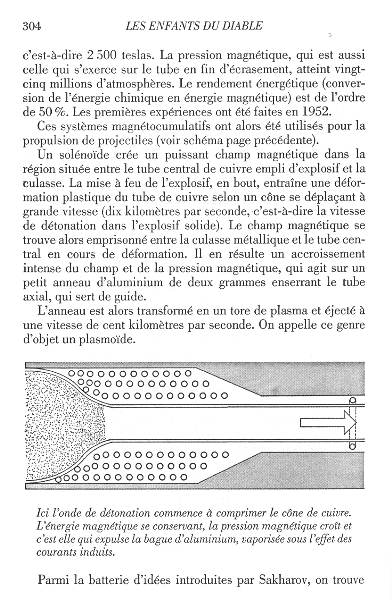
First, we have what are called Explosive Pumped Flux Compression Generators (FCG), or in French, "flux compression systems." This idea originates from Andrei Sakharov, previously presented by the author in 1995 in "Les Enfants du Diable" (Albin Michel Editions), page 303. This coaxial configuration is the most common. The following figure is taken from Carlo Kopp's article, already cited.
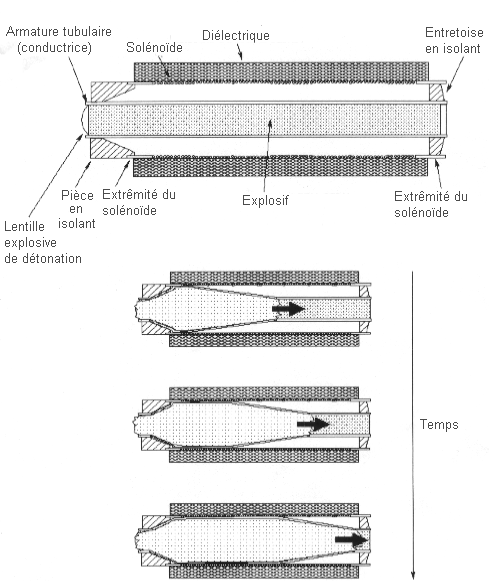
Sakharov-type electromagnetic pulse generator using flux compression
In the system above, a solenoid creates a strong magnetic field, particularly in the empty space between its inner face and a copper tube filled with explosive. When the charge is detonated, the explosion plastically deforms the tube, which closes the magnetic cavity upon contact with the first turn of the coil. The explosion propagates (to the right, see the three lower figures). The rapid movement of the copper tube through the magnetic field lines induces a current in it, which also flows through the solenoid. This results in currents reaching millions of amperes, or even more. The magnetic field also reaches very high values in the cavity. All this can be exploited in various ways to produce a beam of electromagnetic waves. The axisymmetric shape of this pulsed generator makes it easy to fit into a bomb, cruise missile, or even a grenade shaped like a "beer can."
A second type of generator is related to "shock tubes," on which I worked in the 1960s, where explosive energy was also converted into electricity. But back then, French military officials were apparently unable to imagine that electromagnetism could one day become a strategically important weapon. In a shock tube, a burst of ionized gas is sent at very high speed through the gap of an electromagnet, and the current produced by the induced electric field (V × B) is recovered using electrodes. But all these visions remain highly schematic. In reality, everything is integrated into a single assembly. It's MHD and plasma physics. Anything goes to produce high-frequency oscillations in "resonant cavities." The only difference is that the power levels involved are no longer comparable to those from the klystrons or magnetrons powering radar systems. In fact, there are as many microwave weapons as there are target types. These targets behave like receiving antennas, and the destructive effect is all the greater the better the emitted pulse is tuned to them. E-bombs can target ground installations in open countryside. They can then be dropped, guided toward their target, and triggered when the distance is optimal for maximum damage. Cruise missiles can be equipped with "E" warheads. Iraqi installations allowed testing their effectiveness during the Gulf War. Other smaller devices can target ventilation shafts of bunkers.
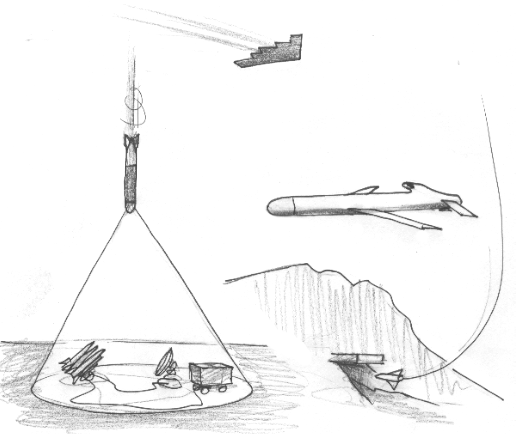
Other devices can be placed inside bombs capable of penetrating multiple layers of concrete. Think of the Bunker Buster weighing 4,700 pounds. When automatically triggered at a predetermined level, these microwave weapons can destroy buried installations more effectively than chemical charges, acting from within the Faraday cage designed to protect them.
The matter of electromagnetic weapons has only recently come to light: on 15 September, journalist Jacques Isnard of Le Monde reported that the Americans intended to use such weapons to destroy and disable Saddam Hussein's underground installations. People are rediscovering the flux compression generator (invented at the end of the 1950s by Andrei Sakharov, producing tens or hundreds of millions of amperes using just a simple explosive), which I described in 1995, seven years ago, on page 303 of my book "Les Enfants du Diable" (completely overlooked at the time and receiving no press attention).

Regarding the long-term effects of electromagnetic radiation on humans, why not raise the issue of the illnesses suffered by soldiers returning from various countries involved in Operation Desert Storm, blamed at the time on vaccinations? What if the real cause was something else? What if it was "collateral damage linked to the use of microwave weapons"?
28 October 2002. Here is a reproduction of an article published on 28 October in Le Parisien.
Gas and nothing else?
WHY were the eighteen Chechen suicide bombers, each carrying explosives (one to two kilograms) strapped to their belts, unable to trigger their devices? Were they instantly paralyzed by gas? Some hostages do not describe such a stunning effect. They claim they had time to protect themselves with handkerchiefs and woke up relatively quickly. Although the black hijab covering their heads provided useful protection against gas, this raises the hypothesis: they couldn't activate their explosives because the electrical detonators had been rendered inoperative. And this question: did Russian special forces use weapons other than gas? For example, a high-frequency bomb. The Americans have developed this technique with the E-bomb, nicknamed the "microwave weapon," intending to use it in a possible attack on Iraq. Its effects are devastating: it destroys all electrical, electronic, and radio installations, and causes intense agitation of the water molecules in human cells, leading to a very high temperature rise. However, the Americans say they abandoned research on a less powerful, more maneuverable derivative of the E-bomb, called FCG (Flux Compression Generator): too dangerous because it could be used by terrorists. But the idea hasn't been lost on everyone. For instance, Indian military personnel, suspecting Pakistan of possessing such weapons, have conducted studies on this "poor man's E-bomb." Proof that its dissemination has already begun.
Ph.D.
I fully agree with the journalist's observation. No matter how fast gas spreads, it takes about ten seconds in such a vast, high-ceilinged space. Realizing that their group was about to be attacked with an incapacitating weapon, at least one of these women should have been able to trigger her detonator, seeing her comrades collapse from asphyxiation. Moreover, the hijab would have provided immediate protection and allowed a brief delay. It therefore seems highly plausible that portable EMP weapons (the size of a beer can) were used. However, note that these weapons would also have destroyed all electrical installations in the venue, including lighting.
That said, if E-weapons can fry electrical firing systems, they are ineffective against automatic weapons. Therefore, gas must have also been used, in high doses, to prevent any of the suicide bombers from opening fire on hostages before losing consciousness. In such cases, dosage may be difficult to manage. The Russians may have thought: "Better too much than too little." Finally, the suicide bombers would quickly find a way to counter electromagnetic weapons. It's enough to use bombs with purely mechanical firing mechanisms—i.e., equipped with a firing pin and a good spring. Against such systems, EMP weapons are ineffective. But these EMP weapons can also incapacitate people. The issue then becomes one of dosage. An hostage is not an enemy to be neutralized. EMP effects decay very rapidly with distance. How do you incapacitate 35 suicide bombers scattered throughout a theater? What power level should be used? What is the threshold between incapacitating dose and one causing irreversible brain damage?
Banks and some public places are already equipped with alarm systems. One can imagine that in the near future, such locations will also be fitted with "incapacitating systems" of all kinds: gas emission, properly dosed this time (though this measure would be nullified if attackers wore gas masks), microwave emission (which attackers could protect themselves against by wearing copper wire mesh hoods, acting as Faraday cages). But these mesh elements would "respond" like antennas to detectors placed at building entrances. Measures, countermeasures... One thing is certain: madness is spreading like oil on our planet.
25 February 2003:
Surrounded by the greatest secrecy, the "E-bomb" was primarily developed by researchers working for the Air Force at Kirtland Air Force Base near Albuquerque (New Mexico). In fact, it involves using powerful electromagnetic waves to destroy electronic equipment—even when those devices are not operating. If the effects of this bomb, with a range of about 200 meters, can affect an entire city's power grid and destroy it permanently, military officials admit hesitation about using it. Indeed, the E-bomb would not harm people, but would destroy vital civilian infrastructure such as telephone networks or hospitals. The E-bomb is among a series of projects developed for the armed forces using extremely high energy. Lasers have already been tested from a Boeing 747 to neutralize missiles, and the Marine Corps possesses a prototype laser mounted on a Humvee, a modern jeep, intended to be used against enemies, causing such intense pain on the skin that they would be unable to move. Currently, the Army is testing a grenade capable of stopping a tank by destroying its electronic system. As for the Navy, it is working on using microwaves to neutralize missiles. WSJ 20/02/03 (U.S. studies using 'e-bomb' in Iraq, but leans against it).
http://online.wsj.com/article/0,,SB1045693871355690103,00.html?mod=technology_main_whats_news ---
14 February 2003: publication of this paper in Air et Cosmos. This information release can be considered a kind of response from the DGA to my allegations that France lags 25 years behind the Americans. Thus, the top-secret Franco-German mini electromagnetic cannon for combat drones is revealed. In passing, it is confirmed that the French are well advanced toward developing high-power E-bombs, not only with conventional charges but also, of course, nuclear ones. Hence the continuation of French nuclear tests on national territory. Two points to note:
- This work is the result of eleven years of secret effort
- The explicit mention of efforts toward