Untitled Document
The Enarchie
November 10, 2012
Someone first created this PowerPoint, which I think is worth watching:
Then there is a presentation made on a book on the subject:
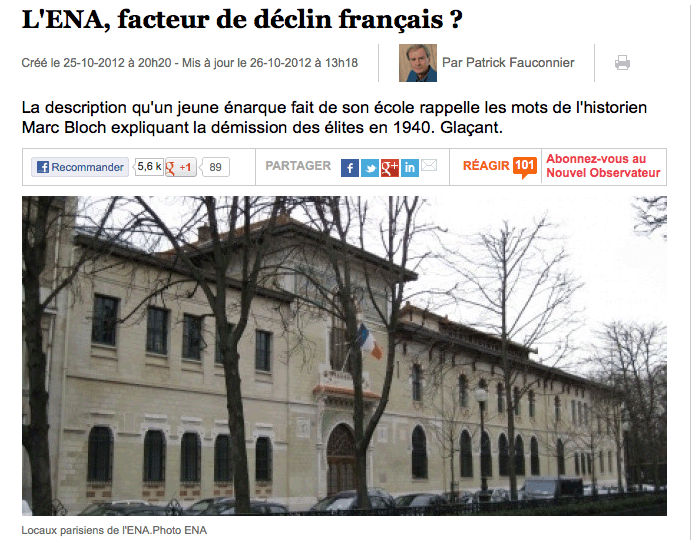
| In the "Nouvel Observateur" of October 26, 2012: | Olivier Saby has just graduated from the ENA. And he has written a book titled "Promotion Ubu Roi", subtitled "My 27 months at the ENA". At first, one fears one of those bitter testimonies from graduates who have chosen the wrong path. And the style of the book, a diary-style narrative, makes one fear a narcissistic exercise, common on blogs. None of these interpretations is correct. | For the first time, an ENA graduate undertakes to tell us in detail what his life and courses were like during 27 months. Therefore, it is not, either, the Nth book proposing reforms to be applied to this august institution. It is a book that directly shows the mediocrity of the school's program, immersing us in the students' studies. "I like this TV show called 'Strip Tease'," explains Olivier Saby: slices of life presented without any commentary. The viewer is left to judge. My book is a bit like that." | The obsession with ranking | Many things in this book leave a chilling impression. It becomes clear quickly that it is a school that selects 80 brilliant young people through merciless exams, only to subject them to a miserable curriculum. Saby talks about the "abyssal void of the teaching." A void they dare not complain about, as it could harm their graduation ranking. The obsession with this sacred ranking, which can determine a lifetime career, and which several governments have unsuccessfully tried to eliminate, marks the curriculum and the DNA of the graduates. It is a constant subject of conversation among students and alumni. When Saby arrives at the French embassy in Beirut for an internship, one of the first questions asked by the second-in-command, an ENA graduate, is about the ranking he aims for. And the ENA graduate immediately states his own ranking, as one would give a business card. The same happens with the ambassador. Saby expects to be questioned about his choice of Lebanon. Instead, the first question from the excellence is: "Is the ranking still in effect at the ENA?" The ambassador is an ENA graduate (he immediately gives his ranking) but also the son and brother of ENA graduates. He has no idea what work he is going to assign to this intern, who will wait two weeks before receiving any instructions. | The rejection of initiative and innovation | Saby recounts the dreadful "Observation Theme" exam, which lasts 8 hours, locked in, without being able to move or refer to any documents. The exam is about rural development and its role within the European machinery. | This subject is as unknown to us as to a Landaise chicken. But it's not a problem, the important thing is just that we know how to draft a resolution, being graded on our ability to imitate existing texts and mimic their formulation. The mistake would be to show creativity. The punishment would be immediate. | In this way, they follow the advice of a tutor at the school if they want good grades: memorize regulations, directives, decisions of the European Commission and the European Parliament's opinions. "To pass the exam, you don't need to think: you must know the format and fill it with the appropriate keywords." | Every time Saby, alone or with a few classmates, dares to ask if something could not be improved, he gets a response like "why change, we've always done it that way." There is no clearer summary of conservatism and stagnation. Is it good to instill such a philosophy in these future elites? | "You have to watch your back" | More radical is the: "no initiatives, it could harm us!" The author recounts his internship at the Urban Community of Brest, with interesting tasks that show the state's disdain for local communities. Should he mention this to the director of internships, who came to inspect him on-site, nicknamed "The Inspector"? Saby has learned to self-censor: never forget that the inspector who will evaluate me at the end of my internship may be called upon tomorrow to use me when he becomes a prefect or a minister's chief of staff. It's the problem of the closed circuit. The internship inspector will be a prefect, chief of staff, tomorrow... Who knows. You have to watch your back, never oppose the rules that have made the careers of our judges and peers, go with the flow and let yourself be carried along. | Reading these stories of submission and resignation, one suddenly thinks of another fascinating testimony, "The Strange Defeat," a key book written just after the 1940 debacle by historian Marc Bloch. There are observations that almost exactly match Saby's analyses. | Bloch, who at 54 years old demanded to be mobilized as a reserve officer (before being shot by the Nazis), tried to understand how France had not seen the rise of the Hitlerian threat for 8 years, and suffered a massive defeat on the battlefield. He blames a "withdrawal of the elites, timid and conventional," which would later fuel countless debates. He particularly criticizes the submission of officers who, at the front, dared not express their disagreements: | it was out of fear of trouble, and out of this concern for diplomacy, which, for men in need of promotion, becomes a second nature, [and also] the fear of displeasing a powerful person today or tomorrow. | Saby has repeatedly wanted to take initiatives, alone or with classmates, to complain about the courses. Like the day when a case on the hospital was treated by an intervenor from the Quai d'Orsay, "who knows little about the health issue and discovers the file as we do." Each time, he was countered by other students in this way: | You're crazy, it will be recorded on your file for life, it could block your access to certain positions later | Marc Bloch, in his chapter on education in France, laments | The fear of any initiative, among teachers and students, the negation of any free curiosity, the worship of ranking (Bloch says "success") substituted for the love of knowledge | "You will be burned" | Back to the ENA: during an exercise, Saby wants, with two colleagues, to suggest in writing an innovation: merging the three main administrative schools (ENA, territorial public service, hospital public service) into one: students would choose their specialization during their studies, but there would be a common set of values before choosing their direction. Classmates dissuade him from publishing this proposal: "this article could come back to haunt you. They will include it in your file and it will follow you throughout your career." | More amusing. Saby fails to have the promotion baptized...