Should We Bet on Degrowth, Eco-Energy, Nuclear Fusion, Solar Energy?
Should We Bet on "Degrowth"?
May 20, 2007
This will actually be the subject of the conference (free admission) that I will give at the "eco-energy" fair on Saturday the 2nd, in Room 1 at 11:00 AM, on the occasion of the eighth edition of this fair, which will be held on Saturday the 2nd and Sunday the 3rd of June in Mérindol (Vaucluse).
Interested readers will find all the information in the attached PDF.
The 2007 Mérindol Eco-Energies Fair
or
http://ecoenergies.free.fr/crbst_16.html
The theme of my conference:
Everyone knows that "things are going badly," that the planet is warming, and that the ice is melting. We also know that if the Chinese lived at the same pace as Westerners, "we would need a second planet." I was in China a month ago and in India two weeks ago. Despite a policy of limiting birth rates, China has still tripled its population in just over half a century. India's population is growing by ten million people every year. One billion three hundred million Chinese ("official" figures), one billion Indians.
Can we talk about degrowth to these people? It seems to me that this concept applies to countries like the Western nations. I am not saying that saving energy is undesirable. But, on a global scale, it is like trying to contain a forest fire with a garden watering can. These billions of human beings have imperative, legitimate, and urgent needs for energy. To deny them is simply absurd and... dangerous.
Are there outsider solutions, up to the scale of these needs?
There are two kinds.
- There are technological leaps forward, based, for example, on the perspectives opened by results obtained in 2005 on the Z-machine, which I mentioned last year in Mérindol, which could eventually lead to... non-polluting and non-radioactive fusion ("aneutronic" Boron-Hydrogen fusion). In 2005, at Sandia (New Mexico), temperatures of 3.5 billion degrees were achieved (Boron-Hydrogen fusion begins at one billion degrees, producing only... helium, if we exclude parasitic reactions).
On this subject, I will simply reproduce a paper published in the newspaper "Les Echos" on May 16, 2007.
**
* *****
**** **
**
Les Echos
May 16, 2007
Skills
NUCLEAR
French Z-machine shuns energy
Little "Sphinx".
In the heart of Quercy, at the Gramat Study Center (CEG), the DGA has been operating for several years a small French Z-machine (2.5 million amperes), named "Sphinx". Like its American big sister, it is mainly used to test the resistance of nuclear warheads.
Unlike its counterpart, it will not undergo civilian experiments. A few years ago, however, the researchers at Gramat had reached out to their military overseers to diversify their studies, without success.
Asked by "Les Echos", the very "wary" CEG today assures that it has no energy project. This investment timeliness worries z-pinch specialists.
"French expertise in this field of high-power electrical engineering is threatened," one of them assures.
In Great Britain, an equivalent machine, the Magpie at Imperial College (1.4 million amperes), is actively working on magnetic z-pinch, notably with American funding. Not powerful enough to reach the nuclear objectives of the Z-machine, it is used by the Americans to complement their research on the z-pinch itself. The Russians are also said to be on the verge of investing in this research theme.
- Much more interesting: there are solutions based on proven technologies, and even frankly rustic ones compared to current science, which would allow for the massive production of electricity, provided that essentially political decisions are taken in this direction.
-
The possibilities offered by Stirling engines have been known for ages; they are very well suited to exploiting moderate temperature differences, whether from solar energy or from surface-deep water temperature differences in coastal areas or lakes. These systems require the use of a heat transfer gas that is a very good conductor of heat, primarily hydrogen. However, hydrogen is difficult to contain due to the small size of its molecules. The Americans (Sandia Labs) have made enormous progress in this area (seals) and plan to deploy solar power plants coupled with Stirling generators in New Mexico, by the... tens of thousands. This technology should be widely made available to all of humanity and not managed as a source of profit through patent exploitation. In New Mexico, the primary energy is solar, captured by parabolic micro-mirrors. This is impractical in regions with unstable weather. Submerged Stirling plants (under 20 meters of water, they would be indifferent to the worst storms) would allow, in tropical coastal areas, the exploitation of the surface-deep water temperature difference. The same applies to mountain lakes. Submerged Stirling plants could, for example, populate... Lake Geneva. In France, most people do not even know the meaning of the term "Stirling generator."
-
Deserts are a fantastic source of solar energy. Locally, this could be used to desalinate seawater and develop hydroponic crops in the middle of the desert (as in the hinterland of the Emirates). Fresnel mirror stations ("flat" mirrors) would be particularly suited to the massive production of this electricity and would simultaneously help moderate climatic excesses. This energy can also be stored in various forms, for example by producing hydrogen through the electrolysis of water, which, when burned and combined with oxygen in the air, will yield... water. This would be an exportable energy. These energy solutions are not merely local. Countries like Germany are considering importing electricity from producing countries, such as Algeria, via submarine cables. France has long been exporting its surplus electricity to England using conductors operating at 900,000 volts.
-
Solar towers have been successfully tested. "Full-scale" projects (one thousand meters high) are underway in Australia, which also realizes that its deserts represent an enormous source of energy. Equipped with blade-shaped struts, these towers can also function as hot-air cannons, sending this air to altitudes of several thousand meters in the form of a rotating dart, and acting, with respect to tornadoes, as the equivalent of lightning rods.
-
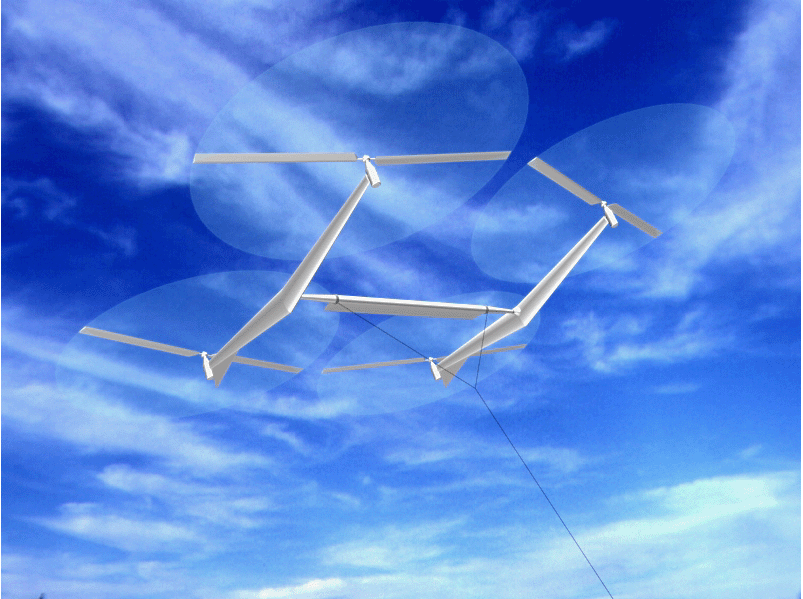
If humans exploited 1% of the available wind energy, they would largely cover their needs without creating climatic or ecological disturbances. Here, one must look towards "helicodynes," sorts of "kites" consisting of four rotors producing high-voltage current (for information, French high-voltage lines operate at 400,000 volts and are 2.5 cm in diameter), transmitted to the ground by relatively modest cables (500 kilograms to one ton per kilometer).
These devices could be positioned at altitudes between five and ten thousand meters. Studies show that while the "availability" of ground-based wind turbines is 20%, at altitude this figure rises to 80%. At ten thousand meters, jet streams reign. Wind energy is then 20 times denser than at ground level. Furthermore, the anchoring of these helicodynes, relatively rustic devices, by a cable makes them... insensitive to gusts. 30 MW plants, which could be produced in very large series, would have the wingspan and weight of a simple airliner. Tens of thousands could be deployed over Xinjiang, in China, over Mongolia, in the middle of the ocean....
- Let's not even mention wave energy, etc.
In fact, we are swimming in oceans of non-polluting and renewable energy, the intensive development of which would have... geopolitical consequences by altering situations of energy dependence.
One no longer thinks in terms of "degrowth." It is a different vision of things. It is a pity that Nicolas Hulot (and his circle of scientists, composed exclusively of people "concerned about the environment") is not more aware of these solutions, which have nothing to do with science fiction.