water engine system pentone environment
Two years later
October 28, 2006
I see that more than two hundred thousand people have read this page, or at least the following file. I have not touched this text, which dates from 2004. It features a photo of Christophe Tardy and, below it, Jean-Louis Millet’s tractor. Christophe has partnered with David Dieulle, who optimized this system for increasing combustion efficiency via electrodynamic catalysis and turned it into the SPAD. What I had thought is being confirmed. When the combustion mixture is admitted, the depression created draws air into a "bubbler," a water balloon heated by the passage of exhaust gases. A warm mist forms and then circulates between two cylindrical walls. As in a storm cloud, this mist becomes electrically charged. It is then mixed with the diesel fuel. The electric field created by the micro-droplets breaks the long fuel molecules, increasing combustion efficiency and reducing pollution by releasing fewer unburned hydrocarbons.
The idea is gaining ground, slowly. The automotive industry does not appreciate the Robin Hoods of internal combustion engines, who fight courageously. Things must be done according to the rules. Inventors take out patents, then hand them over to manufacturers, who keep them under wraps "for as long as necessary." Then an entire profit chain must be established, at every level. Otherwise, where are we headed? If diesels emitted clean gases, who would buy catalytic converters?
Fuel expenses, savings, pollution?
The consumers bark, and the automotive caravan moves on.
Before reading or rereading this file on this "water engine," and while waiting for their site to open, take a look at Christophe and David’s brochure:
The "Water Engine"
November 23, 2004
Paul Pentone, inventor of the GEET, thrown in prison on August 21, 2005
Follow-up on this case dated December 9, 2005
The "Ecological Mechanics" site
For months, my friend Christophe Tardy, an engineer, had been asking me to come and see the achievements made by some of his friends regarding the "Pantone reactor."

Christophe Tardy, engineer and "Pantone man" (among other things), who equips an aging R5.
I therefore established initial contact with these like-minded tinkerers. Fraud is ruled out, given the simplicity of the setups. I was able to examine two vehicles, both running on diesel: a tractor and a Mercedes vehicle.
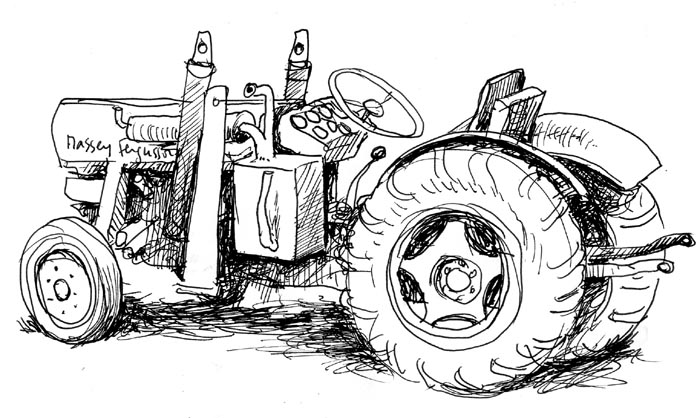
The tractor equipped by Jean-Louis Millet, from Mérindol, with a Pentone system, clearly visible to the left of the dashboard. Following a phone call on 11/25/04: consumption reduced from 4 to 2 liters per hour (0.75 liters of water for 2 liters of diesel)
Even allowing for the enthusiasm of the "militants" of this new cause, it seems that vehicles equipped with such devices see their consumption reduced by very significant proportions. I was able to conduct a pollution test with the Diesel vehicle using a simple paper towel placed in front of the exhaust pipe. A very clear difference is observed. Place such a towel in front of the exhaust pipe of a diesel vehicle, and a black spot appears very quickly. When the Pantone system is connected, this effect is considerably reduced. I have seen pollution analyses done in labs, which report a drop of more than half. Finally, I literally put my nose ten centimeters from the Mercedes’ exhaust pipe while its "reactor" was running and took two or three breaths. It is ... surprisingly, abnormally breathable.
In short, there is a Pantone issue that deserves attention. Given the spectacular increase in efficiency and the decrease in pollution, the matter is significant, even if until now it has been managed primarily by enthusiastic tinkerers.
I took notes and hope not to make any errors; otherwise, my readers will point them out immediately, as usual.
What is an internal combustion engine? It is a system where a fuel-oxidizer mixture is admitted into a combustion chamber. Fuel: various hydrocarbons, in the form of aerosols or gases. Oxidizer: God’s air. In the case of a gasoline engine, ignition is achieved by triggering an electric arc between the two electrodes of a "spark plug." In the case of a diesel, combustion is spontaneous, resulting from significant compression (compression ratio: 20). In both cases, the exothermic chemical transformation occurs through combustion and not detonation.
Difference between combustion and detonation:
-
In combustion, there is a flame front that starts from an ignition point, from the spark plug in a gasoline engine, or from various ignition points in a diesel. I will need to get in touch with my old friend Antonio Oppenheim, who was director of the combustion department at Berkeley (currently retired).
-
In a detonation (for example, initiated by a spark plug), the heat release is so brutal that a shock wave forms. The increase in heat downstream of this wave is sufficient to cause the combustion of new molecules. A "detonation wave" is thus "self-propelled" through the gas. In gasoline engines, an "anti-knock agent" is added (&&& Please, how does lead play its role as an anti-knock agent?). A reader clarifies that detonation is not desirable in engines. According to him, there are two reasons: mechanical damage and a rise in temperature.
Car engines are apparently improperly called "explosion engines." The term "internal combustion engine" would be more appropriate, as an explosion proceeds by detonation. There is a shock wave. Otherwise, it is an ignition.
To complete this file, it would be good for engineers and students to provide precise figures. I have nothing regarding, for example, gasoline engines. I know nothing about it; I am new to this and simply trying to think with my own background as a physicist and fluid mechanic. What happens in the cylinders is a matter of chemical kinetics. We would like to have precise figures, particularly regarding the percentage of unburned hydrocarbons that pass into the exhaust pipe. Not everything burns in the cylinders, for various reasons. First, not everything has time to burn. There must have been an optimization carried out a long time ago. The combustion speed is higher the higher the density and temperature of the medium, thus the pressure at the end of the piston’s upward stroke. There must be limitations related to mechanical and thermal constraints.
A certain C. Martz produced figures and calculations on a website (http://quanthomme.free.fr/pantone/martz/PageC_Martz.htm). It concerns a diesel system.
-
He indicates that a diesel injector sends a mixture into the cylinder at a pressure of 0.7 bar and a temperature of 150°C.
-
The piston’s upward movement compresses this mixture, raising its temperature to 400° at a pressure of 15 bars (the compression ratio is 20).
-
After combustion, the temperature would rise to 1000°C and the pressure to 80 bars. The piston’s downward movement, until the gas is evacuated by a valve system, brings this (exit) temperature back to 400°C and the pressure to 1.5 bar.
At this stage, we would like to know precisely the combustion efficiency (the percentage of unburned hydrocarbons). This is a question I had never asked myself. But the pollution inherent to the operation of an internal combustion engine stems from:
- The diffusion into the atmosphere of unburned hydrocarbon molecules.
- The diffusion of chemical compounds created during combustion processes. &&& We would like to have data and figures on pollutants concerning gasoline engines and diesels.
A "catalytic converter" is a system that acts on unburned hydrocarbons. According to my friend Elio Flesia, it ensures the transformation of CxHy compounds into CO2.
Incidentally, and we will see why later, I would like students or teachers from the École Supérieure de l'Aéronautique in Toulouse (where I graduated) to give us the combustion efficiencies of various combustion systems: piston engines, turbojets, ramjets. When I was a student at the School, turbofans did not exist. They are now standard in airliners. They increase propulsive efficiency.
A turbojet ejects hot gas at supersonic speed. The thrust it produces is merely the resultant of the pressure forces acting on the entire machine. The nozzle is designed to transform heat into speed, with the best possible efficiency. Ideally, one would eject cold, totally "expanded" gas into the surrounding air. A rocket ejecting gas at a density Q and an ejection velocity V produces a thrust that is simply QV. Therefore, it is advantageous to obtain the highest possible ejection velocity. However, this leads to a paradox.
The energy initially comes from the thermal agitation speed of the molecules, from their individual kinetic energies. The nozzle channels these speeds along the axis (Read "The Aspi-Suction" in CD Lanturlu 1). But this does not mean that by ejecting carefully expanded gas into the surrounding air, we have exhausted all its energy resources. The air is ejected at speed V, and the plane flies at speed v. There is a speed difference (V - v). This represents lost energy that will be converted downstream of the plane into turbulence, and ultimately into heat (to warm the little birds).
Attempts were made to recover this energy, first by switching to a turboprop system, coupling the turbojet shaft to a simple propeller, with a reducer. Propellers turn slower than jet turbines. A plane equipped with a turboprop is the "Pilatus Porter," well known to skydivers. But two problems remained. The gear reducer consumed energy, and there were also tip losses (inherent to propeller operation) in the form of tip vortices. The solution eventually emerged with the "fan" of modern aircraft, which consists of increasing the diameter of the first stages of the bladed compressor. This system, placed upstream of the combustion chambers, has two functions.
- It initiates the compression necessary for combustion to occur sufficiently quickly in the combustion chambers.
- It accelerates the surrounding air; the blades then act as shrouded multi-propellers, operating with better efficiency, the shroud reducing losses due to turbulence and tip vortices.
It is good to give the reader some ideas on this point, as we will return to it one day when we address the problem of wind turbines, unshrouded or shrouded; the former causing a quite useless nuisance in the form of noise and infrasound and remaining very bulky. But this, as Kipling would say, is another story.
Let us return to our modern fan airliners. The resultant downstream is multiple. Two flows exit the aircraft.
- The jet from the turbojet, fast.
- The annular jet from the fan.
The two mix. As a result, the fluid is ejected downstream at a speed V', lower than the speed V at the jet exit. The mass flow rate is higher. Let us say the jet ejects a flow Q at a speed V. The fan produces Q' at a speed V' < V.
Far behind, everything has mixed, and we have a flow Q" = Q' + Q, with a speed V" intermediate between V and V'. We gain in propulsive efficiency. There is also a very interesting secondary effect. Downstream of the jet, the hot, very turbulent gas from the turbojet nozzle is surrounded by a sheath of cold air. The speed of sound propagation is different in the two media. This results in an "acoustic refraction" effect. Sound waves bounce off this sheath of cold air exactly as light rays produce a mirage effect at the interface between two layers of air at different temperatures, which have different refractive indices. These engines are thus much less noisy, the noise being directional, along the axis of the jet streams, the sound energy being attenuated by absorption in the cold air sheath.
Engineers have done their best to increase the various efficiencies, but it is obvious that an airliner functions optimally only at a given altitude and configuration (cruise altitude). Military aircraft, which must operate at variable altitudes, are equipped with variable geometry nozzles to be able to eject their gas straight along the axis. Otherwise, at too low an altitude, the jet is pinched, and a system of shock waves forms. At too high an altitude, the jet expands, and a velocity component perpendicular to the flight axis appears, which does not contribute to propulsion.
We would like to have data and figures &&& concerning current aircraft, the type of fuel used, combustion efficiencies, the form of pollution generated and its effects (it is hard to see how airliners could be equipped with "catalytic converters").
Let us return to the problem of catalysis. It can be surprisingly effective. I heated myself in Aix for years with simple gas bottles, the gas being burned on a catalyst, in the form of a plate. The efficiency of the combustion, producing carbon dioxide CO2 and water vapor H2O, must have been almost total since one could sleep practically without ventilation, without being bothered by odors. Unless I am mistaken, catalytic combustion also allows chemical reactions to be carried out at lower temperatures (&&& figures please).
We find this theme again with the automobile catalytic converter, with a more or less long lifespan (&&& temperature in a catalytic converter in operation, please. Types of catalyst poisons? Efficiencies of these catalytic converters? Residual pollution?).
Is catalytic combustion of hydrocarbons using water employed?
The answer is yes, and in many cases, for example when one has to burn "heavy oils" in thermal power plants, hydrocarbons containing complex molecular assemblies. This was also the case when afterburning appeared in military aircraft in the 1950s. It consists of injecting kerosene downstream of the combustion chambers (exit temperature: 2000°), downstream of the turbine (whose blades, which cannot withstand more than 1500°, must be cooled), into the nozzle, exploiting a residual excess of oxygen. The thrust of the jet can then be increased by 17 to 30%. Water and methanol mixture injection is also carried out in the engines of 747s during takeoff, for a fairly short time. I remember that we spoke then of "afterburning systems with water injection." &&& I would also like to know the combustion efficiency of these aircraft engines. What is the percentage of unburned hydrocarbons?
When I was twelve years old, during a visit to the air show held at the time in Paris, at the Grand Palais, I asked an American presenter what the water was for in the afterburning systems, a fairly recent introduction. He replied that it allowed breaking hydrocarbon molecules and improving combustion.
As far as I know, the energy released comes only from the combustion of kerosene and not from this ... water, which, having the ability to become electrically charged, plays the role of a catalyst. (&&& other questions along the way, for engine manufacturers: how does water actually act in this type of afterburning? Is there electrification of the medium? Does water play a role simply because of the dipolar nature of its molecule?). A reader specifies that, for example, in the case of water injection during takeoff, at the entry of the combustion chambers of a 747, its vaporization has the effect of cooling the mixture during this "full throttle" operation. My friend Jean-Claude Mitteau, who also attended Supaéro with me, indicates that the B-52s also had a system involving water injection, but personally I do not remember it.
I pass (finally) to the schematic description of the Pentone engine.
To access the initial patent (1998!)
You will need to click again on the patent number US5794601 to access the PDF file
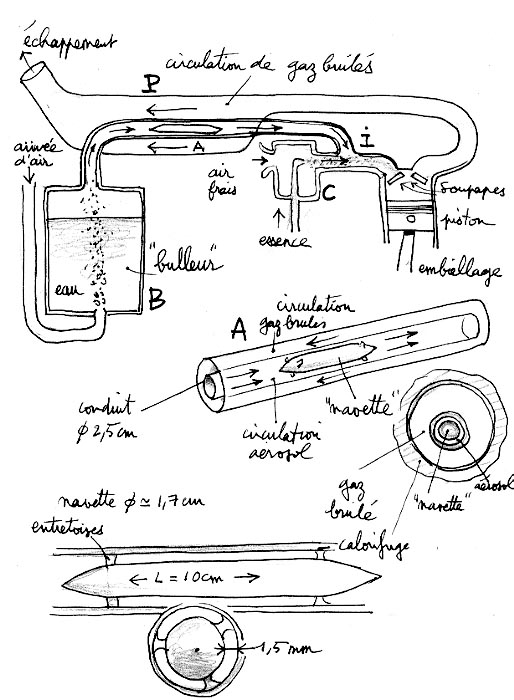
Pentone assembly, schematic
We have taken a configuration associated with a gasoline engine, but the diesel system is not different in principle. I took notes. If there are errors, on the dimensions, for example, those who showed me their achievements in Mérindol will correct them. It should be noted that in the initial diagram of Paul Pentone’s patent, the right is reserved to add fuel to the water in the bubbler.
-
At B, a "bubbler." Air is drawn in by the engine cylinder during the downstroke. This depression draws in both dry air, which is mixed in the carburetor with fine droplets of gasoline, and air passing through the bubbler. All this is obviously carefully insulated and cleverly made "compact." The water through which the bubbles pass is hot. The air in these bubbles becomes charged with water vapor. It seems to me that this enrichment in water vapor via the "bubbler" seems more effective than that resulting from the spraying of an aerosol (water droplets). Indeed, in aerosol spraying, the enrichment of air in water vapor decreases the size of the droplet, thus the contact surface on which evaporation occurs, whereas in the bubbler it remains constant.
-
This mixture (to be analyzed, to be defined) then passes into a "Pantone reactor," which is a section where two counter-current circulations take place. In our drawing, the air enriched with water vapor (with droplets?) circulates from left to right, while the exhaust gas from the cylinder circulates in a sleeve, from left to right. In terms of thermal balance, this can only be beneficial. But in this Pantone reactor there is a (fixed) part shaped like a cylinder completed by two conical ends, located in the central tube and held by struts, which forces this air enriched with water vapor to circulate in the space between two cylinders, 1.5 mm apart, if my memory serves me right.
-
At I, this mixture "treated in the reactor" mixes with the air-plus-gasoline mist from the carburetor.
The result is that:
- Consumption is reduced.
- Pollution is also reduced. A reader reports his own testimony, having witnessed the operation of a diesel tractor equipped with a Pantone system, and says that "the result was spectacular," simply by observing that the gas exiting the exhaust pipe became transparent, whereas in normal operation it spat out quite a bit of smoke.
On his site (http://quanthomme.free.fr/pantone/martz/PageC_Martz.htm), C. Martz develops a hypothesis and performs calculations. He starts from the idea that in this "Pantone reactor" the water molecules are dissociated, and it would be the combustion of hydrogen that provides the energy. It should be specified that in the process, starting from water in the liquid state, energy must first be supplied to vaporize it (latent heat of vaporization), then to dissociate it, if dissociation occurs.
Where would the initial energy come from? Martz supposes that it is energy recovered using the calories brought by the exhaust gas. But the balance does not add up. According to his calculations, there is ... too much energy to explain such an increase in efficiency, or such a reduction in gasoline (or diesel) consumption. Pantone reactor fans then engage in all sorts of speculations about "a mysterious energy that could be present in the air or in the water." One even hears discourses going as far as cold fusion or "quantum vacuum energy."
Let us try to find an explanation that may be less romantic but simpler. We know that an engine (gasoline or diesel) does not have a 100% combustion efficiency (&&& figures, please). I am told that the overall efficiency of a gasoline engine would be around 30%. A bit more for diesels and truck engines. Anything that could increase this efficiency would be welcome. It seems to me that we find here an idea akin to this ancient water injection in turbojet afterburners. In my opinion, we do not achieve the cracking of water, but that of ... hydrocarbons. I do not know the percentage of unburned hydrocarbons in the exhaust pipes of gasoline engines or diesels, but it must be significant. There is therefore exploitable energy remaining at the exit of an internal combustion engine cylinder. This imperfection of combustion is responsible for pollution. It also explains why we fight it using "catalytic converters," sites of exothermic reactions, which achieve an "afterburning" external to the cylinder, representing lost energy. I would also like to know the efficiency of such systems.
In the Pentone system, besides this action of water molecules to break complex hydrocarbon molecules, something much more interesting could intervene: a possible electrification of a two-phase medium (water enriched with water vapor and populated with micro-droplets).
This leads us to consider how nature creates strong electric fields in ... storm clouds. In a storm cloud, a cumulonimbus, the updraft speeds are high, up to 80 m/s according to the Météo-France site. There is then a double circulation, or even a triple circulation.
- Ice crystals descend.
- Moist air rises.
- Water droplets descend (that is called ... rain).
According to the Météo-France site
http://www.meteo.fr/meteonet/decouvr/dossier/orages/ora.htm
electrification would result from collisions between ice particles and water droplets. Extracted from this same site, here is what the result would be:

Electrification of a storm cloud
But on other sites like http://metamiga.free.fr/Meteo_applique/Electrisation/electrisation.htm, one reads that the mechanism of charge appearance in a storm cloud is more complex, with a tripolar distribution (...) and charge transfers between ice crystals of different sizes. This dissonance shows that in fact the exact process of this electrification is not perfectly known.
These opposite circulations lead to a separation of electric charges, generating very strong electric fields. In a cloud, breakdown occurs, one reads, when the field is between 100,000 volts per meter and one megavolt per meter. The storm cloud thus transforms into a dynamic capacitor. The charge separation is maintained by the upward movement. The only way to "discharge this capacitor" is to ground it, that is, "to earth." To do this, a conductive line is needed, and it forms in the shape of an electric arc. This is lightning. There is breakdown, disruption, creation of a thin, highly ionized channel, heated by the Joule effect. This heating is so intense that the sudden dilation of said channel gives rise to a shock wave called thunder. There is visible lightning, external to the cloud, but the entire cloud-capacitor is traversed by mini-arcs that strive to restore its electrical neutrality, partially, since the same cloud can function multiple times. Let us add, according to what we have read, that the operating mode of a storm cloud, whose upper part, rising up to 8000 meters, reaches the stratosphere, seems both very complex and imperfectly known. Never mind: the upward movement of moist air recharges the capacitor, etc. It is a multi-shot capacitor, which stops functioning when the upward movement of the air subsides.
I wonder if this "Pantone reactor" does not function on this model, with electrification of this mist of air and water droplets sent downstream of the carburetor. If this were the case, the electric field created would have a very effective effect on combustion, playing the role of a catalyst. This would explain the very significant decrease in pollution. Normal: more fuel is burned.
In my opinion (but I could be wrong), the remarkable efficiency of the "Pantone engine" would come from the fact that it implements an extremely clever electrodynamic catalysis. It could be more appropriately called:
Electrodynamic Catalysis System
It is less romantic than vacuum energy or energy hidden in water, but it seems more rational. It is obvious that all this could be the subject of very simple, inexpensive research, feasible in any technical school. But I am losing hope of seeing "people" react. Many readers who read my pages consume them more than passively. No one has built remote-controlled models of Egyptian and Peruvian ships (I will have to do it myself). The "Language of the Heart" project was read by 8000 people, but apart from wise advice from linguists, there are not many people working on it, although this theme has already produced a perfectly concrete and feasible project (conversion of current messages in airports into animated sequences, "animated gifs." I am just waiting for the work of computer scientists to create them, quickly).
As a general rule, I give you an infallible way to identify an academic:
He drives with the handbrake on
So it should not be surprising that Pantone systems were born in the hands of tinkerers, simple garage mechanics, and amateurs of all kinds. It is too simple to interest scientists. Farmers have not remained insensitive to substantial savings possibilities either. The Massey-Ferguson shown at the top of the article would consume 2 liters of diesel per hour instead of four, its owner tells me!
I think that this idea of using a water vapor mist as a catalyst, possibly with electrification, is interesting and could have industrial applications far exceeding the lawnmower, the tractor, or the resuscitation of an aging vehicle. Despite the obvious reduction in consumption and pollution, what attracted some distrust towards the "Pantone reactor" (the name is not well chosen) is the myth of the "water engine." People still say:
- It continued to run while the tank was empty. So it ran on pure water.
In an empty tank, vapor remains. This is a mixture of air and the most volatile hydrocarbons, composed of the simplest molecules. A mixture that has had all the time to become very intimate. Therefore, it seems to me that this mixture should a priori offer better combustion efficiency. &&& Here again, all insights are welcome. I would like to know how long an engine can run using the gasoline or diesel vapor contained in its tank.
If I am right, I would have somewhat destroyed the myth of the "water engine," but an interesting idea would remain, on which I hope work will begin as soon as possible. Christophe Tardy has bought an aging R5 and plans to equip it. We will therefore learn more about this subject thanks to him.
My friend Jacques (from Venelles, Bouches du Rhône) says that to conduct "bench tests" with clean measurements, the best would be to equip a generator set. He owns one, running on gasoline, which he is willing to make available for these tests. Quite powerful, it could be coupled to an electric radiator. It would thus be possible to measure the power obtained at the output, according to the different configurations, with or without the Pentone system, obtaining precise measurements of the consumption-to-power-supplied ratio, at different operating regimes.
We saw above that the system was coupled to the engine at the carburetor outlet. Jacques points out that disconnecting this supply of air enriched with water vapor modifies the richness of the mixture. I did not see how the system was coupled to a diesel engine. Jacques recalls the diesel engine diagram.
The fuel (fuel oil) is brought by a pump producing a pressure commonly reaching 200 bars (up to 500 bars, it seems, in some advanced devices). Fuel injection is done through a nozzle, closed by a needle held pressed by a calibrated spring. When the compression is sufficient, the needle lifts and releases tiny droplets of fuel oil, which quickly mix with the fresh and turbulent air admitted through the valve. At the end of compression, this mixture ignites spontaneously. In a diesel system, the Pentone device, not shown, is in principle placed at the air intake level.

Diesel engine (schematic)
If there is electrification, one may wonder if this will not create nitrogen oxides, thus generating new pollution. We note in passing that nitric oxide NO is the molecule that, in air, has the lowest ionization potential, giving free electrons most easily or, conversely, NO+ ions, but the pollutant is NO2 which, mixed with water, gives nitric acid NO3H ("acid rains").
All this is to be considered, measured, quantified, which should not be too complicated. Some tinkerers have made voltage measurements and obtained values and amperages. But without error, these were "transverse" voltages, in directions perpendicular to the axis of the "reactor." It is the axial field that we would like to know. But beware: measuring potential differences in a two-phase fluid or a plasma, if there is a plasma, is not without pitfalls. Beware of the "shielding effect" (spherical shielding). One can also make simple electrical conductivity measurements, extending the study by changing materials for the coaxial tubes.
It is specified that the circulation of burnt gases must be in the opposite direction to that of the water mist. This would support the idea of electrification of the medium rather than a simple heat transfer, which would then be independent of the gas flow direction. But, as Jacques immediately points out to me, how to maintain this polarization of the system when the tubes and elements of this section are metallic, constituting "equipotentials"?
Some put ... magnets. Well, why not?
Will one day couple this ultra-simple gadget to the rear of a powerful thermal power plant? I would like to live long enough to see that. Why a certain delay in interest in this thing?
Info from a reader:
Paul Pantone
This inventor filed an international patent No. US005794601A1 for his Geet (Global Environmental Energy Technology) multi-fuel processor. He worked alone and without the help of industrials with a mercantile and greedy mindset. To make himself credible, he had the excellent idea of freely distributing the plans to equip any engine under 20 hp, that of a lawnmower in this case. In this way, you will be able to verify the information transmitted to you, for a cost of less than 65 euros, by manufacturing your kit from materials you will find in any hardware store, in the plumbing section. You can access the site describing the patent and see the original diagram via Jean-Claude Naudin’s site: http://jlnlabs.imars.com/bingofuel/pmcjln.htm - Patented? Okay, but if there were valuable industrial applications, would it not have left tangible traces in our economy?
- It is too simple.
- If it worked, it would have been known for a long time.
- It was not invented by a polytechnician.
- This research originated outside recognized university bodies (Cf Egyptology).
- The major automobile manufacturers are not involved.
- If consumption is reduced, goodbye to taxes on petroleum products.
- Until now, we did not understand how it could work ("what I do not understand cannot work").
A question: when God invented clouds, did he immediately think of lightning?
For my part, I will continue to help with my insights the like-minded tinkerers, idealists in their own way, who mount this kind of gadget on their vehicles and tractors. Nowadays, utopians are rare. In any case, in today’s world, when one has some knowledge in science, I think the best thing to do, to try to anticipate future disasters, is to devote some neurons to renewable energies. That is exactly what I intend to do in the future.
A few hours later.
Reactions to my paper are already numerous. I am going to be "my own devil’s advocate." My intention is not to turn into a militant for the cause of the "water engine" but to try to see if there is not an interesting idea here, to be developed.
A question, for example: does this catalyzed carburetion work at all regimes? In Mérindol, I did not have the presence of mind (we stayed for a short time) to ask these people what were the percentages of water and diesel consumed?
Another thing: a guy told me on the phone earlier:
- I saw a "water engine" work in the seventies. It actually worked, on a 2CV engine, but only at idle. When you wanted to "pull" on the engine, it stopped working.
I would therefore like to know more about these energy savings and reduced consumption. At this stage, I would say: even if the use were limited to a particular regime, this could suit tractors that are not faced with accelerations and restarts. Same for boat engines and lots of types of engines with narrow operating ranges (generator sets). If pollution could be interestingly reduced at idle, this would interest the automotive industry and vehicle use in urban areas, in traffic jams. All this needs to be clarified and will be.
I believe we are emerging from an idea that I think is false, that of the "engine running on water," which indeed made headlines about thirty years ago. The idea of the experimenters was to put as much water as possible, and some models worked with 25% gasoline and 75% water. And some aimed for 100% pure water ...
I just spoke with the editor-in-chief of an automotive magazine who told me, "I must say that it has happened to me to notice that my car engine ran a bit better when I crossed a region richer in humidity." And if I call upon my memory, I also had, rightly or wrongly, this impression. Did the mist admitted into the carburetor have a catalytic role?
What is a plus in the Pantone system is the idea that this mist is probably electrically charged.
November 23, 2004: Go see Naudin’s site which reports on tests carried out on a lawnmower:
http://jlnlabs.imars.com/bingofuel/pmcjln.htm

J.L. Naudin’s lawnmower, equipped. ---
11/27/04: Very useful information, transmitted by Rémy Lebene
who is in the Carcassonne area, a teacher in a technical high school with teachers, BTS, CPI, MAI students. He has a gasoline generator set, like my friend Jacques, who owns a 45 KW set, weighing 300 kilos, and is willing to lend it to Jean-Louis Millet’s eco-group, from Mérindol (between Avignon and Pertuis). He is "the man of the Massey-Ferguson tractor," at the top of the page.
Rémy Lebene sends us a combustion course, in PDF. He writes:
Attached is a small thermodynamics course on engines, from which we see that efficiencies cannot exceed 50%. If we recover the heat from the engine to break molecules into ions, the efficiency should logically rise. The challenge is to control the quantities, especially in variable regimes. If we draw a parallel with fuel cells that run on a gasoline-type fuel (C8H18 roughly), we see that it is necessary to heat and add water to obtain hydrogen (H2). The efficiency then rises to a maximum of 70%. The GEET principle must manage to do the same but with less costly technology and, above all, adaptable to any vehicle. In my opinion, this is the only explanation for the decrease in consumption.
His email: remy.labene_at_free.fr
Jean-Louis Millet’s group organizes in Mérindol, as every year, a kind of "ecology festival," on June 5 and 6. We will go there, and I will give one or more lectures. Mérindol has a hall that can accommodate 400 people. Millet tells me that last year 6000 people attended their event. I think they have a very good spirit. Nowadays, when one has a few neurons lying around, one no longer knows quite how to use them. I think that ecology, energy savings, and new energies constitute a very interesting field of reflection and investigation, and I would even say: a priority. We will therefore get closer to people who have these concerns, more and more. This Mérindol festival is a way to mark the occasion. Joining us will be: several engineer and researcher friends as well as my old friend Elio Flesia, who handles contacts with industry and labs at the CNRS.
There are certainly many readers who visit my site and who came once or several times to the Sciences Frontière festival, created by journalist Jean-Yves Casgha more than twenty years ago. This festival, which started at the Puy Saint Vincent ski resort, then continued in Cavaillon, is now in a state of crisis. It traditionally took place during the last week of January that did not contain a day in February. This meeting place was a pretext for people from very diverse backgrounds to meet and exchange ideas, and it also allowed the general public to meet them and discuss with them. I was one of the "founding fathers" of this festival from its creation, as were Jacques Benveniste, Rémy Chauvin, the evolution specialist Louis David, the late Michel Bounias, Rémy Chauvin, to name just a few.
But this festival gradually began to drift and, to use Benveniste’s own terms, to purr. I think there is nothing more to expect from such an event. Benveniste and I had mutually decided last year not to participate anymore. Same observation for the magazine "Sciences Frontière," which lacks ... vitamins.
There were also very unpleasant things. Casgha, for example, had hooked us up to the case of underground nuclear tests in Gardanne. It was he who put us on this track. We went to the front line, took risks, and got hit (heavy conviction in a defamation trial). Casgha, brave but not reckless, did not come to either of the two hearings (the second corresponding to the appeal). When I asked him, for these two legal confrontations, to mobilize the press world, he did not move, he did absolutely nothing.
Moreover, he was not present at Benveniste’s funeral, who had nevertheless brought him so much over twenty years. He had "his radio show." But we thought he could very well have broadcast a recorded cassette and told his guests of the day to come back later. On the other hand, he dedicated a subsequent show to Jacques’s memory, interviewing Jacques Testard, a well-known biologist and researcher, colleague and long-time neighbor of Benveniste at Inserm in Clamart (Benveniste was stationed in barracks, in the courtyard, while Testard had premises in the main building). Coincidence: Testard did not come to our friend’s funeral either and only had a rather poor text read in which he acknowledged "that he had not perceived the needs and calls for help from his friend." Every time Benveniste did an experiment, he warned Testard. If the latter had merely been a witness, he could have reported in writing on a success (or a failure), and his moral (and media) weight would have strongly weighed against the dishonorable attacks Benveniste suffered for many years. But he prudently stayed on the sidelines watching his friend struggle and ... finally drown before his eyes.
My readers are therefore warned: you will not see me at the Sciences Frontière festival, wherever it is held, and we are a certain number who have made this choice.
That being said, the niche was interesting and corresponded to a real need: that of a place for free discussion, outside scientific constraints. Perhaps Mérindol, in June, could constitute the core of a similar event?
November 28, 2004: People are wondering about the possibilities of powering vehicles with rapeseed oil. Here are some figures, communicated by a reader.
1 hectare of rapeseed allows producing: 1.6 t of rapeseed cake (healthy animal feed without GMOs and without animal meal) sellable at 1F/t and 800 liters of oil. With classic consumption (approx. 8l/100km), 1,200,000 hectares corresponding to all currently fallow land would allow powering 1 million vehicles. With 4 million hectares (hypothesis of the Terres énergie plan for independent biofuels), we could supply 3,260,000 cars, or about 25 million vehicles if, Cf my previous email, we reduced consumption to 1l/100km with a hybrid+pentone engine running on oil.
There are 60 million vehicles in France, so this is not enough, but we can easily imagine that 4 million hectares x the number of countries equivalent to France would make the happiness of Third World producers, rather than, for example, growing tobacco, or other crops.
On the other hand, and here I am a bit stuck, but there are more than 2000 plant species containing oil; one would need to find a high-yield species, with a freezing point not too low (< -10°C), not necessarily edible.
December 7, 2004: A remark from a reader:
In large-capacity petrochemicals, pure water vapor is used as a catalytic element in cracking furnaces (800°C, 2 to 3 bars) for fuel oils, gasolines, and diesels to obtain lighter hydrocarbons (ethylene and propylene, methane...) usable for the manufacture of plastics. This undoubtedly explains in part the better performance of "water" engines.
NICOLAS Gerard
August 9, 2005
Hello,
After reading your "article" concerning water engines and/or other "Pantone" type processes (page moteur_a_eau1.htm on your site), I wished to clarify to you that EDF used water injection in certain gas boilers, among others, at the Artix power plant (fed by the LACQ complex - gas production - and dismantled about twenty years ago). This had the effect of increasing boiler efficiency, reducing consumption and pollution. The water was injected directly under high pressure.
William Connes ---
September 1, 2005: Paul Pentone in prison since August 21!
http://pesn.com/2005/08/21/9600153_Paul_Pantone_in_Custody
********http://geet-pantone.com/index.html
PAUL PANTONE, THE INVENTOR OF THE GEET, THROWN IN PRISON ON AUGUST 21!!!!
Paul Pantone is currently incarcerated in SLC. He tried to avoid a warrant being issued against him until August 22, the date of his court appearance. His wife Molly recently left him and had him arrested. According to him, she is recovering his assets, moving his belongings, and trying to leave town before he gets a dismissal. How to interpret all this? Paul feared that hostile powers to his projects would use Molly to discover his ideas and secrets. His greatest concern is that the Utah Minister of Justice obtains a felony charge against him, to crush him.
If this is the case, Paul will lose all rights to his patents, and GEET will be a thing of the past.
One of the convenient ways to bury innovative ideas while appropriating the work of their authors.
December 9, 2005
: Upon inquiry, Paul Pentone was thrown in prison for not appearing for a court summons, all of this stemming from the fact that
his own lawyer
had deemed it intelligent to falsify the summons date on the document. Even his wife Lolly could not visit him then. Pentone is counter-attacking.
In legal battles, Pentone will be neither the first nor the last client that his own lawyer has screwed over.

--- ****
November 19, 2005
. Message from a reader:
Hello ... I take the liberty of making a small remark about your theory regarding steam injection to improve combustion. I work at the Berre chemical plant, and I confirm the fact that steam is injected to crack hydrocarbon molecules. For example, at the Aubette steam cracker, steam at 107 bars and high temperatures is used.
To produce this steam, the boilers are fed with fuel (heavy fuel oil and distillation residue) via steam spraying at 20 bars. Your theory seems attractive to me and deserves to be studied .. I will document myself and try to communicate the results and my personal conclusions to you ....
Thank you for your work.
Laurent LANFRANCHI
la Couronne
Martigues
For those who read English and want to know more:
http://pesn.com/2005/08/21/9600153_Paul_Pantone_in_Custody
Go to the beginning of the file
Back to Guide Back to Home Page
Number of views since November 23, 2004: