Canola oil, a new "petroleum product"
Canola oil, a new "petroleum product"
September 15, 2005
About a year ago, my friend Christophe Tardy introduced me to the subject of the "water-powered engine." At the time, I produced the following dossier. In short, the idea originated in the United States, from a man named Paul Pentone. He patented his invention, prohibiting any commercial exploitation outside himself, but allowing individuals to install it on their own vehicles.
What is it?
It starts with a fairly simple idea. Hydrocarbons—gasoline or diesel—are the fuels that burn inside the cylinders of automobiles, tractors, or various thermal machines. This combustion is not perfect, resulting in pollution among other things. However, there are ways to control chemical reactions, increase their efficiency, and one such method is catalysis. "Lyse" means "to cut" in Greek. Consider a butane or propane heater. If you operate it in a closed room, the air quickly becomes unbreathable. But if you use a "catalytic heater," where combustion occurs on a felt-like plate that glows red—surprisingly—the smell disappears, and you can live and heat your home with it, even with windows closed, without suffocating (though it’s still advisable to ventilate occasionally or leave a window slightly open at night). I used such a heater for ten years. With catalysis, the combustion of gaseous hydrocarbons (or a mixture of various hydrocarbons) becomes nearly complete. The only emissions from the heater are carbon dioxide (CO2), which is not toxic in itself—unlike carbon monoxide (CO)—and water vapor (H2O).
Catalytic combustion is feasible inside an engine cylinder, and the catalyst in this case can consist of "electrically charged water molecules." We have a very mistaken perception of water as an electrical conductor. Water is dangerous. Claude François died after electrocuting himself in his bathroom. It is never recommended to perform electrical repairs with your feet in water. Thus, we primarily see water as an electrical conductor. But water molecules and water vapor can also carry an electric charge. An example: thunderclouds and the associated phenomenon—lightning.
How does a thundercloud become electrified? Through friction. Within the cloud, two opposing vertical currents flow. There are water droplets and ice particles. These elements become electrically charged, transforming the thundercloud into a gigantic capacitor. Lightning occurs in two places: from the cloud to the ground, and within the cloud itself. In the first case, it's a "grounding" event. In the second, it resembles a "capacitor breakdown," except that in everyday life, this would permanently destroy the capacitor, whereas a thundercloud can recharge and discharge multiple times.
Thus, it is possible to electrically charge fine water droplets produced by a misting device—what people building Pentone engines call "bubble makers." These charged droplets are then injected into the engine cylinders along with fuel and fresh air. The result, undeniable, is improved combustion efficiency, and for the same performance—whether using gasoline or diesel—the fuel consumption is easily reduced by... 40 to 50%. Here is the diagram for a gasoline engine.
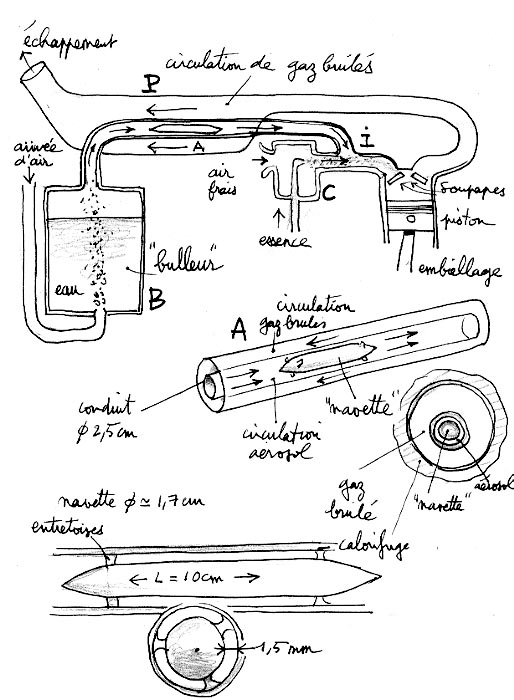
Diagram of the Pentone system
I have personally observed these systems operating in Mérindol, near my home, on various vehicles. Below is the famous tractor of my friend Jean-Louis Millet, which achieves a 50% reduction in fuel consumption.
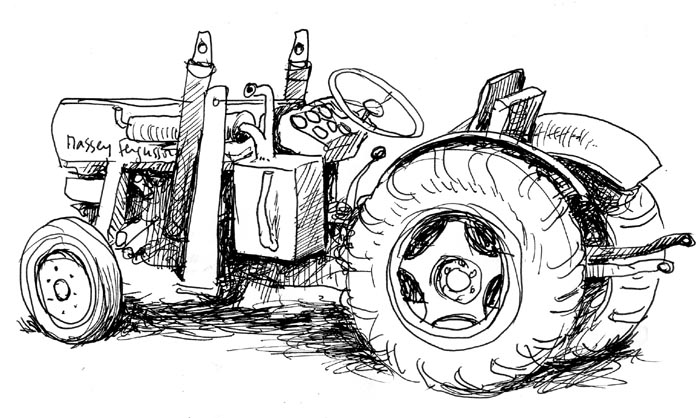
Jean-Louis Millet's tractor from Mérindol, equipped with the Pentone system
When I first contacted these friendly tinkerers, I suggested renaming their system with the grandiose name of "electrodynamic catalysis."
Months passed, and suddenly the world experienced another "oil shock." Individuals saw their wallets emptying even as their fuel tanks filled. Professionals, such as farmers, saw their production costs rise and their profits shrink further. Meanwhile, major oil companies like Total passed on price increases and recorded fabulous profits. The same goes for the state, which collects its 80% tax on petroleum products.
On the other side of the world, the emirs—who no longer know what to do with their money—announced plans to build a "Disneyland unlike any seen before." Former Bedouins turned multimillionaires no longer know how to amuse themselves, seeking to create the illusion of building something meaningful. In reality, it's tourism for the ultra-rich, for the wealthy from all corners of the globe.
In certain parts of the world, such as the Emirates, people are desperately trying to spend or invest money corresponding to a 58% growth rate. Elsewhere, people just stare in disbelief and wonder. It is precisely at such moments that fuel-saving tinkerers emerge on stage, as recently on FR3. In the film, farmers visit a peculiar neighbor who has equipped his powerful tractor with this strange system, enabling substantial savings. He cuts his diesel consumption in half. Despite the blackout—based on mockery—that kept these commendable efforts off the small screen, public opinion forced our courageous journalists to cover the topic.
Yet, strangely, these inventors only reveal their first names. Indeed, their activities are potentially doubly illegal. First, they modify engines without obtaining approval from the Mines Department. Second, they fill their tanks with "unrecognized" fuels—especially non-taxed ones, like canola or sunflower oil. What about this water, this "aqua simplex," which in practice functions as a "fuel"? Should it also be taxed?
Successful tests have been conducted with vehicles capable of using public roads. A year ago, I saw a Mercedes diesel passenger car equipped with this system for injecting electrically charged steam, and I was astonished to be able to... breathe normally while practically putting my nose into the exhaust pipe. However, these tests were suspended. After all, all vehicles are prone to accidents. What if a modified vehicle were involved in a traffic accident? It could easily be blamed on the fact that the engine had been tampered with. Prudently, our tinkerers now focus on tractors and generators.
Clearly, enormous savings could be achieved if automobile, tractor, truck, and bus manufacturers incorporated this electrodynamic catalysis system into their powertrains. But how would one make money from it? How could one secure exclusive rights to such a system, collect substantial royalties with a...