Solar energy with Fresnel mirrors
Fresnel mirrors and the harnessing of solar energy.
August 23, 2005
I am not the only one to have thought of this, as evidenced by this article: http://www.klimaschutz.com/synth/sfc021001.htm
A reader, Laure Emmanuelle Muller, translated it for us. We thank her for this.
I am providing a summary before reading.
The Belgians opted for a formula featuring a fixed heat-collecting tube, in which steam is generated directly, and onto which solar radiation is concentrated using a series of ground-mounted mirrors shaped like long strips, whose orientation is mechanically adjusted.
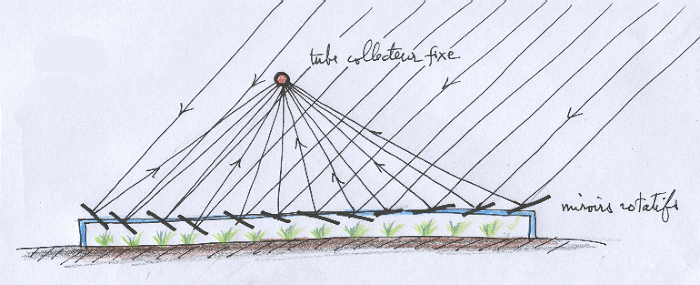
"Solarmondo" System. Rotating flat mirrors (1000 m long). Fixed collector tube. Below, crops.
As seen in this diagram, reflective strips, mirrors 1000 m long, are mounted on a chassis. Beneath this chassis, in regions with very high solar irradiance, it is possible to develop crops; part of the collected energy could be used to desalinate seawater. Such a system could be installed in the Dubai region, in the United Arab Emirates, where the coast is ultimately of little interest and is close to a vast, very flat desert, also devoid of interest. These installations, giving rise to bio-deserts, would not be incompatible with the luxury tourism dreams currently developed by the emirs. But, obviously, it is ... something else.
A variant would consist of having a mobile collector, carried on rotating arms to which worm gears would be attached. The mirror would then be fixed. In my opinion, it would then more easily withstand strong winds (the collector tube would be retracted into a housing). It would also be easier to clean, using a traveling wiper. This type of mirror would also be better suited to planetary standardization by being supplied in elements.
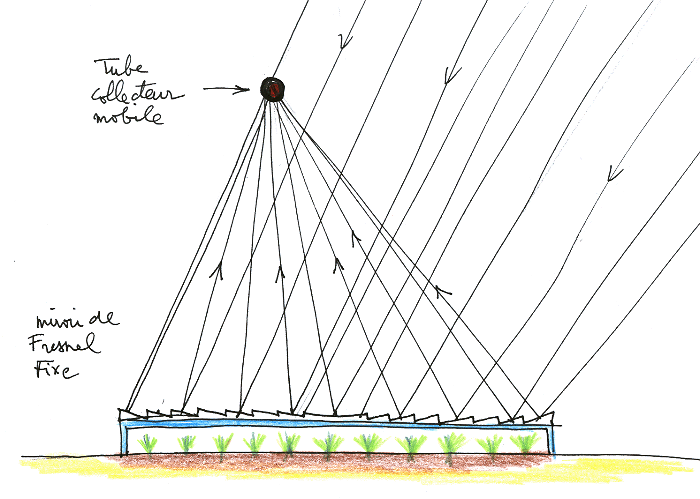
Solar collector with fixed mirror and mobile focal sensor tube.
Both formulas should be tried. The Belgians have already successfully tested their system. Nothing on this front in France, unless I am mistaken.
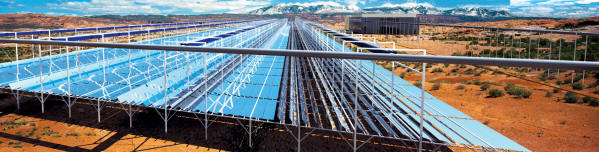
http://www.solarmundo-power.com
The Solarmundo Fresnel Lightweight Collector (SFC)
can make solar energy cheaper than oil
An assessment of the potential of the new Solarmundo collector for climate protection
Christoph Bals (Germanwatch, bals@germanwatch.org), and
Dr. rer. nat. Gerhard Knies (Hamburg Climate Protection Fund, knies.gerhard@t-online.de)
An artist's view of a Solarmondo unit, deployed in a desert
After a careful inspection of the new Solarmundo Fresnel Lightweight Collector (SFC), the two authors reach the following assessment: With this recent development, in well-sunlit countries, solar energy could become cheaper than oil within a few years, without any further technological breakthrough. If the SFC works as expected, it will provide enormous potential for global climate protection, and for clean, inexhaustible electricity worldwide. - Bonn and Hamburg, October 2001.
-
Performance of SFC power plants
-
Clean electricity, cheaper than oil:
At locations with good solar radiation, the Solarmundo collector () can produce steam more cheaply than oil, for oil prices above US$20 per barrel. This means that a solar power plant can produce electricity at lower costs than an oil-fired thermal power plant.
Combined with water desalination
The cooling power, as in any thermal power plant, can be used for desalinating seawater or brackish water. A 400 MW solar power plant could cogenerate 10 to 20 thousand cubic meters per hour. This technology is well established.
Combined with site cultivation
The flat mirror of the SFC is about 4 meters above the ground. In the shade below, light intensity and water evaporation are reduced. There is enough light, for example, to grow tomatoes.
A 400 MW plant would provide approximately 3 square kilometers of shade for crops. Water for irrigation could come from desalination.
The details of this application, such as yield per harvest and hectare and the water required for irrigation, must be assessed by a feasibility study and studied in a pilot project.
Future potential with integrated solar energy storage
There is a promising perspective for a fairly simple adaptation for heat storage, and thus for on-demand electricity supply 24 hours a day. This gives solar electricity great potential for energy supply in sunlit countries, and for export to industrialized northern countries.
SFC technology therefore offers interesting possibilities to provide low-cost clean electricity in sunlit countries, for their domestic needs and for export, and to avoid dangers to the local environment such as dirty coal combustion or the cutting of firewood. Given that a large part of the construction, maintenance, and operation work can be done by local labor, it can create industrial jobs in developing countries.
Computer animation: 4 rows of SFC collectors with the steam transfer line to the plant.
- Potential of SFCs for global climate protection
SFC technology would significantly extend our capabilities for solar electricity production. As soon as this technology is verified by complete operating software - probably within 1 or 2 years - it could contribute to providing clean electricity for the enormous future needs foreseen in developing sunlit countries, including India and China. Here, new capacities for hundreds of Gigawatts are needed.
Combined with the relatively low cost of long-distance energy transport via high-voltage direct current (HVDC) lines, approximately 95% of the world's population resides within reach of desert locations suitable for low-cost solar thermal electricity production and with sufficient space for collector fields. For example, for the production of 500 TWh/year of electrical energy, corresponding to 20% of the EU's annual electricity consumption, a collector field of approximately 45 x 45 km is necessary, along with Saharan sunshine. Morocco offers both conditions: good sunshine and easy connection to the European grid.
Since heat storage would allow on-demand electricity production day and night, with this future application, SFC technology could significantly contribute to the rapid transition globally required towards clean electricity.
Even with the current construction method, this solar electricity could be competitive with oil-fired power plants. Further conceptual improvements and further cost reductions must be expected from the expansion of production capacities.
Due to the exceptional potential of SFC technology for global climate protection, there is a significant public interest in accelerating the development of this technology as much as possible. Therefore, we recommend appropriate support for a rapid verification of this technology's potential. If the tests are successful, the door would be open for a global market launch.
The full power for global climate protection can come from unlimited North-South cooperation.
- The SFC - technical devices
Sunlight can be concentrated by a parabolic mirror to produce steam for a power plant. The French physicist A. J. Fresnel (1788 - 1827) invented a simple system to replace curved mirrors with a flat set of mirror strips.
With this system, Solarmundo NV (Belgium) has converted the cumbersome bowl of the parabolic mirror into a simple flat surface consisting of elongated mirror strips. A row of 48 of these strips, each 50 centimeters wide and up to approximately 1000 meters long, reflects sunlight onto a 1000-meter-long collector tube mounted 15 meters above the row. The mirror strips can be tilted around their longitudinal axes to follow the sun. In clear weather, the concentrated sunlight could heat the collector tube to more than 500° Celsius. This is sufficient to produce steam for a conventional turbine coupled to a generator with a power output of 4.8 megawatts. A large number of these collector elements can be combined to extend capacities - up to several hundred megawatts.
Here we summarize the improvements that the SFC design offers compared to first-generation linear parabolic trough collectors, which have been operating very reliably for 10 years in the Mojave Desert in California.
Differences in design:
-
A large parabolic mirror, typically 6 meters wide, resting on a complicated mobile support structure to follow the sun, is replaced by a fixed, horizontal row of small pivoting flat mirror strips and a small secondary concentrator behind the collector tube.
-
The focus of the moving parabola - following the sun's movement - is replaced by a fixed focal line, onto which each mirror element and the secondary concentrator reflect sunlight. The collector tube is now in a fixed position.
-
The support structure for the mirror axes and for the collector tube is fixed.
Thanks to a new surface coating on the collector tube, the expensive vacuum insulation of the long tube could be replaced by simple protection against heat loss and radiation in a normal atmosphere.
Steam is produced directly in the collector tube, rather than after heat transfer to a steam boiler by a special fluid and heat exchangers.
Differences in light collection efficiency and performance during the day
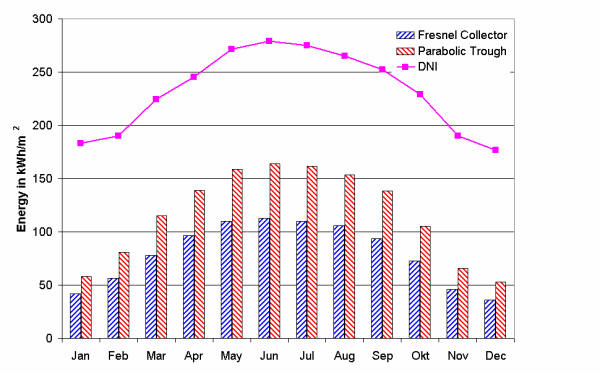
The compared efficiencies of systems based on parabolic mirrors and Fresnel collectors (at the latitude of Cairo). It can be seen that they are quite close.
The coverage of the collector field by the mirror elements is different in the two devices.
In the Solarmundo device, the collector field is almost completely covered with mirrors. This leads to some mutual shading during the extreme hours of the day, early and late in the day. In parabolic devices, the north-south aligned parabolic rows are separated by 2 empty rows to avoid shading each other in the morning and afternoon, thus providing a lower yield, in only 1/3 of the collector field, but more constant during the day.
From the point of view of used mirror surface, radiation collection is better for Solarmundo Fresnel collectors, and from the point of view of mirror sector, radiation collection is better with parabolic mirrors.
-
Cost reductions are mainly achieved by:
-
Many small flat mirrors easy to build instead of a large specially designed (parabolic) mirror.
-
Only the small mirrors are rotated to follow the sun. Their support axes, frames, and the collector tube remain fixed.
-
The entire support structure can easily be made from standard parts.
-
The permanent horizontal position of the mirror row significantly reduces wind power.
-
Vacuum insulation around the collector tube could be avoided.
-
Direct steam production in the collector tube.
-
Low-cost local labor can be widely used to assemble the components.
-
Simplified operation and maintenance of the collector field.
-
Development stage
So far, the Fresnel mirror strips, the secondary concentrator, and the collector tube have been manufactured, tested in the laboratory, and assembled in a pilot installation in Belgium, over a width of 24 meters, but with a length of only 100 meters instead of the 1000 meters planned for the envisaged standard 4.8 MW module.
The mechanical functions of the collector have been verified in this pilot installation. In addition, steam was produced at a temperature of 270 degrees Celsius, in line with expectations for the pilot installation, with a maximum temperature limited by a preliminary selective coating on the collector tube. A new selective coating, special for high temperatures, has thus been successfully examined in the laboratory, at 500 degrees Celsius. Production of tubes with this coating has been initiated. The long-term stability of the high absorption and low radiation properties of this coating, and the control of the steam production process, must be verified at the expected operating temperatures of 400 degrees Celsius with a full-size collector and full solar radiation.
Additional devices for heat storage and agricultural cultivation exist only "on paper" so far.
-
Next steps
-
The next step is to demonstrate the collector's operation under realistic solar conditions and for a reasonable period, for example, a few months. For this purpose, a demonstration plant, consisting of at least one full collector row for approximately 5 MW, should be built and operated for solar steam production.
This requires an investment of 8 to 10 million euros and the identification of a location with strong sunshine and low labor costs. The government of Morocco has offered to provide a suitable site. In Southern Europe, with lower sunshine and higher labor costs, it would be approximately 50% more expensive.
It would be desirable for construction work to begin in early 2002 (! ... ).
-
In parallel with construction work, there should be feasibility studies on technical potentials and market studies of the agriculture option for Solarmundo collector fields, as well as a demonstrator.
-
The technical feasibility of day-night energy storage should be studied, as well as the significance of on-demand electricity production, for domestic supply and for large-scale electricity export.
-
Based on the experience of constructing and operating the demonstration plant, planning and construction of commercial power plants in the range of 50 to several hundred MW should be started.
The Solarmundo Fresnel Lightweight Collector (SFC)
can make solar energy cheaper than oil
An assessment of the potential of the new Solarmundo collector for climate protection
by
Christoph Bals (Germanwatch, bals@germanwatch.org), and
Dr. rer. nat. Gerhard Knies (Hamburg Climate Protection Fund, knies.gerhard@t-online.de)
An artist's view of a Solarmondo unit, deployed in a desert
After a careful inspection of the new Solarmundo Fresnel Lightweight Collector (SFC), the two authors reach the following assessment: With this recent development, in well-sunlit countries, solar energy could become cheaper than oil within a few years, without any further technological breakthrough. If the SFC works as expected, it will provide enormous potential for global climate protection, and for clean, inexhaustible electricity worldwide. - Bonn and Hamburg, October 2001.
-
Performance of SFC power plants
-
Clean electricity, cheaper than oil:
At locations with good solar radiation, the Solarmundo collector () can produce steam more cheaply than oil, for oil prices above US$20 per barrel. This means that a solar power plant can produce electricity at lower costs than an oil-fired thermal power plant.
Combined with water desalination
The cooling power, as in any thermal power plant, can be used for desalinating seawater or brackish water. A 400 MW solar power plant could cogenerate 10 to 20 thousand cubic meters per hour. This technology is well established.
Combined with site cultivation
The flat mirror of the SFC is about 4 meters above the ground. In the shade below, light intensity and water evaporation are reduced. There is enough light, for example, to grow tomatoes.
A 400 MW plant would provide approximately 3 square kilometers of shade for crops. Water for irrigation could come from desalination.
The details of this application, such as yield per harvest and hectare and the water required for irrigation, must be assessed by a feasibility study and studied in a pilot project.
Future potential with integrated solar energy storage
There is a promising perspective for a fairly simple adaptation for heat storage, and thus for on-demand electricity supply 24 hours a day. This gives solar electricity great potential for energy supply in sunlit countries, and for export to industrialized northern countries.
SFC technology therefore offers interesting possibilities to provide low-cost clean electricity in sunlit countries, for their domestic needs and for export, and to avoid dangers to the local environment such as dirty coal combustion or the cutting of firewood. Given that a large part of the construction, maintenance, and operation work can be done by local labor, it can create industrial jobs in developing countries.
Computer animation: 4 rows of SFC collectors with the steam transfer line to the plant.
- Potential of SFCs for global climate protection
SFC technology would significantly extend our capabilities for solar electricity production. As soon as this technology is verified by complete operating software - probably within 1 or 2 years - it could contribute to providing clean electricity for the enormous future needs foreseen in developing sunlit countries, including India and China. Here, new capacities for hundreds of Gigawatts are needed.
Combined with the relatively low cost of long-distance energy transport via high-voltage direct current (HVDC) lines, approximately 95% of the world's population resides within reach of desert locations suitable for low-cost solar thermal electricity production and with sufficient space for collector fields. For example, for the production of 500 TWh/year of electrical energy, corresponding to 20% of the EU's annual electricity consumption, a collector field of approximately 45 x 45 km is necessary, along with Saharan sunshine. Morocco offers both conditions: good sunshine and easy connection to the European grid.
Since heat storage would allow on-demand electricity production day and night, with this future application, SFC technology could significantly contribute to the rapid transition globally required towards clean electricity.
Even with the current construction method, this solar electricity could be competitive with oil-fired power plants. Further conceptual improvements and further cost reductions must be expected from the expansion of production capacities.
Due to the exceptional potential of SFC technology for global climate protection, there is a significant public interest in accelerating the development of this technology as much as possible. Therefore, we recommend appropriate support for a rapid verification of this technology's potential. If the tests are successful, the door would be open for a global market launch.
The full power for global climate protection can come from unlimited North-South cooperation.
- The SFC - technical devices
Sunlight can be concentrated by a parabolic mirror to produce steam for a power plant. The French physicist A. J. Fresnel (1788 - 1827) invented a simple system to replace curved mirrors with a flat set of mirror strips.
With this system, Solarmundo NV (Belgium) has converted the cumbersome bowl of the parabolic mirror into a simple flat surface consisting of elongated mirror strips. A row of 48 of these strips, each 50 centimeters wide and up to approximately 1000 meters long, reflects sunlight onto a 1000-meter-long collector tube mounted 15 meters above the row. The mirror strips can be tilted around their longitudinal axes to follow the sun. In clear weather, the concentrated sunlight could heat the collector tube to more than 500° Celsius. This is sufficient to produce steam for a conventional turbine coupled to a generator with a power output of 4.8 megawatts. A large number of these collector elements can be combined to extend capacities - up to several hundred megawatts.
Here we summarize the improvements that the SFC design offers compared to first-generation linear parabolic trough collectors, which have been operating very reliably for 10 years in the Mojave Desert in California.
Differences in design:
-
A large parabolic mirror, typically 6 meters wide, resting on a complicated mobile support structure to follow the sun, is replaced by a fixed, horizontal row of small pivoting flat mirror strips and a small secondary concentrator behind the collector tube.
-
The focus of the moving parabola - following the sun's movement - is replaced by a fixed focal line, onto which each mirror element and the secondary concentrator reflect sunlight. The collector tube is now in a fixed position.
-
The support structure for the mirror axes and for the collector tube is fixed.
Thanks to a new surface coating on the collector tube, the expensive vacuum insulation of the long tube could be replaced by simple protection against heat loss and radiation in a normal atmosphere.
Steam is produced directly in the collector tube, rather than after heat transfer to a steam boiler by a special fluid and heat exchangers.
Differences in light collection efficiency and performance during the day
:
The compared efficiencies of systems based on parabolic mirrors and Fresnel collectors (at the latitude of Cairo). It can be seen that they are quite close.
The coverage of the collector field by the mirror elements is different in the two devices.
In the Solarmundo device, the collector field is almost completely covered with mirrors. This leads to some mutual shading during the extreme hours of the day, early and late in the day. In parabolic devices, the north-south aligned parabolic rows are separated by 2 empty rows to avoid shading each other in the morning and afternoon, thus providing a lower yield, in only 1/3 of the collector field, but more constant during the day.
From the point of view of used mirror surface, radiation collection is better for Solarmundo Fresnel collectors, and from the point of view of mirror sector, radiation collection is better with parabolic mirrors.
-
Cost reductions are mainly achieved by:
-
Many small flat mirrors easy to build instead of a large specially designed (parabolic) mirror.
-
Only the small mirrors are rotated to follow the sun. Their support axes, frames, and the collector tube remain fixed.
-
The entire support structure can easily be made from standard parts.
-
The permanent horizontal position of the mirror row significantly reduces wind power.
-
Vacuum insulation around the collector tube could be avoided.
-
Direct steam production in the collector tube.
-
Low-cost local labor can be widely used to assemble the components.
-
Simplified operation and maintenance of the collector field.
-
Development stage
So far, the Fresnel mirror strips, the secondary concentrator, and the collector tube have been manufactured, tested in the laboratory, and assembled in a pilot installation in Belgium, over a width of 24 meters, but with a length of only 100 meters instead of the 1000 meters planned for the envisaged standard 4.8 MW module.
The mechanical functions of the collector have been verified in this pilot installation. In addition, steam was produced at a temperature of 270 degrees Celsius, in line with expectations for the pilot installation, with a maximum temperature limited by a preliminary selective coating on the collector tube. A new selective coating, special for high temperatures, has thus been successfully examined in the laboratory, at 500 degrees Celsius. Production of tubes with this coating has been initiated. The long-term stability of the high absorption and low radiation properties of this coating, and the control of the steam production process, must be verified at the expected operating temperatures of 400 degrees Celsius with a full-size collector and full solar radiation.
Additional devices for heat storage and agricultural cultivation exist only "on paper" so far.
-
Next steps
-
The next step is to demonstrate the collector's operation under realistic solar conditions and for a reasonable period, for example, a few months. For this purpose, a demonstration plant, consisting of at least one full collector row for approximately 5 MW, should be built and operated for solar steam production.
This requires an investment of 8 to 10 million euros and the identification of a location with strong sunshine and low labor costs. The government of Morocco has offered to provide a suitable site. In Southern Europe, with lower sunshine and higher labor costs, it would be approximately 50% more expensive.
It would be desirable for construction work to begin in early 2002 (! ... ).
-
In parallel with construction work, there should be feasibility studies on technical potentials and market studies of the agriculture option for Solarmundo collector fields, as well as a demonstrator.
-
The technical feasibility of day-night energy storage should be studied, as well as the significance of on-demand electricity production, for domestic supply and for large-scale electricity export.
-
Based on the experience of constructing and operating the demonstration plant, planning and construction of commercial power plants in the range of 50 to several hundred MW should be started.
Table of Contents " Renewable Energies "
Back to Guide Back to Home Page
Number of views since August 20, 2005 :