Kirkland, New Mexico: Solar Energy Galore with Mirrors and Stirling Engines
Solar energy and the Stirling engine: The USA: leaders in this field
August 13, 2005
My readers keep me very busy. But that is how it should be. It is my job to sound the alarm bells and also to disseminate ideas. Admittedly, it is more pleasant to propose solutions than to tediously insist on all the world's distresses. Frédéric Deroche tips me off to a new topic, adding, "Sorry, it's in English." Well, I will have to translate this fresh this morning.
The Stirling engine is a way of exploiting a temperature difference between a hot source and a cold source. Search on Google to see how it works. In what follows, people are using solar energy as the hot source.
This is where we measure the full absurdity of the world. Here is an intelligent solution. It happens to be implemented by the... Sandia Laboratories, a high place of US military technology, which I visited in '76. Proof that science can generate the worst as well as the best. It is the result of large investments. If we were not complete idiots in France, we would be moving toward formulas like this one. Currently, unless I am mistaken, Stirling systems are studied by eco-hackers (unless I am wrong).
But what is a minister of research and technology in France, if not another incompetent person in office, lavishly paid? We had indeed seated an astronaut in this chair, without a shadow of an idea.
Without money, you do nothing, or not much. You tinker. This is unfortunately a reality. Or else you do what I have been doing for 25 years: putting ink on paper, lining up equations. By the way, the battle has begun for the publication of our latest work. "It's something," one might say. Big stakes, big breakthrough, with heavyweight co-signatories. We oiled the tube, went into periscopic immersion, and launched the torpedo. The blockade is already starting. But in science, you know what to expect. It is useless to gently knock on the doors: you have to break them down. We will have to call in the "stars" to the arenas where they are not rushing to descend. The most terrible thing is... the wall of silence. One only has to think of the one who greeted the release of "We Lost Half the Universe in 1997," Albin Michel.
Isn't science beautiful?
Apart from that, I am occasionally informed that I am attacked by people who courageously hide behind pseudonyms, venting on forums. Before leaving for the Emirates, I had an exchange with a certain "Kouropoulos," who does not go easy on me, pretending to know everything about everything. I questioned him. Canadian, 47 years old, living in Geneva. He urgently asked me to keep his real name secret: Couropoulos with a C. And what else? No, he is not a researcher. He has published nothing. By his own admission, at the DEA level (Diplôme d'Études Approfondies - a postgraduate degree). A self-taught man who does not draw a salary from any university-research body. I could not find out what he lived on. He probably lives with his mother.
This is a beginning of an answer to a question asked many times: "What do you think of what Kouropoulos says about you?" My answer:
*- This brave boy overestimates himself. *
Let us return to more serious matters.
Source: http://pesn.com/2005-08-11/9600147_Edison_Stirling_largest_solar
I am starting to translate.
How it works
The Stirling system converts solar energy into electricity by sending solar energy to the engine's receiver. Each panel is motorized to follow the sun's rays and track them as best as possible.
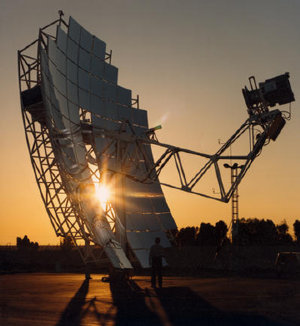
Receiver of the Sandia system.
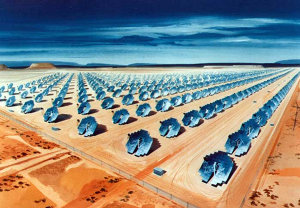
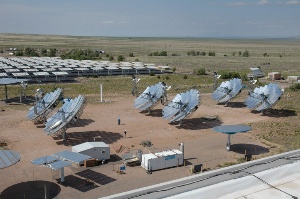
The project. The current state with six receivers.
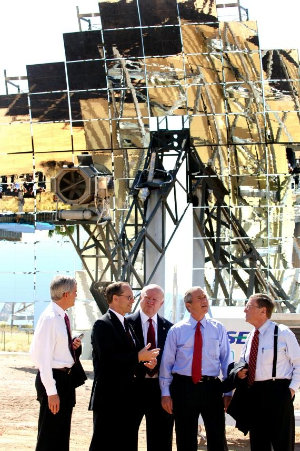
Bush visiting the Sandia laboratory facilities (New Mexico)
Here, note: Since the mirror is in the background, we can estimate its surface area at 100-120 square meters. Further on, it is stated that the mirrors are 12 meters [in diameter].
Here, a JPP remark, concerning what we will try to draw the attention of the emirs to in Dubai, Christophe Tardy and I, if possible. There is a way to concentrate solar energy that is much more rational than using these concave mirrors, which are bulky and sensitive to wind. We could, in France, easily develop this, if we were not led by complete imbeciles. It is also on our soil that the inventor of these systems was born, a certain... Fresnel.
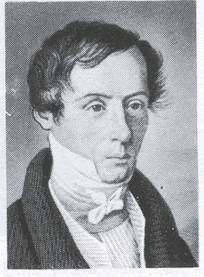
Augustin Fresnel (1788 - 1827)
In Fresnel's time, there was a desire to improve maritime safety by developing lighthouses and beacons. But how to install lenses of a meter or so in diameter at the top of lighthouses? Fresnel has an idea. He "segments" the object:
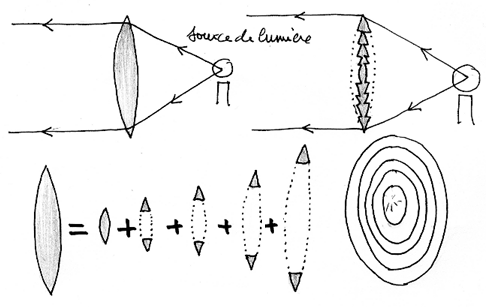
Fresnel lens
You can find this type of lens in the form of "micro-grooved" stickers in all supermarkets. You can even fix them to the rear window of your van. This is what allows the cashier to inspect the contents of your trolley.
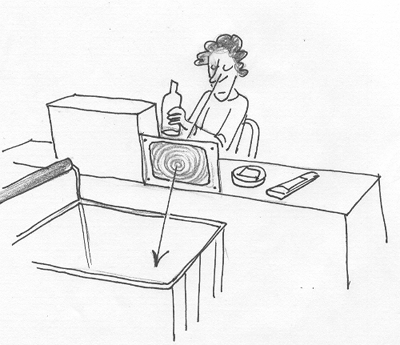
Fresnel lens with micro-grooves.
In the same vein, one can design a Fresnel mirror, spherical or cylindrical.
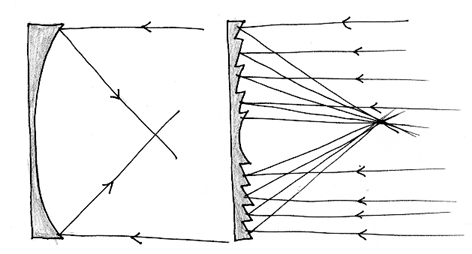
Fresnel mirror
One could even move to a "micro-grooved" system. Hence, a gadget that a motorist could fold up in his trunk and which would allow him to cook sausages with an improvised solar oven, at a rest area on the side of the highway. Know that the Sun generously sends us one and a half kilowatts per square meter.
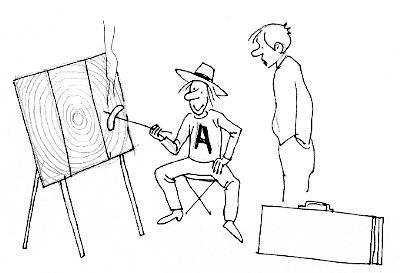
Beyond the gadget, there is here an extremely convenient way to capture solar energy. I remember (it was thirty years ago) finding at the INPI (National Institute of Industrial Property) a patent concerning a "solar house."
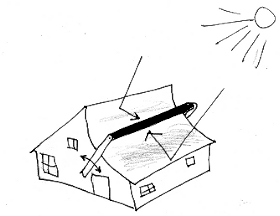
The solar house patent. Nothing more convenient.
The author had imagined capturing the sun's energy by transforming a roof slope into a concave cylindrical mirror. Do the same thing with prefabricated elements, which would be produced in large numbers and sold by building material merchants, allowing you to transform one of the roof slopes into Fresnel mirrors. Focusing on a mobile segment. It is easy to move this on an arm, with a worm screw and a gear system so that it is located at the focal point of the system at every instant. With a roof slope of 10 meters by five, that's 50 kilowatts coming through. Not bad for heating your bath or powering your radiators.
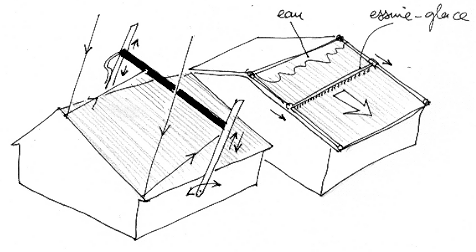
House equipped with a roof slope made of Fresnel mirror
On the right, the automatic cleaning of the roof with a ... linear motion windshield wiper. Water injection at the ridge of the roof. Brushing the mirror. A box could produce adaptable elements to compose roofs of variable size. But who will do this?
August 14. Remark: Here is an American site, I believe, where you will find Fresnel lenses of 38"x50": http://www.alltronics.com/lenses.htm but not mirrors.
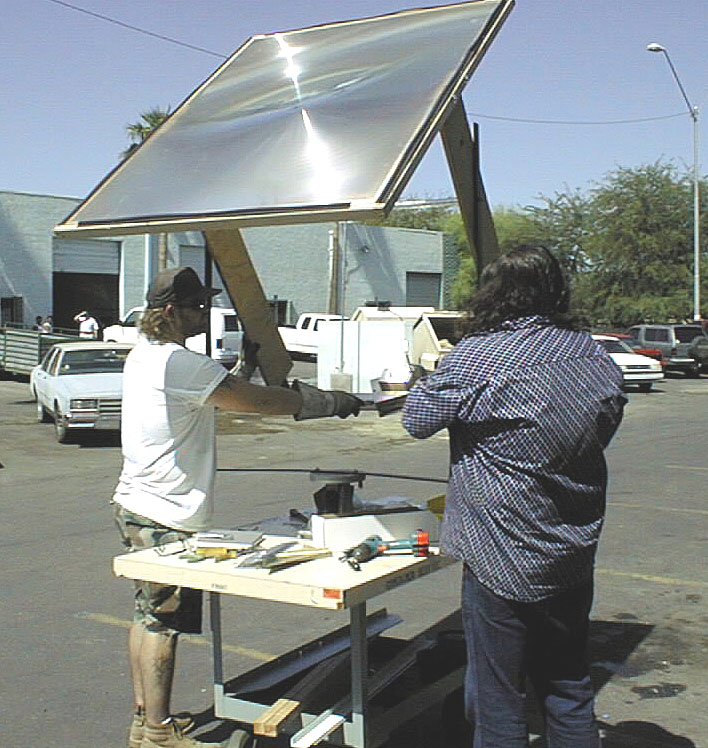
Large Fresnel lenses, simply fixed on a wooden mount. USA
Energy storage? If I were to build a house, I would plan for a large volume of water, buried and carefully insulated. I would simply store ... hot water. Calculations of heat loss would need to be done. Knowing how many tens of cubic meters of water at a good temperature would need to be stored to be able to heat for a long time. There is also heat concentration. A winter sun, focused on a segment, will give boiling water. I experimented with this matter a good thirty years ago, in Aix. I had rented a shack on the Verguetiers plain. Fresh water was brought by a long black pipe, from a basin located two or three hundred meters away. In the spring, I was annoyed. The evaporation of the dew froze the water in my pipe. I then hung it on the tree branches. And there, horror, I had only scalding water at my tap. But, compensation: I could take free hot baths.
The Sun dispenses us with crazy energy that we do NOTHING with. If I were minister of research and technology, I would have developed this Fresnel mirror business, on an industrial scale. But ministers of technology are not there to drive projects. They are there to talk, talk.... Remember the hollow words of Haygnerie, in the chapter composed by our Minister of National Education, Luc Ferry:
- I will make it a point of honor to ensure that researchers are provided with means commensurate with the missions they set for themselves....
Blah blah blah....
I have met ministers. I even had lunch one day with Madelin, ... 25 years ago. I showed him a CAD software running on a 64K microcomputer. At the time, it was an Amstrad. I was the first in the world to do this. He took it for a ... video game. He had gathered people who were cutting-edge in computer science at the time. At that time, that was my case, and I had even presented this software on TF1, running on an Apple II. By throwing "pre-calculated images" with hidden parts eliminated, stored on "a 256K memory expansion card," onto the screen, I even produced an ... animation. We obtained a 360° flyover of a village, in a loop. In short, in '79 I had invented the ... CD-ROM, without knowing it. Madelin gave us a nice speech. I felt like saying to him:
- Say, for once, couldn't you give us something other than something that looks like your election speeches?
Madelin, Edith Cresson, Curien, the people from La Villette. I met them all. In France, going door-to-door with a thousand ideas, you waste your time.
If I were minister, I would draw inspiration from the Sandia experience, plus Fresnel mirrors. But let us return to this matter and resume our translation.
There are those who could develop all this. They are the emirs of Dubai. One can always try. But they will have to build "the largest Fresnel mirrors in the world." Sun, space, they have it. They have a whole desert behind them, as far as the eye can see.
But let us resume our translation.
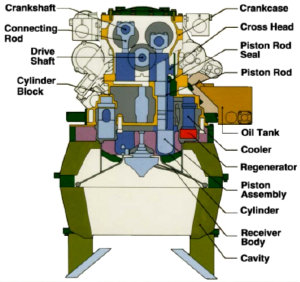
The receiver captures the heat used to heat hydrogen. The expansion of the gas acts on a piston connected to a crankshaft, and the whole constitutes an engine without internal combustion. (Why hydrogen? Because it is more efficient as a heat transfer fluid.) The rotation drives an electricity generator. The entire conversion system has the footprint of a large oil drum. The process requires no water and emits no energy.
Remark
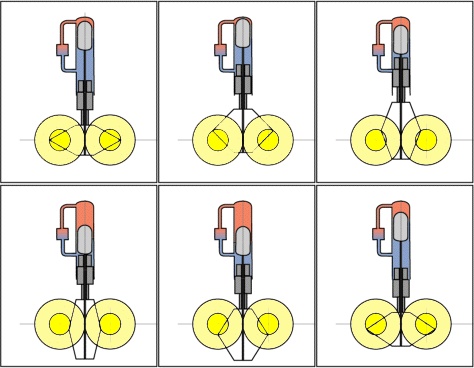
On this drawing, solar energy arrives from below. There are two pistons, connected to connecting rods, coupled by a gear system, working alternately. The entire device indeed fits in a volume of less than 200 liters, hanging at the focal point of the system visible in the photos. Simpler than the Stirling system, you die.
Comparison with other systems using solar energy
Tests conducted by SCE and the Sandia National Laboratories have shown that the system based on a Stirling engine was almost twice as efficient as others, such as parabolic mirror systems used to create steam to power turbines, or photovoltaic systems.
Additional applications
They are countless.
But let us resume our translation:
The receiver captures the heat used to heat hydrogen. The expansion of the gas acts on a piston connected to a crankshaft, and the whole constitutes an engine without internal combustion. (Why hydrogen? Because it is more efficient as a heat transfer fluid.) The rotation drives an electricity generator. The entire conversion system has the footprint of a large oil drum. The process requires no water and emits no energy.
Remark:
On this drawing, solar energy arrives from below. There are two pistons, connected to connecting rods, coupled by a gear system, working alternately. The entire device indeed fits in a volume of less than 200 liters, hanging at the focal point of the system visible in the photos. Simpler than the Stirling system, you die.
Comparison with other systems using solar energy
Tests conducted by SCE and the Sandia National Laboratories have shown that the system based on a Stirling engine was almost twice as efficient as others, such as parabolic mirror systems used to create steam to power turbines, or photovoltaic systems.
Additional applications
They are countless.
http://pesn.com/2005-08-11/9600147_Edison_Stirling_largest_solar
The world's largest installation using Stirling engine technology
This is the result of 20 years of work by the Southern California Edison Company and Stirling Energy Systems, Inc. The project consists of covering 4,500 acres of land with 20,000 mirrors, producing 500 megawatts of electricity. More than all systems currently operating in the USA.
"We are competitive in the market, although we do not wish to indicate the amount of dollars we have invested in this operation. We did not need any subsidies to carry out this job," Gil Alexander told us on August 11, 2005.
Remark
Let us estimate the surface area of the mirrors between 100 and 120 square meters. Twenty-four thousand units for 500 megawatts, that makes 20 kW each. With 1 kW per square meter (in New Mexico), this gives us a collected solar power between 100 and 120 kW. With a gross efficiency of 16 to 20%. This seems very honest, given the simplicity of the device. Reader comments welcome &&. In fact, these efficiencies may seem low to us. But what sense does that make since the converted energy (solar) is ... free. When coupling gas turbines to the burners of a thermal power plant, one is very attentive to efficiency. Every point gained represents a huge saving on the oil import bill. In this case, every point of efficiency lost (by changing the conversion mode) simply requires increasing the surface area of the collecting mirror. The work done by the people at the Sandia labs consisted of improving the operation of the Stirling system, neglected until now because of "relatively low" efficiencies. But this formula turns out to be particularly well suited for this collection of solar energy, which accommodates low efficiencies. By coupling the converters developed by the Americans with Fresnel mirrors, it seems to me that we would arrive at a very interesting concept, in terms of simplicity of construction, wind resistance, and ease of cleaning (in the Albuquerque region where the tests were conducted, pollution is not, I believe, a major concern. Elsewhere, yes. Cleaning a 12-meter concave mirror: not easy).
ROSEMEAD, California, USA
On August 8, 2005, President Bush visited the entire complex of solar energy conversion capacity installations, located at the Kirkland Air Force Base in Albuquerque (New Mexico).
Note the size of the 12-meter diameter mirrors compared to the people present.
Based on a contract signed by Edison Company, a subsidiary of Southern California Edison (SCE), the country is now ready to position itself as a leader in renewable energies. An agreement has just been signed, subject to approval by the California Public Utilities Commission, concerning the development of a 500-megawatt facility located 70 miles northeast of Los Angeles, using this Stirling engine-solar mirror combination. This would be enough to power half a million homes. The plan is to expand this project to 850 MW. Construction would span a period of four years, starting in 2008. If the facility is increased to 850 MW, this would bring the number of mirrors to 34,000.
Remark
The cost of the mirrors is very likely significant in the total quote. These must be motorized. They are sensitive to wind. Fresnel mirrors could have much larger dimensions and present a lower unit cost of manufacture and maintenance. Furthermore, it seems simpler to us to move the energy collector rather than the entire installation itself.
Continued: Blah blah blah......
Leaders in the profitability of Stirling systems coupled with solar energy.
The systems have undergone 26,000 hours of testing. A six-mirror system is currently operating at the Sandia laboratory. Of course, this is not the first application of Stirling systems. Thus, Swedish submarines use engines of this type for their propulsion.
The SCE company delivered more than 13,000 gigawatt-hours of renewable energy in 2004, more than any military-use energy source system and enough to power two million households for an entire year.
In 2004, more than 18% of the energy delivered to the 13 million Californians by the SCE company came from the exploitation of renewable energies.
- 1,021 MW of wind energy
- 892 MW in geothermal
- 354 MW solar
- 226 MW from biomass
- 95 MW of small hydroelectric installations.
- In the coming weeks, SCE will launch its ninth independent power producer solicitation program, using renewable energies. This policy results in contracts covering a capacity of 1,630 MW.
- The Southern California Edison Company is one of the largest in the country, supplying 13 million people. It has 4.6 million customers spread over an area of 50,000 square miles.
- Stirling Energy Systems (SES) develops renewable energy systems. Its activities include the development of engines for submarines (Kockums Submarine Systems), and result in links with NASA-Glenn Laboratories, the US Department of Energy (DOE), and Boeing. In the future, SES will be involved in projects using biomass and hydrogen engines.
- Apart from its Sandia facilities, SES has laboratories in Huntington Beach; UNLV, Nevada; and near Johannesburg, South Africa, which represents the largest installation located in Africa. Solar Stirling systems are also installed in the state of Washington. The company is in talks to install them in other regions of the country.
Source:
SES holds the record for solar energy conversion efficiency.
Stirling Engine Systems
602-957-1818
Bruce Osborn, CEO
or Robert Liden, Executive VP, General Manager
Edison International
Corporate Communications, 626-302-2255
The world's largest installation using Stirling engine technology
This is the result of 20 years of work by the Southern California Edison Company and Stirling Energy Systems, Inc. The project consists of covering 4,500 acres of land with 20,000 mirrors, producing 500 megawatts of electricity. More than all systems currently operating in the USA.
"We are competitive in the market, although we do not wish to indicate the amount of dollars we have invested in this operation. We did not need any subsidies to carry out this job," Gil Alexander told us on August 11, 2005.
Remark:
Let us estimate the surface area of the mirrors between 100 and 120 square meters. Twenty-four thousand units for 500 megawatts, that makes 20 kW each. With 1 kW per square meter (in New Mexico), this gives us a collected solar power between 100 and 120 kW. With a gross efficiency of 16 to 20%. This seems very honest, given the simplicity of the device. Reader comments welcome &&. In fact, these efficiencies may seem low to us. But what sense does that make since the converted energy (solar) is ... free. When coupling gas turbines to the burners of a thermal power plant, one is very attentive to efficiency. Every point gained represents a huge saving on the oil import bill. In this case, every point of efficiency lost (by changing the conversion mode) simply requires increasing the surface area of the collecting mirror. The work done by the people at the Sandia labs consisted of improving the operation of the Stirling system, neglected until now because of "relatively low" efficiencies. But this formula turns out to be particularly well suited for this collection of solar energy, which accommodates low efficiencies. By coupling the converters developed by the Americans with Fresnel mirrors, it seems to me that we would arrive at a very interesting concept, in terms of simplicity of construction, wind resistance, and ease of cleaning (in the Albuquerque region where the tests were conducted, pollution is not, I believe, a major concern. Elsewhere, yes. Cleaning a 12-meter concave mirror: not easy).
ROSEMEAD, California, USA
On August 8, 2005, President Bush visited the entire complex of solar energy conversion capacity installations, located at the Kirkland Air Force Base in Albuquerque (New Mexico).
Note the size of the 12-meter diameter mirrors compared to the people present.
Based on a contract signed by Edison Company, a subsidiary of Southern California Edison (SCE), the country is now ready to position itself as a leader in renewable energies. An agreement has just been signed, subject to approval by the California Public Utilities Commission, concerning the development of a 500-megawatt facility located 70 miles northeast of Los Angeles, using this Stirling engine-solar mirror combination. This would be enough to power half a million homes. The plan is to expand this project to 850 MW. Construction would span a period of four years, starting in 2008. If the facility is increased to 850 MW, this would bring the number of mirrors to 34,000.
Remark:
The cost of the mirrors is very likely significant in the total quote. These must be motorized. They are sensitive to wind. Fresnel mirrors could have much larger dimensions and present a lower unit cost of manufacture and maintenance. Furthermore, it seems simpler to us to move the energy collector rather than the entire installation itself.
Continued: Blah blah blah......
Leaders in the profitability of Stirling systems coupled with solar energy.
The systems have undergone 26,000 hours of testing. A six-mirror system is currently operating at the Sandia laboratory. Of course, this is not the first application of Stirling systems. Thus, Swedish submarines use engines of this type for their propulsion.
The SCE company delivered more than 13,000 gigawatt-hours of renewable energy in 2004, more than any military-use energy source system and enough to power two million households for an entire year.
In 2004, more than 18% of the energy delivered to the 13 million Californians by the SCE company came from the exploitation of renewable energies.
- 1,021 MW of wind energy
- 892 MW in geothermal
- 354 MW solar
- 226 MW from biomass
- 95 MW of small hydroelectric installations.
- In the coming weeks, SCE will launch its ninth independent power producer solicitation program, using renewable energies. This policy results in contracts covering a capacity of 1,630 MW.
- The Southern California Edison Company is one of the largest in the country, supplying 13 million people. It has 4.6 million customers spread over an area of 50,000 square miles.
- Stirling Energy Systems (SES) develops renewable energy systems. Its activities include the development of engines for submarines (Kockums Submarine Systems), and result in links with NASA-Glenn Laboratories, the US Department of Energy (DOE), and Boeing. In the future, SES will be involved in projects using biomass and hydrogen engines.
- Apart from its Sandia facilities, SES has laboratories in Huntington Beach; UNLV, Nevada; and near Johannesburg, South Africa, which represents the largest installation located in Africa. Solar Stirling systems are also installed in the state of Washington. The company is in talks to install them in other regions of the country.
Source:
SES holds the record for solar energy conversion efficiency.
Stirling Engine Systems
602-957-1818
Bruce Osborn, CEO
or Robert Liden, Executive VP, General Manager
Edison International
Corporate Communications, 626-302-2255
A final remark: In our time, limiting oil consumption and CO2 emissions are crucial problems. Hence the need to focus attention on energies that are both renewable and non-polluting, like the one the Sun so generously provides us and which we do nothing with. In this perspective, the work done by the Americans seems very interesting, and I think that by opting for fixed mirrors, of the Fresnel type, with a mobile energy collection system, we might lose a little efficiency, but we would gain in simplicity of construction and maintenance. It is not simple to move the entire mirror plus converter assembly, keeping the system axis pointed at the Sun. It is also not simple to clean spherical mirrors. They would need to be equipped with windshield wipers with water spray. With a fixed mirror, glued to a simple concrete structure, there is no longer a problem of resistance to the most violent winds. In case of a storm, one only has to retract the converter and its arm into a protective housing (which can be done automatically when the wind exceeds a certain force). Where the Sandia lab has undoubtedly added value is in perfecting the Stirling system.
A stupidly political problem then emerges. These systems could allow providing electrical energy, completely autonomously, to the most remote regions of the globe. With 20 kilowatts of electrical energy, one can do a lot of things, such as allowing a hospital unit or a small mechanical workshop to function. One can also recharge the batteries of electric vehicles, etc. The strong political gesture would be to place this realization in the public domain, instead of seeking to profit from it. But that is not in the American mentality, where on the contrary, the quest for profit is almost a "moral principle." In fact, the Americans should implant systems of this kind in Iraq, in Afghanistan, in many places in the world. Electricity can be useful... everywhere, and there are no negative repercussions. One cannot transform such systems into weapons.
Instead of seeking to ensure the country's economic future by developing luxury tourism, the emirs of Dubai should focus on these solutions, dotting the desert against which the country is backed with such systems for converting solar energy into electricity. What pride, when one has the means, to be able to say:
- We are at the forefront of progress. Our cities, our facilities are the first to be powered using the energy sent to us by the sun.
To install these collectors, you need space, a lot of space. Paradoxically, they then fit very well with desert regions. Through this file, we see that there are solutions.
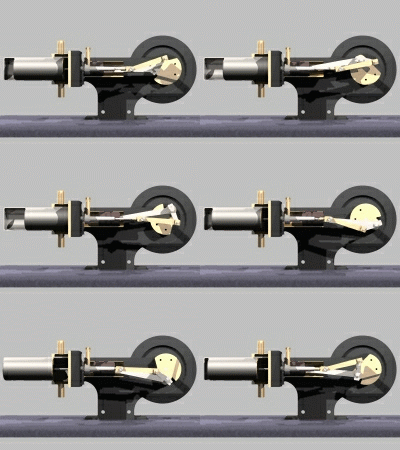
Stirling Engine (How it works)
The explanations on the site in question are excellent and very clear. Go take a look.
**
Advantages and disadvantages of the Stirling engine
The advantages
-
Quiet operation: there is no expansion to the atmosphere as in the case of an internal combustion engine; combustion is continuous outside the cylinder(s). Furthermore, its design is such that the engine is easy to balance and generates little vibration.
-
High efficiency: a function, it is true, of the temperatures of the hot and cold sources. As it is possible to operate it in cogeneration (mechanical and thermal power), the overall efficiency can be very high.
For example, one can couple two energies: wind and solar (when the sky is overcast, the wind can take over, and when the wind dies down, the Sun can provide).
- The multitude of possible "hot sources": combustion of various gases, wood, sawdust, waste, solar or geothermal energy...
Not to mention, it seems to me, the hot and cold sources represented by the surface of an ocean (or a lake) and the deep waters, even if efficiency drops. This energy is also inexhaustible. Furthermore, in coastal regions, by housing generators of this kind at twenty meters depth, one protects them from the strongest storms. No "environmental" pollution. Such generators would be ... invisible. The hot source: the ocean (or lake water) at the surface. The cold source: the deep water.
In our regions, lakes have a high temperature in summer, while at a moderate depth, it can drop to 4°C. Energy is there for the taking.
-
The ecological aptitude to best meet environmental requirements regarding air pollution. It is easier to achieve complete combustion of fuels in this type of engine.
-
Reliability and easy maintenance: the relative technological simplicity allows for engines of very high reliability requiring little maintenance.
-
Long lifespan due to its "rusticity."
-
Very diverse uses due to its autonomy and adaptability to the need and the nature of the hot source (from mW to MW).
The disadvantages
- Price: the brake on its development is today probably its cost, not yet competitive compared to other well-established means. A generalization of its use should overcome this problem inherent to any novelty.
(This is what the Americans seem to have achieved: the possibility of producing a converter in large series.)
- The lack of awareness of this type of engine by the general public. Only a few enthusiasts know of its existence.
Not anymore....
- The variety of models prevents standardization and consequently a drop in prices.
See the remark on the Yankee breakthrough.
-
Technological problems to solve:
-
Sealing problems are difficult to solve as soon as one wants to have high operating pressures. The choice of the "ideal" gas, namely hydrogen for its lightness and capacity to absorb calories, is hindered by its ability to diffuse through materials.
-
Heat exchanges with a gas are delicate and often require bulky devices (by succeeding in fitting a system producing 20 kW into a space with the volume of an oil drum, the Americans scored again).
This is where the American investment was played out. The lighter the molecules of a gas, the higher its thermal conductivity at a given temperature. This conductivity is proportional to the speed of thermal agitation of the molecules (energy is transferred at a speed close to this).
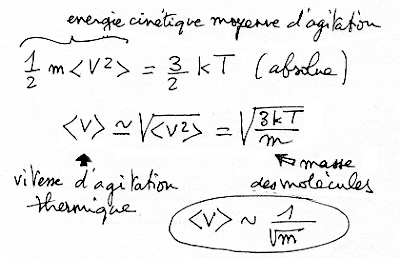
So, rapid energy transfer: light molecules, therefore hydrogen. But this hydrogen is not dangerous: a Stirling engine works entirely in a closed circuit. The problem is that the very small molecules cross the barriers of seals more easily. This is again where the Americans must have scored points.
Advantages and disadvantages of the Stirling engine
The advantages:
-
Quiet operation: there is no expansion to the atmosphere as in the case of an internal combustion engine; combustion is continuous outside the cylinder(s). Furthermore, its design is such that the engine is easy to balance and generates little vibration.
-
High efficiency: a function, it is true, of the temperatures of the hot and cold sources. As it is possible to operate it in cogeneration (mechanical and thermal power), the overall efficiency can be very high.
For example, one can couple two energies: wind and solar (when the sky is overcast, the wind can take over, and when the wind dies down, the Sun can provide).
- The multitude of possible "hot sources": combustion of various gases, wood, sawdust, waste, solar or geothermal energy...
Not to mention, it seems to me, the hot and cold sources represented by the surface of an ocean (or a lake) and the deep waters, even if efficiency drops. This energy is also inexhaustible. Furthermore, in coastal regions, by housing generators of this kind at twenty meters depth, one protects them from the strongest storms. No "environmental" pollution. Such generators would be ... invisible. The hot source: the ocean (or lake water) at the surface. The cold source: the deep water.
In our regions, lakes have a high temperature in summer, while at a moderate depth, it can drop to 4°C. Energy is there for the taking.
-
The ecological aptitude to best meet environmental requirements regarding air pollution. It is easier to achieve complete combustion of fuels in this type of engine.
-
Reliability and easy maintenance: the relative technological simplicity allows for engines of very high reliability requiring little maintenance.
-
Long lifespan due to its "rusticity."
-
Very diverse uses due to its autonomy and adaptability to the need and the nature of the hot source (from mW to MW).
The disadvantages:
- Price: the brake on its development is today probably its cost, not yet competitive compared to other well-established means. A generalization of its use should overcome this problem inherent to any novelty.
(This is what the Americans seem to have achieved: the possibility of producing a converter in large series.)
- The lack of awareness of this type of engine by the general public. Only a few enthusiasts know of its existence.
Not anymore....
- The variety of models prevents standardization and consequently a drop in prices.
See the remark on the Yankee breakthrough.
-
Technological problems to solve:
-
Sealing problems are difficult to solve as soon as one wants to have high operating pressures. The choice of the "ideal" gas, namely hydrogen for its lightness and capacity to absorb calories, is hindered by its ability to diffuse through materials.
-
Heat exchanges with a gas are delicate and often require bulky devices (by succeeding in fitting a system producing 20 kW into a space with the volume of an oil drum, the Americans scored again).
This is where the American investment was played out. The lighter the molecules of a gas, the higher its thermal conductivity at a given temperature. This conductivity is proportional to the speed of thermal agitation of the molecules (energy is transferred at a speed close to this).
So, rapid energy transfer: light molecules, therefore hydrogen. But this hydrogen is not dangerous: a Stirling engine works entirely in a closed circuit. The problem is that the very small molecules cross the barriers of seals more easily. This is again where the Americans must have scored points.
People say: what we need is a new revolution. We know the phrase "only the truth is revolutionary!" Perfect. Having realized this, all people go down into the street and start killing each other, each brandishing their truth. But the contemporary revolution offers another face. It is called giving, communication, help, sharing. It is as simple as that. If the people at Sandia wanted to place the plans for their Stirling engine converter in the public domain, instead of seeking to profit from it, they would be moving in this direction.
One can always dream. But only dreams truly make things progress. In other words:
Be realistic, demand the impossible ---
October 17, 2005: In France:
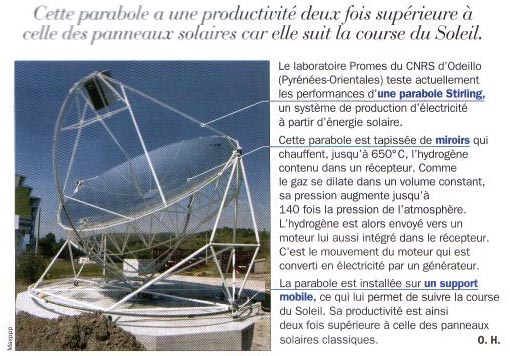
August 17, 2005: Mr. Stéphane Roussel informs me that I am not the only one to have considered using Fresnel mirrors to capture solar energy. The movement is underway:
http://www.klimaschutz.com/synth/sfc021001.htm
****The text in French: Solar converters with Fresnel mirrors
Table of Contents "Renewable Energies"
Return to Guide Return to Home Page
Number of views since August 13, 2005: