Introduction to the article “Questionable black holes”
French translation: Doubts about the existence of black holes.
To go directly to the scientific article
Authors:
Jean-Pierre Petit, Observatoire de Marseille
Pierre Midy, CRI d’Orsay.
This work represents the culmination of ten years of effort. For the past 30 years, astrophysicists have had only one word on their lips: “black holes.” The term fascinates the general public; numerous books have been written on the subject. Yet observational confirmation is lacking: black holes “shine by their absence.” We know, however, that the cosmos is vast; our own galaxy contains at least 100 to 200 billion stars.
The existence of certain objects has been revealed through observation—quasars, for example. Over four thousand are now known. That doesn’t mean we know exactly what these objects are, how they form, how they evolve, or how long they last. In fact, we know nothing about them. They’re simply cataloged, just as “nebulae” were in the time of astronomer Messier.
Apparently, some quasars reside at the center of structures shaped like galaxies. These galaxies thus have an “active nucleus”—which means both everything and nothing, since we know nothing about the nature of this activity, such as its energy source.
Contemporary astrophysics seems content with very little. To the question:
– What is a quasar?
The astrophysicist replies:
– It’s the nucleus of an active galaxy.
And to the question:
– What is an active galaxy?
He answers:
– It’s a galaxy that has a quasar at its center.
More recently, a few years ago, “gamma-ray bursts” were discovered, occurring at a rate of one per day. The journal Ciel et Espace once featured on its cover: “Gamma-ray bursts: a mystery finally solved.” The answer, in the article itself: a small bright spot had just been located where a gamma-ray burst had been detected. In other words: solving a mystery consists of knowing that the areas of the sky emitting these bursts also emit light...
Isn’t that a bit... meager?
Conversely, there are other objects whose existence was conjectured, often with considerable precision, even before they were observed. The classic example is the supernova, described as early as 1931 by American astrophysicist (of Swiss origin) Fritz Zwicky during a famous lecture at Caltech, USA. Zwicky explained that sufficiently massive stars—those whose mass exceeds, say, twenty solar masses—must undergo a cataclysmic end, with a rapid rise in activity over just a few days; the entire phenomenon lasts about twenty days. This was a truly remarkable prediction, though it wasn’t taken seriously at the time. But Zwicky, persistent, discovered the first supernovae; today, several hundred are known. The same goes for neutron stars, later identified as pulsars (rotating neutron stars), and white dwarfs. In these cases, too, the “bestiary” includes several hundred identified specimens.
The black hole was proposed as an answer to a problem: what happens to a neutron star exceeding a certain “critical mass”? These neutron stars, once identified, resemble gigantic atomic nuclei, devoid of protons. Why are these objects composed solely of neutrons?
The neutron star is considered what remains of the iron core of a massive star after it explodes. A massive star is one where many types of fusion reactions occur over its lifetime. Eventually, it produces iron, which can no longer undergo any exo-energetic fusion reactions. This heavy iron then falls to the star’s center, like ashes in a fireplace. When the star suddenly runs out of fusion fuel (as Zwicky understood), it collapses upon itself at 80,000 kilometers per second (give or take a few kilometers per second). Upon striking the iron core, this gas is strongly compressed. Not only does it bounce off, but numerous fusion reactions also occur in the process; these no longer need to be exo-energetic, since energy now comes from the star’s sudden contraction. All possible and imaginable nuclear species are thus created, including many radioactive atoms with very varied lifetimes. We know that in 1987, observation of the explosion of the star Sanduleak in the Magellanic Cloud provided definitive confirmation of such phenomena (just 150,000 light-years away).
This process completely crushes the iron core, disintegrating its atoms. The core becomes so compressed that electrons no longer have enough room to move among the nucleons. Trapped, they combine with protons to form neutrons and neutrinos.
Normally, when a gas is compressed, a phenomenon called pressure opposes this compression. This applies to liquids and solids as well (everything is compressible). This is what happens, for example, when a young star is born. The proto-star is a mass of gas that collapses under its own weight. But it heats up, and pressure limits its contraction. It’s a poor radiator, so it must lose energy via radiation (infrared) before it can contract enough to become a real star. Unless its mass is insufficient, in which case it becomes “a giant Jupiter” (this giant planet continues to radiate more energy than it receives from the Sun, but will never become a star).
When a supernova explosion compresses the iron core, it releases its energy by emitting a fantastic amount of... neutrinos. Here, the scenario changes completely: radiative cooling is instantaneous, since neutrinos escape effortlessly. Thus, there’s no counter-pressure. The iron lump crumples pathetically. What remains is a pile of neutrons, packed tightly together, like commuters on a Tokyo subway at rush hour.
Why a critical mass? Because neutrons can’t withstand pressure above a certain maximum value. It’s like light bulbs piled in a mine shaft: beyond a certain height, the glass breaks and a cloud of shattered glass collapses to the bottom.
When a neutron star’s mass exceeds a bit more than twice the Sun’s mass, the pressure at its core becomes too great; neutrons can no longer withstand it. Then it’s supposed to collapse upon itself, with no known physical mechanism able to prevent this “gravitational collapse.” A frightening prospect for any physicist.
Even before collapsing, a neutron star is “relativistic,” as opposed to a “Newtonian object.” This manifests in the trajectories of “test particles” nearby (any mass, an atom, for example). We know that spacetime curvature causes precession of Mercury’s elliptical orbit. But this precession is minuscule. In contrast, the diagram below, derived from computer calculations, shows the strong precession of a quasi-elliptical orbit around a neutron star.
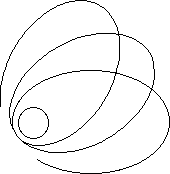
Therefore, it’s impossible to describe a neutron star using “Newtonian material.”
The computational program is quite simple; someday, when I have time, I’ll put it on the site so you can play with it, and also highlight the (here very pronounced) phenomenon of gravitational lensing:
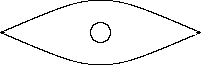
Thus, to describe the fate of a neutron star reaching criticality, one must use a “field equation,” Einstein’s equation.
S= cT
T is a “tensor” describing the local content of “matter-energy.” Before the neutron star collapses, this tensor is zero outside and non-zero inside. The geometric solution must therefore be deduced from two equations:
S= cT
for the interior
S= 0
for the exterior.
Solutions to such equations are called “metrics.” But the precise form these objects take doesn’t matter. Moreover, they’re “tensors”; before understanding what a tensor is, we’re lost. It took me a long time.
The Sun is associated with a local “geometry” that is a solution to these two equations: the first describes the Sun’s interior, the second the outer vacuum. Still, we can only describe a sort of “ideal Sun,” a sphere filled with matter of constant density. But that’s better than nothing. These solutions have mathematical expressions we won’t mention; they’d mean nothing to you. Each has its own “pathology.” Let rn be the radius of a star of constant density r. From this density r and the value c of the speed of light, we calculate a first characteristic radius, “R hat”:

The interior geometric solution is “non-pathological” if and only if the value of radius rn is less than this critical value.
Again, from these data, we can calculate a second characteristic radius:

which is what’s called the “Schwarzschild radius” Rs. The exterior solution, referring to the “vacuum” surrounding our star of constant density r and radius, is non-pathological if and only if the value of radius rn exceeds this characteristic length. Combining both, we must have:

The quantity on the right depends only on the star’s density (between 10^15 and 10^16 grams per cubic centimeter). At constant density, the left side grows as the cube of the star’s radius rn.
This applies to the Sun, considered as a star of constant density in first approximation. What do we mean by “pathologies”? Anything: quantities under radicals becoming negative, denominators turning into zero. Thus, a star of constant density can be described by this type of stationary solution only if:
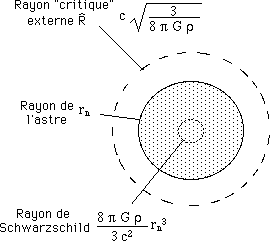
The Sun’s “Schwarzschild radius” is 3.7 km; it lies well within this limit (rn). You can amuse yourself by calculating, knowing the Sun’s radius is 695,000 km, the value of this second critical radius “R hat,” which is larger.
For the Sun, the Schwarzschild radius (3.7 km) would, on the scale of the diagram, be practically a point; the “R hat” radius would exceed the page. The diagram above refers rather to a “subcritical neutron star.”
How does the “rise to criticality” occur? Simply by adding layers of neutrons at constant density (we treat the neutron star, if not as a solid, at least as a practically incompressible fluid droplet).
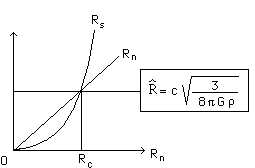
The curves above are obtained simply by using the indicated formula. The star’s radius increases, but the “Schwarzschild radius” catches up. Both meet when rn reaches the value “R hat.” Then, at the star’s surface, quantities under radicals become negative, denominators vanish, etc. This is the mathematical and geometric translation of criticality. It simply means it’s impossible to use either of the two connected geometric solutions derived from Einstein’s equation with non-zero (interior) or zero (exterior) right-hand side to describe the star. The maximum characteristic value of this radius is about twenty kilometers; from this you can deduce the density within a neutron star.
But there’s one little-known fact, even among “cosmic men,” despite it dating back to the 1940s: there’s another criticality, of a physical nature, which manifests just before the star’s radius reaches this value. It’s very close—only 5% lower. But when the star’s radius reaches it, or equivalently when its mass doubles that of the Sun, the pressure at the star’s center becomes infinite, according to a “TOV” model developed in the 1940s by Tolman, Oppenheimer, and Volkov (yes, the Oppenheimer of the bomb).
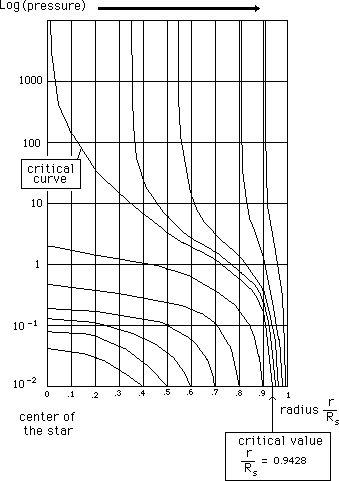
Pressure inside a neutron star as a function of distance from the center, for various values of the object’s mass.
For us, this is a crucial datum.
Perhaps scientists, like other people, only ask questions they think they can answer. How to answer the question:
– What happens in a medium where, suddenly, at one point, pressure becomes infinite?
No one has asked this, at least not in these terms. Apparently, it’s attracted no attention. Many cosmologists I’ve talked to were unaware of this aspect.
Back to “the black hole story.” One might think: The implosion of a destabilized neutron star is a non-stationary phenomenon. So, let’s construct a non-stationary solution to both equations above. But we can’t do that credibly. Thus, theorists turned their gaze to the “external solution” (the one describing, for example, the geometry outside the Sun, which becomes “pathological” at its Schwarzschild radius of 3.7 km).
– In other words, “remove the Sun” and explore the properties of this geometry. Like that...
– But this is a solution referring to a void universe?!
– Never mind, let’s see what it yields...
They began studying the radial trajectories of objects freely falling into what, under these conditions, would be “a black hole of one solar mass,” 3.7 km in diameter. They kept the variable t, supposed to refer to the time experienced by an “external observer,” a poor Earthling watching a Sun that’s just been whisked away. They found that the free-fall time of any test particle, measured in this time, becomes infinite. Yet, if we attach a clock to that particle, it reaches the geometric center of this object in finite time.
The theorists then proposed this vision:
– This stationary external solution finds a providential new use. Gravitational collapse indeed occurs in a very short time (on the order of a tenth of a millisecond for a destabilized neutron star). But since this phenomenon seems to last, for an “external observer,” an infinite time, we can use a stationary solution to describe a highly non-stationary phenomenon.
When the sparrows are out of reach, we eat sparrows...
Based on this idea, theorists then wondered what happens to matter when it crosses this Schwarzschild surface. There they found all the horrors mentioned earlier: the particle’s proper time becomes... pure imaginary. Its speed exceeds that of light; it becomes a tachyon, whose mass is... imaginary, etc., etc.
Some even suggested (and this appears in all books) that inside this sphere the variable r transforms into time and the variable t into... radial distance.
Jean Heidmann, cosmologist at Meudon, now retired, used to say:
– When talking about black holes, one must leave one’s common sense in the cloakroom...
Under these conditions, if we decide to abandon common sense, where’s the limit to unreason? How to decide on building a “physics of the unobservable”? This is the case with “dark matter,” about which all sorts of things are said and written, with dozens of papers published daily. No one seems to have considered the twin model, extensively developed on my site. Yet foreign researchers (China, Japan) seem quite interested.
Here’s a new fact: in 1988–89, I published three articles in Modern Physics Letters A (reproduced on the site) introducing the unprecedented idea of a cosmology where physical constants can vary, including the sacred speed of light c. This idea was “rediscovered” in 1993; since then, many papers have been published in highly selective journals such as Physical Review, Classical and Quantum Gravity. There’s now a fairly large group of “constant variers.” Some of them discovered my work via the Internet; for many, it was sheer astonishment, all the more so since this work came from France, a country never noted for any major innovation in cosmology or astrophysics (fields typically dominated by Germans, Russians, Americans, Britons). Contact was established, very cordially. The Chinese, not without humor, say they rushed to an atlas to find where Marseille was, “feeling as if they’d discovered an unknown region of the globe.”
Why this digression? Because, in our view, this dizzying rise in pressure at the core of a neutron star should alter physical constants and create a “hyperbolic bridge” between the universe and its twin. An idea still to be substantiated. Still, if help is to be found in this endeavor, it might come from the “constant variers,” who’ve already taken this step. For now, we’re the only “twinners,” but that may not last forever.
Thus, in our opinion, the twin context should completely change the scenario of a destabilized neutron star. But before proposing a competing model, we had to examine the classical black hole model. That’s what this lengthy paper does. Things aren’t treated “in order.” In one section, we carefully examined Kruskal’s work, pointing out flaws in his approach.
Everything has a motivation. In 1960, Kruskal noticed that the speed of light, in the original model (“Schwarzschild metric”), was zero on the relevant sphere, the “horizon sphere,” or Schwarzschild sphere. So he tried to cure the model of this “illness.”
But how does one work on these geometric solutions? Do we invent others? The answer is no. I believe we’ve clearly shown in the article the arbitrariness of coordinate choice. By nature, a geometric solution is “coordinate invariant,” independent of the chosen coordinates. Imagine a soap bubble: it’s a surface; in a sense, it’s a solution to a field equation reflecting the fact that the energy involved in tensions counteracting a constant internal pressure is uniform across its surface. To the question:
– What surface mechanically responds so as to withstand internal overpressure?
The answer is:
– It’s a sphere.
But this sphere, geometric object, exists independently of the coordinate system we use to locate its points. We know that, for example, using a system of meridians and parallels creates polar singularities, “apparently singular points” that aren’t really singular. These are singularities induced by coordinate choice. In the case of a sphere, they’re inevitable. Below is a sphere with its latitude-longitude coordinate system.
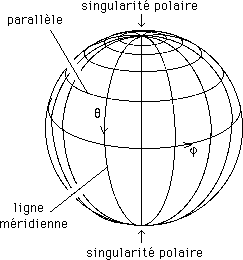
Note: one can map a sphere, endow it with a two-parameter coordinate system, using just one pole. See the diagrams below:
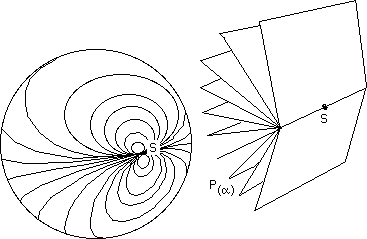
First mapping, first family of one-parameter curves obtained by cutting the sphere with planes passing through a tangent line at one of its points.
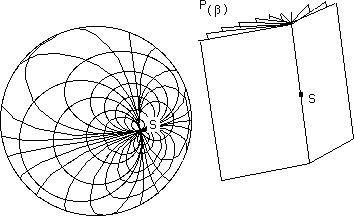
Combine with a second family of curves obtained by cutting the same sphere with other planes passing through another tangent line at the same point, e.g., orthogonal to the first.
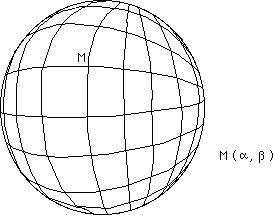
...Combine with a second family of curves obtained by cutting the same sphere with other planes passing through another tangent line at the same point, e.g., orthogonal to the first.
The sphere, thus mapped, seen from another angle, hiding its sole singularity.
[../../Copie%20de%20Extensions/presentation/PQ2.htm](https://www.jp-petit.org/Copie de Extensions/presentation/PQ2.htm)