The missing mass problem (p3)
4) Spherically symmetric solution
...In 1916 Eddington derived a spherically symmetric steady-state solution, combining the Vlasov and the Poisson equations. He assumed that the ellipsoid of the velocities was spherically symmetric and pointed towards the center of the system.
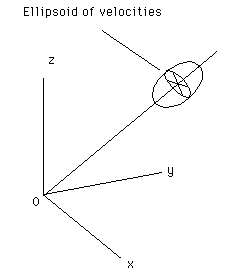
Figure 1 (ga3114): Ellipsoid of velocities corresponding to an Eddington-type solution.
Eddington derived the following relation between the mass density and the gravitational potential:
(20)
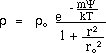
which represents a steady-state distribution of matter in a collision-free gas, in a gravitational potential Ψ, in which the gravitational force balances the pressure force. Let us take the same kind of a solution for the antipodal region:
(21)
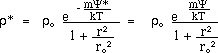
So that we have to solve the following equation:
(22)

Take
(23)
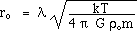
Introduce the following adimensional quantities:
(24)

We get
(24 bis)
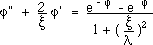
which can be solved by numerical computation. We can take the following initial conditions:
φ'₀ = 0
φ"₀ = 10
λ = 10
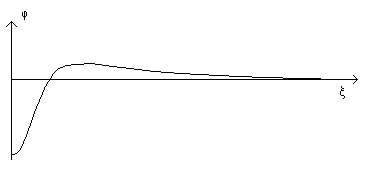
Figure 2 : Spherically symmetric Eddington-type solution. The gravitational potential
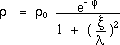
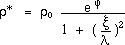
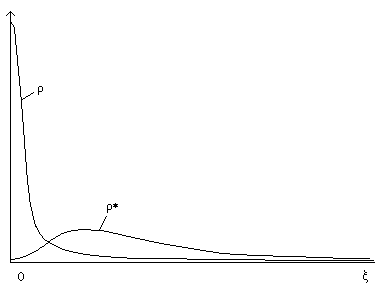
Figure 3 : Spherically symmetric Eddington-type solution. Mass densities. If a cluster exists in one fold, an associated diffuse halo exists in the conjugated region of the second fold.