missing mass problem (p5)* .
5) The interpretation of the solution
...From figure 2, we see that the potential Y tends to a constant at infinity. In the classical Eddington solution, the potential has a logarithmic growth. Figure 3 shows the association of a matter cluster, located in region s, surrounded by a smooth cavity located in region s*.
...In both regions, matter attracts matter. However, the negative sign from the field equation and the Poisson equation causes matter and "antipodal matter" to repel each other. This contributes to the confinement of the cluster. For a given thermal velocity, the amount of matter needed to balance the pressure force is smaller. The smooth halo acts like a corset.
...A field equation provides a macroscopic description of the universe. It does not take into account the corpuscular nature of matter. The model implies that particles and antipodal particles live in very distant, antipodal regions of space. In fact, their natures are identical. The physical meaning of the field equation is as follows: particles and antipodal particles interact by gravitational effect, but not by electromagnetic effect. We assume that antipodal particles, clusters, rings, are not observable with a telescope or a radio telescope. The observation of antipodal structures should require some kind of gravitational telescope.
...From equation (22), clusters can be located in the antipodal region. Then, associated large halos, surrounding wide rarefied regions, should also exist in the observable universe. In fact, they do, because this corresponds, in our view, to the observed large-scale structure of the universe: galaxies seem to be arranged around large rarefied bubbles. According to our model, large clouds of antipodal matter should exist in the corresponding antipodal regions.
...The universe was assumed to have a S3 × R1 topology. The reader probably has some difficulties in understanding this strange three-dimensional geometry. In fact, the sphere S3 is simply defined as the double cover of a projective space P3. In this framework, each point s of the sphere is associated with its antipode A(s). The situation is similar for a sphere S2 covering a projective space P2, which can be represented in our space R3 by the well-known Boy surface.
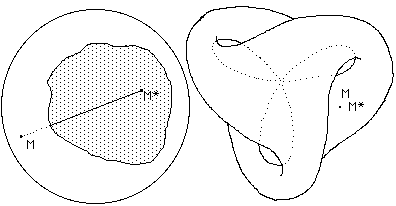
Figure 9 : A pair of antipodal points on a sphere S2 and the Boy surface, image of the projective space P2
On figure 10, we have represented the equator of a sphere and its location on the Boy surface.
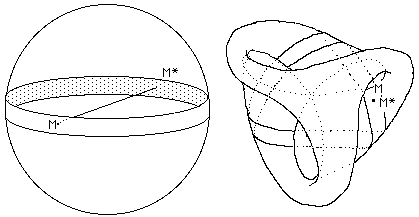
Figure 10 : The vicinity of the equator of a 2-sphere and its position on a Boy surface
...Figure 11 shows how the equator of a S2 sphere can be glued onto itself along a three half-turns Möbius strip. Locally, the surface can be assimilated to a fibered manifold whose fiber has two values +1 and -1.
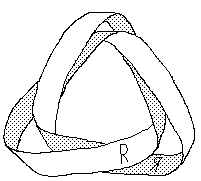
Figure 11 : Enantiomorphic image corresponding to the cover of a Möbius strip.
...In a 3-sphere S3, if one follows a geodesic, the antipodal point is at the halfway. If the 3-sphere is immersed in a four-dimensional space, it is possible to make any point coincide with its antipode. These pairs of points are associated through the antipodal involutive mapping A, but are not identified.
...As shown in figure 12, we can continuously go from a "gruyère" structure to a cluster structure. This particular feature had already been illustrated previously by 2D numerical simulations. When a region of space is placed "in front" of the antipodal region, as suggested in figure 12, the clusters nest in the holes.
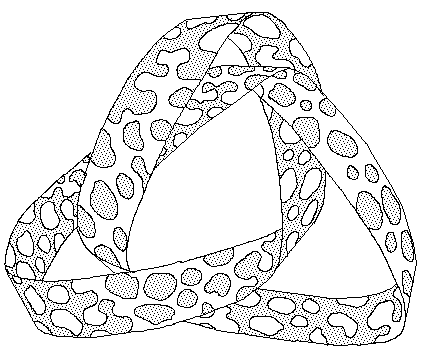
Figure 12 : Two-dimensional image of the global large-scale structure of the universe ****
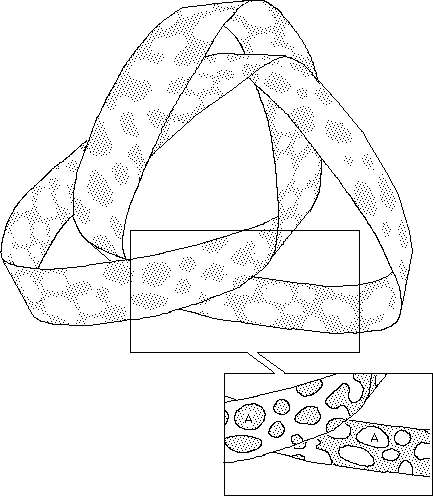
** ** Figure 13 : The interaction between two antipodal regions ** **
...This effect could act at the level of the galactic structure, as suggested in figure 14, each galaxy nesting in a "hole" of the conjugated antipodal region.