cosmology universe twins missing mass
The missing mass problem (p6)
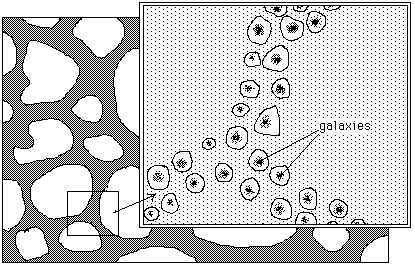
Figure 14: Smaller size structure
7) Some comments about the axioms.
...Classical General Relativity proposes a macroscopic description of the universe, shaped by the gravitational field. But, fundamentally, electromagnetic phenomena are not taken into account. To link this classical model to observations, it is necessary to introduce the following additional axioms:
-
The universe is filled with particles: neutral particles with a mass equal to m, and photons. Both contribute to the field.
-
These particles move along the geodesics of space-time.
-
A particle can emit an electromagnetic signal.
-
Another particle can receive this electromagnetic signal.
-
This electromagnetic signal, carried by photons, follows the null geodesics of space-time.
-
A massive particle can emit a gravitational signal, which is supposed to follow a null geodesic.
-
A massive particle can receive this gravitational signal.
...Thus, for an observer composed of matter, the universe becomes optically perceptible according to these axioms. The photons are the intermediaries that transmit an optical message from one massive particle to another.
...In the current model, the universe is considered as a cover of a S3 sphere, locally we have a structure similar to a fibered manifold, whose fiber should be limited to two values: +1 and -1. We then introduce the following new axioms.
-
The universe is filled with particles: neutral particles whose mass is equal to m, and photons. Both contribute to the field.
-
The massive particles and the photons move along the geodesics of space-time and cannot pass from one region to the conjugated antipodal region of S3.
-
A massive particle can emit electromagnetic and gravitational signals, which can be received by another massive particle.
-
The gravitational signal travels along the geodesics of space-time, but also along the geodesics of the "adjacent folds of the universe", "through the bundle structure", so that the gravitational signal has a certain sort of ubiquity, because it acts both in a region of the manifold and in the antipodal region (or, in other words, in the "adjacent region", if we choose the image of the fibered manifold).
-
The structure of the new field equation brings the following features.
...If a gravitational signal is emitted and received by two particles which "belong to the same fold", the phenomenon corresponds to the classical description.
...But a gravitational signal emitted by a massive particle can be received by another particle located in the adjacent region (the antipodal region), in other words "through the bundle structure", the negative sign in the second member of the field equation changing the nature of the signal, as if it had been emitted by a "negative mass".
- The electromagnetic signal follows the ordinary null geodesics of the manifold, but does not have this property of ubiquity. It cannot cross from one fold to the "adjacent fold through the bundle structure". To travel from a region of the manifold to the antipodal region, light must make a complete half-turn of the S3 sphere.
...We must acknowledge that this proposed geometric description remains primitive and somewhat unclear. A correct description should involve a more refined model, incorporating gravitational and electromagnetic phenomena, i.e., a unified theory, which does not exist at present.
...The local description of the fibered manifold is similar to a 5-dimensional Kaluza model, in which the fifth dimension would be limited to two values: +1 and -1, as suggested earlier by Alain Connes.
8) Estimation of the "missing mass effect"
Apply a perturbation method to the Euler equations:
(25) (25')
with the first order solution:
(26) DY = DYo = 0
The Poisson equation gives:
(27)

(27')
dY = - dY* (28)
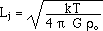
Lj is the classical Jeans length
(29)
(30)
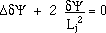
This is the well-known Helmholtz equation.
In the classical steady-state approach we had
(31)

...The interaction with the antipodal region shortens the Jeans length by a factor of 1.414, resulting in a confinement effect. If we have a positive concentration of matter dr in our space-time fold, we will find a negative dr* in the associated antipodal region, and vice versa. The confinement of the mass due to the action of the antipodal region should reduce the necessary mass to balance pressure or centrifugal force by a factor: