twin universe cosmology Twin Universes cosmology (p 2) .
2) Large scale structure and "twin universe model".
...We assumed in the previous paper [1] that the Universe had a S3 x R1 geometry. Any region of the universe interacts antigravitationally with its associated antipodal region, through equation (1). There is a single kind of positive matter m, filling the S3 sphere. Then the total mass of the Universe is non-zero. In the reference [1] several didactic 2D images (figures 10, 11 and 12) were given, in order to explain the mechanisms of the interaction of the two adjacent folds.
...Using a boosted HP work-station and a set of 2 x 5000 interacting points, F. Lansheat confirmed the work of Pierre Midy (reference [1], figure 8). Then he focused on a smaller region, indicated on the figure 3, in which the density of the matter in the "adjacent fold" was much higher than in the other fold. Fig 3. Dotted square: focussing on some portion of the very large scale structure in which the density of matter in the first fold (supposed to be ours, grey color) is supposed to be smaller than the density of matter in the adjacent fold (white color).
As expected the gravitational instability still occurs and provides new conjugated structures. See figure 4 and 5.
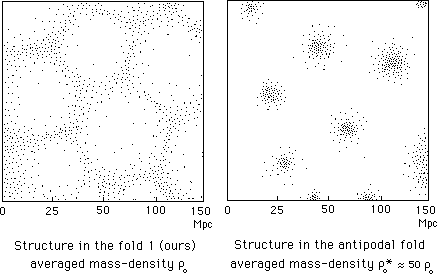
Figure 4: Results of simulations performed by F. Lansheat, showing the large structure of the Universe, due to the interaction of the two adjacent folds. Mean value of r = 50 times the mean value of r (left). Left: cellular structure. Right: cluster structure.*
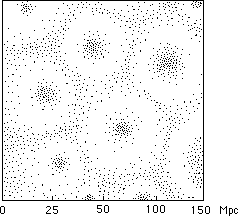
Figure 5: The same, superposed
...The matter of the twin fold forms big stable clumps, which repel the matter of our fold of the universe, this last taking place in the remnant space. By opposition to the pancake model numerical simulations, this pattern is fairly non-linear. After its formation, corresponding to the Jeans time of the high density system (2 × 10⁹ years), there is no significant evolution of the general pattern over a time comparable to the age of the Universe so that this model could be a good candidate to explain the observed spongy aspect of our fold of the Universe, at large scale.
3) 2D and 3D simulations.
...From the results of the 2D simulation, F. Lansheat performed a 2 point correlation and compared to the 2D correlation obtained from a random distribution of points (Poisson distribution). The result is shown on the figure 6. The left hand of the curve is not relevant, for the distance between the points becomes comparable to the mean distance of the random distribution. The growth on the right hand is just an artefact due to the border of the field (periodic boundary). This result cannot be compared directly to the empirical law derived from observational data (slope -1.8), see the surveys of Bahcall (1988) [31], Bahcall and Soneira (1983) [32], Bahcall and West (1992) [33], Luo and Schramm (1992) [34]. Three-dimensional simulations have to be performed, with a larger number of points. If possible, the fitting with the observational data would provide the ratio of the mass densities of the two universes.
...How to outline a scenario for the formation of large-scale cosmological structure in this model? As long as the coupling between mass and light remains strong (t < 10⁵ years), the Universe remains homogeneous and all the processes linked to the gravitational instability (formation of clumps, galaxies, stars and spongy structure) are frozen. When the Universe becomes transparent we can assume that all these processes occur, with their proper characteristic times of formation and evolution. All that we can say is that the suggested very large structure forms in 2 × 10⁹ years.
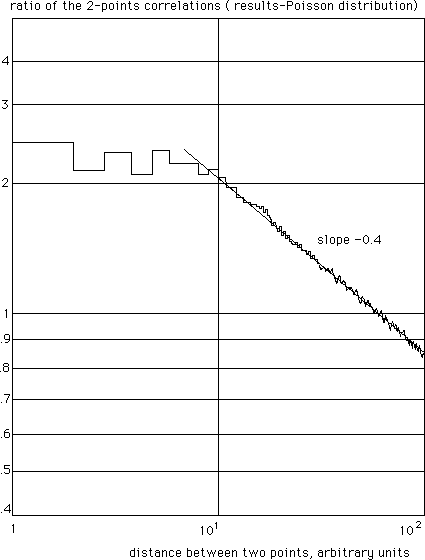
**** Figure 6: The slope of the curve of the 2-points correlations ratio (numerical simulation versus Poisson random distribution)
** **