twin universe cosmology Twin Universes cosmology (p 4) .
...Let us schematize the situation. Consider an homogeneous distribution of antipodal matter. In this distribution we find, in some places, holes in which the galaxies nest.
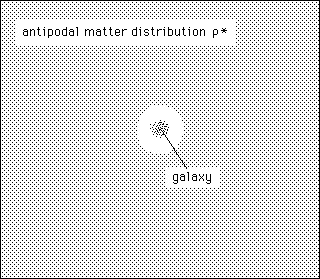
Figure 11: A galaxy nesting in an homogeneous cloud of antipodal matter.
A hole in a distribution of negative mass produces a positive gravitational lensing effect.
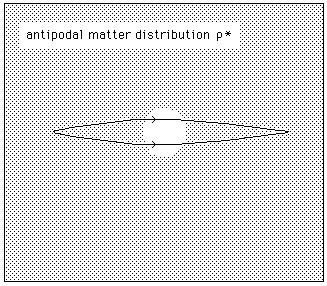
Figure 12: Induced positive gravitational lensing effect.
Qualitatively this is equivalent to the effect due to an homogeneous sphere of positive mass. See figure 13
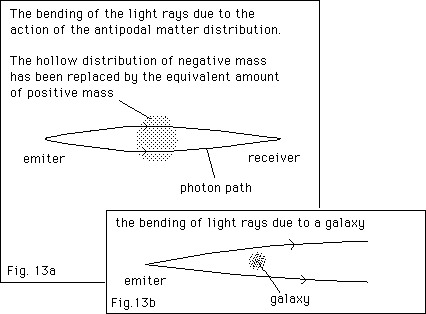
Figure 13. - 13a : Positive gravitational lensing effect due to the distribution of antipodal matter (acting like a negative mass). We have replaced the hollow by an equivalent amount of positive mass. Compared with positive lensing due to a galaxy (Fig. 13b).
...Classically one uses gravitational lensing to evaluate the so-called invisible mass contained in a galaxy. People usually say: "dark matter exists in our galaxy: we measure it, through the missing mass effect". In this twin cosmological model a strong lensing effect should not be a proof of the existence of invisible mass in a galaxy, but could be due to the action of the invisible surrounding antipodal matter, which could be evaluated from the measured effects. See figure 14.
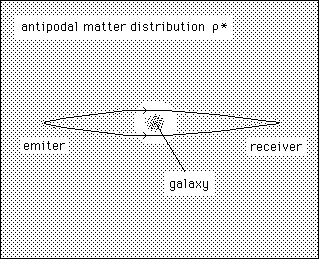
Figure 14 : Combination of the two positive gravitational lensing effects due to the galaxy and to the surrounding antipodal matter.
...In our galaxy the mass necessary to prevent the explosion due to the centrifugal force is about 10 times higher than the observed mass. If the confinement effect is due to the action of surrounding invisible antipodal matter, it means that the effect of this invisible matter is important. This could be general in the region of the universe we live in. Then all the neighboring galaxies could be surrounded by dense halos of antipodal matter, and the observed gravitational lensing should be mostly due to the antipodal material rather than to the galaxies themselves.
...The model based on equation (1) gives a new insight on the missing mass problem [1] and on the very large structure of the Universe. This work was based on the low field and weak velocities hypothesis and referred to a quasi-steady Universe, at cosmological scale, with respect to space and time. In order to complete this cosmological model we have now to study the evolution of the Universe as a whole.