twin universe cosmology Twin Universes cosmology (p 5)
5) About the constancy of G and c.
...Consider the two quantities G (gravitation) and c (velocity of the light). They are involved in the constant of Einstein c. This last is classically determined as the following :
The metric is expressed as :
(12)
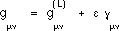
where gmn(L) is the Lorentz metric tensor and e gmn represents a very small time-independant perturbation (nearly Lorentzian metric tensor). Furthermore, in order to make a close connexion with classical theory, one supposes that the velocity of a particle along a geodesic is much less than c, i.e :
(13)

One next applies the same approximation to the differential equation of a geodesic :
(14)
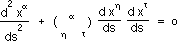
And then we get
(15)
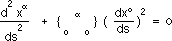
Beyond the steady state conditions, one uses to write :
(16) dx° = c dt
which introduces both the light velocity c and the time t. In addition :
(17)

The geodesic equation becomes :
(18)
If we identify to the Newtonian model, we can relate the gravitational pertubation potential to the metric through :
(19)
If we consider a medium with low density ro and low velocity, the matter energy tensor reduces to :
(20)
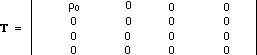
whose trace is ro . Then the second member of the field equation becomes (21)
Still in steady hypothesis condition, we get :
(22)
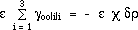
Identifying with Poisson equation, we determine the unknown constant c of the field equation :
(23)
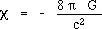
If c is not considered as an absolute constant, the zero-divergence of the field equation (1) is no longer ensured, according to the hypothesis d = 0 , which provides conservations equations of physics. But let us point out that the constancy of c does not require separatly the constancy of G and c, for we determined (23) from a time-independent metric (12). Then we can shift towards the less restrictive condition :
(24)

...This idea which was suggested by the author in 1988-89 in the papers [12,13,14]. But, as far as we know, the idea of a secular variation of the light velocity, was introduced earlier by V.S.Troistkii [11].
6) The Roberston-Walker metric.
...Assuming that the Universe is isotropic and can be described by a Riemanian metric we get the classical Robertson metric :
(25)

If the Universe is assumed to be homogeneous, then T = A(T) and the spatially homogeneous cosmological solution comes from :
(26) S = c ( **T **- A(T)) = 0
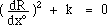
This metric must be introduced in the equation (1), with a zero second member. Then we get the following set of two equations :
(27)
(28)

From (27) and (28) we get
(29) k = - 1 (negative curvature) and R = x°
x° is a "chronological marker". Notice that one have a single solution (k = -1). If we identify, classically, x° to ct, c being considered as an absolute constant, we get the well-known trivial solution R = ct. Doing that, we define somewhat arbitrarly the cosmic time t. But it can be defined differently, in a non-standard way, as will be shown in the following.