twin universe cosmology Twin Universes cosmology (p 6)
7) A model with "variable constants".
...The hypothesis of the constancy of the so-called constants of physics was first challenged by Milne [15]. Then other authors: P.A. Dirac [16 and 17], F. Hoyle and J.V. Narlikar [18], V. Canuto and J. Lodenquai [19], T.C. Van Flandern [20], V. Canuto and S.H. Hsieh [20], A. Julg [21], developed ideas mainly based on the variation of G. Time-dependent G has also been considered by Brans and Dicke [22]; time-dependent e by Ratra [23]. Guth [24], Sugiyama and Sato [25] and Yoshii and Sato [26] considered a time-variable cosmological constant. In general, these approaches focus on the variation of a certain number of "constants", not of all the constants, in a combined fashion, as developed in the present paper. H. Reeves [27] studied the impact of the separate variation of the constants, one after the other. V.S. Troistkii [28] first suggested in 1987 the possible variation of c, and, in general, of all the "constants", but, after choosing a leading parameter, he just tried to adjust the different exponents, associated to a priori polynomial empirical laws, to fit with observational features.
...In the present paper we are going to build a cosmology where all the "constants" vary conjointly. This will be made consistent with the field equation (1). We are going to search laws that let the equations of physics be invariant, so that these variations cannot be detected in local laboratory experiments. These equations are the following:
The Schrödinger equation:
(30)

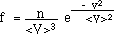
The Boltzmann equation:
(31)

where f is the distribution function of the velocity v, r = (x,y,z), t the time, (g, a, w) the classical impact parameters of a binary collision.
The (new) Poisson equation for gravitation (see reference [1]) is:
(32) D f = 4 p G ( r - r*)
r is the mass density in our fold of the Universe and r* the mass density in the twin fold.
The (new) field equation
(33) S = c ( T - T*)
where:
(34)

is the Einstein constant, G the "constant" of gravity and c the velocity of light.
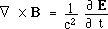
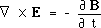
The Maxwell equations are:
(35)
(36)
(37) Ñ . B = 0
(38)
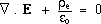
E and B are respectively the electric and magnetic fields. We consider the Maxwell equations for a neutral medium, for we assume that the Universe is electrically neutral. These equations are not all independent. For example, the Poisson equation for gravitation (32) comes from the field equation (33), see [1].
...Introducing a characteristic length R and a characteristic time T we can write these characteristic equations into an adimensional form:
The Schrödinger equation (30), with:
(39)

(40)

becomes:
(41)

The Boltzmann equation (31), with:
(42) v = c **z ** r = R **x **g = c g a = R a
(43)
(44)

(45
becomes:
(46)
The Poisson equation for the gravitational potential (32), with:
(47)

(48)

becomes:
(49)

The Maxwell equations (35), (36), (37), (38), with:
(50) (ga3256)
where e is the electric charge (we assume that the number of electric charges is conserved) become:
(51)

(52)
(53) d . b = 0
(54)
In these equations we find a certain number of physical constants:
(55) h , m , c , G