twin universe cosmology Twin Universes cosmology (p 7)
The invariance of the Schrödinger equation is ensured if:
(56)

The Boltzmann equation is invariant if :
(57)
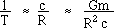
The Poisson equation for gravitation poses no particular problem and simply becomes (58)
From the Maxwell equations, we obtain :
(59)

(60)

which is consistent with the definition of an electric field due to an electric charge.
From the Einstein equation, as mentioned earlier, we obtain :
(61) G » c²
Otherwise, the equation is no longer divergenceless.
If the quantities :
(62) h , m , c , G, R , T
obey these relations, it will not be possible to evidence their variations in any laboratory experiment.
And then?
From (57), we obtain immediately :
(63)

which is nothing but the characteristic Schwarzschild length, so that :
(64) Rs » R
Let us now examine the Jeans length :
(65)
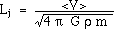
where :
(66)

(66b)
(66t)
(67)

Combining the equations (56) and (57), we obtain :
67b)
(68)

The Compton length varies like R :
(69)

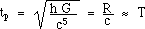
The Planck length is :
(70)

(70b)
The Planck time is :
(71)
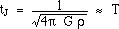
The Jeans time is :
(72)
Combining (61) and (63), we obtain :
(73)

The variation of the constants does not conserve the mass.
If we conserve the number of species, the mass density r is found to obey :
(74)

...same law for the contribution rr of the radiation to the density r. The conservation of the radiative energy gives :
(75) pr R³ = constant
Then :
(76)
