Consolidated document. 28 original pages have been gathered here; the links below open each section.
Collection: 1 J.P.Petit : 1998. — this document is part of it.
Contents
- First axiom of groups.
- Third axiom of groups
- Group of translations:
- Photographs obtained using a bubble chamber (Schem..
- AAg(m) = g-1
- Construction of the coadjoint action of the Poincaré group on its moment space J
- g (g = e)
- passage f
- Particles with spin.
- F4110
- The photon.
- Particles with non-zero mass spin.
- The four components of the Poincaré group.
- Central extension of the Poincaré group.
- Return to the question of the moment.
- F4116
- Application to what is above:
- Dispelling a misconception. Providing clarifications.
- To broaden the problem a little I could just as well consider that these trajectories are ... anyhow:
- Different movements.
- And antimatter?
- The first Petit group.
- F4123
- Let us now take the group:
- According to this model, corresponding to the 1st - Petit group, in summary:
- The 'second Petit group' or 'twin group'.
- In summary:
- The contents of the two universes are summarized in the tables below.
First axiom of groups.
Third axiom of groups
Group of translations:
Photographs obtained using a bubble chamber (Schem..
AAg(m) = g-1
Construction of the coadjoint action of the Poincaré group on its moment space J
g (g = e)
passage f
Particles with spin.
Particles with spin.
The Poincaré group describes the relativistic motion of a point object. Similarly, the Bargmann group, whose expression will be given later, describes the non-relativistic motion of a point object, which is then called a "point-mass".
It can therefore be seen that this technique, the calculation of the coadjoint action of the group on its moment space, has made it possible to bring out hidden elements, attributes of the object: the components of the moment.
What is remarkable is that this approach, due to Souriau, brings out the physicist's key objects as purely geometric objects. He thus accomplished there an unprecedented work of geometrization of physics.
Apart from energy and momentum, of the other components, the "spinning" and the "passage" thoroughly disconcert the physicist. Quès aco?
The expression of the components of the moment obviously depends on the chosen coordinate system.
The simplest is doubtless to make a brief return to the non-relativistic, in other words to the expression of the coadjoint action, as it would have emerged from the analysis of the Bargmann group.
(111)
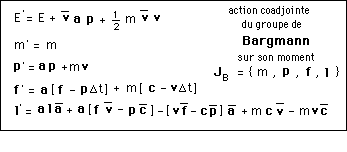
Mysterious formula. What is it used for? How does it work?
In the box above the physicist will have recognized a few familiar objects:
(112)
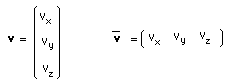
are but two expressions of the velocity vector { vx , vy , vz } the first in the form of a column matrix and the second in the form of a row matrix. The product of the two matrices is a scalar:
(113)

something that is beginning to look like a kinetic energy.
mv is a momentum.
The traditional physicist, when it comes to the dynamics of a material point, knows only three things:
- The mass m - The momentum mv - The kinetic energy 1/2 mv2
Yes, but velocity relative to what?
A group is also a way of looking at things. One can then either consider that one transports, using the group, objects (as was seen with the Euclid group), relative to an observer assumed fixed, or, the object being fixed, that one observes it differently.
If one retains this displacement, this transport of objects, when it comes to dynamical groups, those of physics (as opposed to the Euclid group where time does not appear) one must also say that one animates the objects, by conferring on them velocity v and energy E.
If one adopts the opposite point of view: to consider that the object is fixed and to envisage moving oneself, what meaning should be given to the groups?
The Euclid group would then mean:
"Seen from elsewhere and from another angle".
"The elsewhere" is the translation vector:
(114)

The "seen from another angle" is the rotation matrix a, a rotation in space (which could be made explicit with the Euler angles, which we will not do).
When it comes to dynamical groups, this way of looking, this point of view on "things" must be enriched. Remaining in the context of the Bargmann group, the fact of introducing this velocity v means that in addition, the observer, who observes this point-mass from elsewhere (translation vector c), from another angle (rotation matrix a), is also animated, relative to this point-mass assumed immobile, by a velocity v.
And, to be complete, to complicate matters further, he does not evolve in the same time as the particle, the observed point-mass. He is offset relative to it by a lapse of time Dt. In other words; he observes it from elsewhere, but it is a space-time elsewhere, corresponding to the space-time translation vector:
(115)

Having taken such a "step back" relative to this point-mass, what do I observe? First, that: m' = m
This does not affect its mass. I can make my life simpler by canceling the rotation. It is already complicated enough to observe a point mass, moreover, seen from another time, offset, perched on a skateboard moving at a speedv. Is it in addition absolutely essential to twist one's neck?
No. Let us seta=1.
but this detail is generally omitted in the calculations. The coadjoint action, thus particularized, becomes: (117)
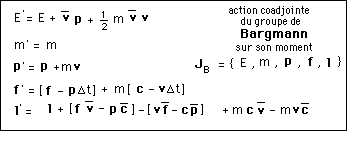
To consider must be taken here in its etymological sense. What do I do when I consider a situation, the sky, a battlefield, the film taken by a spy plane?
A bailiff will write: - Considering the state of the premises.....
Static vision, corresponding to the Euclidean group. The bailiff observes the objects at a distancec, at the same moment (Dt = 0), in principle motionless (v= 0). Where appropriate from a particular angle, from "a certain angle".
A general, strolling in a reconnaissance plane, is a sort of bailiff who moves (v# 0).
But a Chief of Staff who views the film taken by a spy plane, a "drone", is faced with a situation offset in time. He is obliged to say to himself: - Let us consider the target, seen from such and such a point, in a banked turn, at such and such a speed, and moreover as it presented itself two hours earlier...
The target has no particular velocity of its own. One could not consider it as fixed, even if it is "a fixed installation". Even the Earth moves, so does the Sun, the galaxy, etc.
F4110
All I can say is: - that by moving away from the "target" by a distancec. - by observing it while moving myself at a speedv. - by being, relative to this target, offset by a lapse of time Dt
Relative to me: --- I have not varied its mass m. --- I have endowed it with an impulse mv( quantity of motion). ---- I have endowed it with a passage m [c-vDt ] ---- and with a swirling: 
Let us spell this out:
(118a)
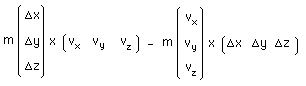
(118b)
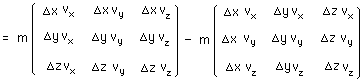
(118c)
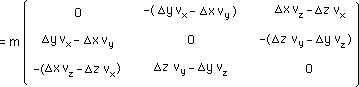
or:
(118d)
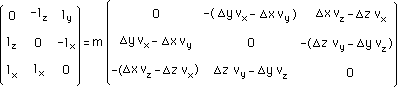
One can consider the three independent components of the swirling matrixlas those of a vector. This is then written:
(119)
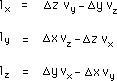
Although the cross product has not been defined in our space, that is to say it has not been given a right-left orientation, one can consider this as a cross product:
(120)
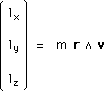
the upside-down v denoting the cross product. We see that the last line of the formulas giving the coadjoint action on the moment corresponds to: (121)
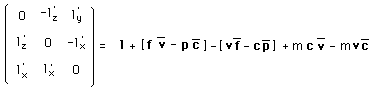
lbeing a matrix and not a vector ( but, in our notations, bold letters denote both indiscriminately, the thin ones referring to scalars).
This cross-product vector begins to resemble, for the physicist, something known: angular momentum .
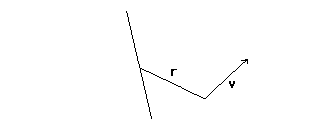
One takes a particle, moves away from it bycand observes it while circulating at the speedv. Everything happens as if it were the reverse: that the particle be moved away from an observer assumed fixed and move at a speedv.
(122)
There remains the "passage"f= m [c-vDt ]
It vanishes by simply settingc=vD t , that is to say by linking the speedvand the spatio-temporal translation:
(123)

Let us return to the expression of the moment arising from the Poincaré group, expressed in a coordinate system where the passage is zero:
(124)
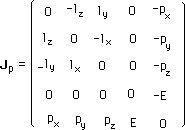
A particle is a particular choice made within the moment. That being so, changes of coordinates make it possible to make the passagefdisappear and to reduce the components of the swirlingland of the impulsePto a single component (motion along z):
(125)
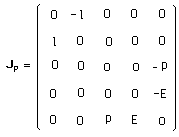
The object described by the Poincaré group therefore possesses a priori:
- An energy E - An impulse P - A proper swirling l
The swirling is a mass, multiplied by a length, the whole multiplied by a speed. It therefore has the dimension M L2 T-1 of Planck's constant h.
The method of geometric quantification , developed by Souriau (see Structure des Système Dynamiques, Dunod 1973) makes it possible to show that this swirling must be proportional to: (125b)

by half-integer values. That is to say either unity (photon), or 1/2 for the other particles such as the electron, the proton, the neutron, the neutrinos, and their antiparticles.
The photon.
The photon.
One then notices that two types of photons are obtained:
(126)
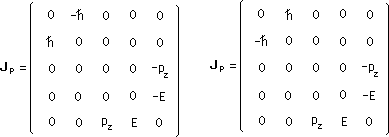
A "right" photon (right polarization) and a "left" photon (left polarization), which differ by their helicity. Two photons that travel in the same direction (OZ), at the speed c, and have the same color (their energy E).
For a photon, the energy E and the impulse p are moreover not independent.
(127)
E = h n

which gives us:
(128)
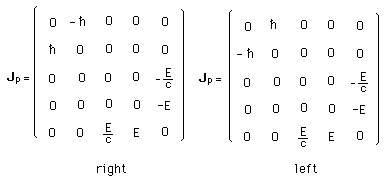
Apart from these characteristics (energy, direction of propagation, helicity) the photon has no other. It possesses no "charge", if you will, "all its charges are all zero", which makes it identical to its antiparticle (plus zero being identical to minus zero).
The neutrinos.
Considered as particles of zero mass (which they are, until proven otherwise) they have moment-matrices identical to those of photons, with the difference that the spin is half: (128b)
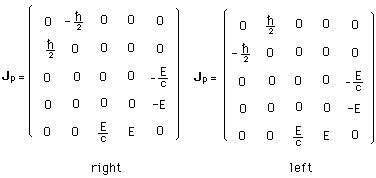
(129)
Neutrinos, traveling at speed c, possess a momentum-energy, a spin, also quantized, although it is different from that of the photon. The neutrino also possesses a helicity. There are right-polarized neutrinos and left-polarized neutrinos.
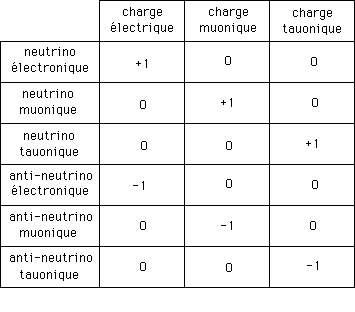
But it is known that there also exist three different types of neutrinos, which the Poincaré group does not reveal and cannot reveal (we will have to modify it in what follows in order to reveal, geometrically, the charges of the different particles).
That being so, neutrinos are of three types:
- electronic - muonic - tauonic
that is to say that three types of charges can be conferred on them:
e = electric = +/-1 ( +/-; the "unit charge"). cm = muonic charge = +/-1 cn = tauonic charge = +/- 1
This inversion of the sign of the charges is also called a charge conjugation or a C-symmetry.
The three types of neutrinos must therefore be associated with the corresponding anti-neutrinos:
(130)
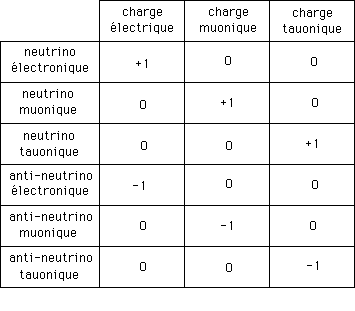
But this distinction, both in terms of quantum numbers, charges, and the matter-antimatter duality, is not inscribed a priori in the Poincaré group either.
Particles with non-zero mass spin.
The four components of the Poincaré group.
Central extension of the Poincaré group.
Return to the question of momentum.
F4116
Application to what is above:
Dispelling a misconception. Providing clarifications.
To broaden the problem a little I could just as well consider that these trajectories are ... no matter how:
Different movements.
And antimatter?
Petit's first group.
F4123
Let us now take the group:
According to this model, corresponding to Petit's 1st group, in summary:
The 'second Petit group' or 'twin group'.
In summary:
The contents of the two universes are summarized in the tables below.
Original pages: f4101.htm, f4102.htm, f4103.htm, f4104.htm, f4105.htm, f4106.htm, f4107.htm, f4108.htm, f4109.htm, f4110.htm, f4111.htm, f4112.htm, f4113.htm, f4114.htm, f4115.htm, f4116.htm, f4117.htm, f4118.htm, f4119.htm, f4120.htm, f4121.htm, f4122.htm, f4123.htm, f4124.htm, f4125.htm, f4126.htm, f4127.htm, f4128.htm