groups and physics coadjoint action momentum
| 5 |
|---|
A square matrix of rank (n,n) acts on a column vector (n,0). We have seen that the 2D Euclidean group, referring to a space (x,y), does not involve actions on column vectors:
(51)

but rather on column vectors:
(52)
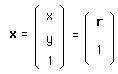
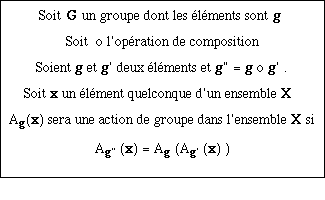
This represents an example of a group action on a space X with x ∈ X. There is an infinite number of possible actions, even just the group acting on itself. Actions are defined by axioms.
(53)
Considering the column vector:
(54)

where x represents, for example, the vectors:
(55)
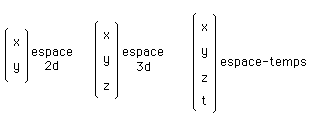
(56)
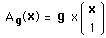
satisfies the axioms of group action. We can then perform a left multiplication of the square matrix representing a group element with a row matrix y, asking whether this also constitutes an action.
(57) Ag(y) = y x g
The answer is no. This is not a group action: it does not satisfy the axioms given above. This is then what I like to call an "anti-action," obeying the following "anti-axioms":
(58)
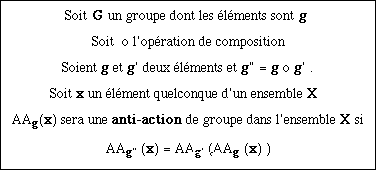
The mathematician will say there is no need to invoke these "anti-actions," and that only one set of axioms is required. Certainly. Similarly, what is considered an anti-action:
(59) AAg(m) = g⁻¹ x m x g
with m being a given vector, an "anti-action of the group element g on the matrix m", where g⁻¹ denotes the inverse matrix, can be treated as an action of the element g⁻¹.
Likewise, an anti-action is simply the dual of an action. Let me say that this appeared convenient to me for didactic reasons.
From a group of square matrices depending on n parameters π, one can construct matrices by differentiating all these parameters according to: dπᵢ. The resulting matrices, filled with elements dπᵢ, do not form a group, but rather what is called the "tangent vector to the group": dg (its "Lie algebra," which incidentally is not truly an algebra, but let's pass over that).
Thus, the group can act on the tangent vector dg, near the identity element e of the group, through the "anti-action":
(60) AAg(m) = g⁻¹ x dg(g=e) x g
We therefore obtain the scheme:
(61)
But an anti-action is the dual of an action. And whenever there is duality, a scalar product S is conserved.
Souriau therefore sought to construct a second group action, the group acting on its space of moments. But this action, called the coadjoint action or essential action, could not emerge directly. He had to pass through this intermediary that I call the "anti-action of the group on its tangent vector."
Thus, the desired action emerges as the dual of the anti-action of the group on its tangent vector. And the dual of an anti-action is an action, which can be written as:
(62) Ag(J)
where J will be the "moment": a collection of quantities that are attributes of a "material point," the action in question, called coadjoint, showing how these attributes change during motion.
There exists a group, which will be given later, that is an extension of the Galilean group, also given later, called the Bargmann group (1960). Applying this method to this group allows us to construct its moment JB and the way the group acts on it.
Souriau is accustomed to saying:
The moment follows the motion like its shadow.
A beautiful image, borrowed from his work "Grammaire de la Nature." Indeed, the material point moves through spacetime (x,y,z,t). As it does so, its attributes evolve, described by this coadjoint action of the group on its space of moments.