groups and physics coadjoint action momentum
| 8 |
|---|
(91)
This coadjoint action can be written in matrix form.
The matrix of the Poincaré group is:
(92)

its transpose is:
(93)

Consider the matrix:
(94)

That is to say, we will put the moment
(95) Jp = { M , P }
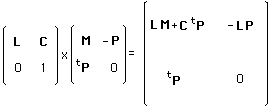
in matrix form and form the product:
(96)
(97)
(98)
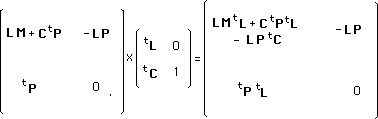
which I can identify with the matrix:
(99)

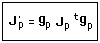
Jp is therefore the moment of the Poincaré group, written in matrix form. And the coadjoint action is written as:
(100)
As an exercise, the reader can, relying on the axioms, verify that it is indeed an action.
The moment of the Poincaré group can be made explicit as follows:
(101)
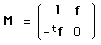
This matrix is antisymmetric (which implies that its main diagonal is composed of zeros). M is the matrix:
(102)
Let us make it explicit:
(103)
It is indeed an antisymmetric matrix, a hypothesis made from the beginning, which depends on six parameters:
(104)
( lx , ly , lz , fx , fy , fz )
The last three ( fx , fy , fz) are the components of a vector, the vector-displacement f:
(105)
The first three ( lx , ly , lz) are the independent components of an antisymmetric (3,3) matrix, the spin l:
(106)
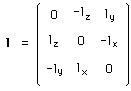
Thus:
(107)
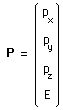
The vector P is the four-vector momentum-energy:
(108)
We can then make explicit the moment of the Poincaré group in its full generality:
(109)
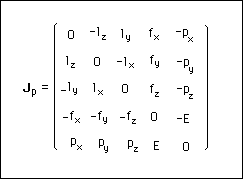
We verify that it is indeed an object with ten components (a number equal to that of the dimensions of the group).
(110) Jp = { E , px , py , pz , fx , fy , fz , lx , ly , lz } = { E , **p , f , l **}