groups and physics coadjoint action momentum
| 9 |
|---|
Spin particles.
The Poincaré group describes the relativistic motion of a point-like object. Similarly, the Bargmann group, whose expression will be given later, describes the non-relativistic motion of a point-like object, which is then called a "point-mass".
Therefore, this technique, the calculation of the coadjoint action of the group on the space of moments, has allowed hidden elements, the attributes of the object, to emerge: the components of the momentum.
What is remarkable is that this approach, due to Souriau, makes the key objects of the physicist appear as purely geometric objects. He thus achieved an unprecedented work of geometrization of physics.
Apart from energy and momentum, other components, the "twisting" and the "passing" greatly confuse the physicist. What are these?
The expression of the components of the momentum obviously depends on the chosen coordinate system.
Probably the simplest is to briefly return to the non-relativistic case, or to the expression of the coadjoint action, as it would have emerged from the analysis of the Bargmann group.
(111)
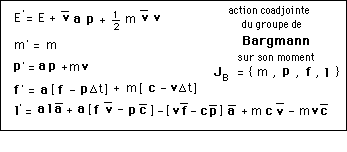
Mysterious formula. What is it for? How does it work?
In the box above, the physicist will have recognized some familiar objects:
(112)
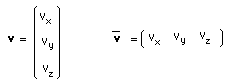
are simply two expressions of the velocity vector { vx , vy , vz }, the first in the form of a column matrix and the second in the form of a row matrix. The product of the two matrices is a scalar:
(113)

something that begins to resemble kinetic energy.
m v is a momentum.
The traditional physicist, dealing with the dynamics of a point mass, only knows three things:
- The mass m
- The momentum m v - The kinetic energy 1/2 mv2
Yes, but velocity relative to what?
A group is also a perspective on things. One can then either consider that one transports, using the group, objects (as we have seen with the Euclidean group), with respect to a fixed observer, or, the object being fixed, consider observing it differently.
If we adopt this displacement, this transport of objects, regarding the dynamic groups, those of physics (as opposed to the Euclidean group where time does not appear), we must also say that we animate the objects, by giving them velocity v and energy E.
If we adopt the inverse point of view: consider that the object is fixed and consider moving oneself, what sense do we give to the groups?
The Euclidean group would then mean:
"Seen from elsewhere and from another angle".
"The elsewhere" is the translation vector:
(114)

"The seen from another angle" is the rotation matrix a, a rotation in space (which could be explicitly expressed with Euler angles, which we will not do).
Regarding dynamic groups, this perspective, this point of view on "things", must be enriched. Staying within the context of the Bargmann group, introducing this velocity v means that, in addition, the observer, who observes this point-mass from elsewhere (translation vector c), from another angle (rotation matrix a), is also animated, with respect to this supposedly stationary point mass, with a velocity v.
And, to be complete, to complicate things further, it does not evolve in the same time as the observed point mass. It is offset from it by a time lapse Dt. In other words, it observes it from elsewhere, but it is an spatio-temporal elsewhere, corresponding to the spatio-temporal translation vector:
(115)

By taking such a "distance" from this point mass, what do I observe? First, that: m' = m
This does not affect its mass.
I can simplify my life by canceling the rotation. It is already complicated enough to observe a point mass from elsewhere, seen from another time, offset, perched on a skateboard moving at velocity v. Is it absolutely necessary to twist my neck?
No. Let us take a = 1.
But this detail is generally omitted in calculations. The coadjoint action, thus specified, becomes:
(117)
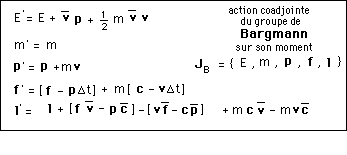
"Consider" should be taken here in its etymological sense. What do I do when I consider a situation, the sky, a battlefield, the film taken by a spy plane?
A bailiff will write:
- Considering the state of the premises.....
Static vision, corresponding to the Euclidean group. The bailiff observes the objects at a distance c, at the same moment (Dt = 0), in principle stationary ( v = 0). In case, under a particular angle, under "a certain angle".
A general walking in a reconnaissance plane is a kind of bailiff who moves (v # 0).
But a staff officer watching the film taken by a spy plane, a "drone", is facing a situation delayed in time. He is forced to say:
- Let us consider the target, seen from such a point, in a banked turn, at such a speed, and furthermore as it appeared two hours earlier...
The target does not have a particular proper speed. One cannot consider it as fixed, even if it is "a fixed installation". Even the Earth moves, the Sun also, the galaxy, etc.