groups and physics coadjoint action momentum
| 11 |
|---|
The photon.
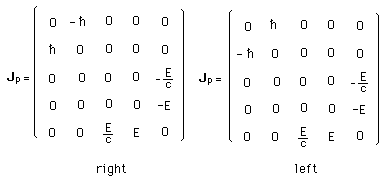
We notice that we then obtain two types of photons:
(126)
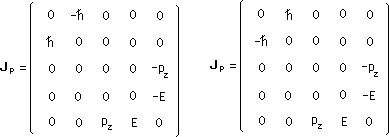
A "right" photon (right polarization) and a "left" photon (left polarization), differing by their helicity. Two photons traveling in the same direction (OZ), at speed c, and having the same color (same energy E).
For a photon, energy E and momentum p are not independent.
(127) E = h n
which gives us:
(128)
Beyond these characteristics (energy, direction of propagation, helicity), the photon has no other properties. It possesses no "charge," so to speak, "all its charges are zero," making it identical to its antiparticle (plus zero being identical to minus zero).
Neutrinos.
Considered as massless particles (which they are, as far as current evidence goes), they have momentum matrices identical to those of photons, except that the spin is half:
(128b)
(129)
Neutrinos, traveling at speed c, possess an energy-momentum, a spin, also quantized, though different from that of the photon. The neutrino also has helicity. There are neutrinos with right-handed polarization and neutrinos with left-handed polarization.
However, we know that there are additionally three distinct types of neutrinos, a fact not revealed by the Poincaré group, nor can it be revealed by it (we will need to modify it later to geometrically account for the different particle charges).
Thus, the neutrinos are of three types:
- electronic
- muonic
- tauonic
meaning we can assign them three types of charges:
e = electric = +/-1 ( +/-; the "unit charge").
cm = muonic charge = +/-1
cn = tauonic charge = +/-1
This reversal of the sign of the charges is also called charge conjugation or C-symmetry.
Therefore, the three types of neutrinos must be associated with their corresponding antineutrinos:
(130)
However, this distinction—both in quantum numbers, charges, and matter-antimatter duality—is not inherently encoded in the Poincaré group either.