groups and physics coadjoint action momentum
| 12 |
|---|
Particles with non-zero mass spin.
There is no longer a direct link between energy and momentum, as is the case for photons and neutrinos, which are massless particles.
(131)
With m being the rest mass, which then corresponds to the mass emerging from the Bargmann group, we have:
(132a)
(132b)
Let us restrict ourselves to:
Proton
Electron
Neutron
and their antiparticles.
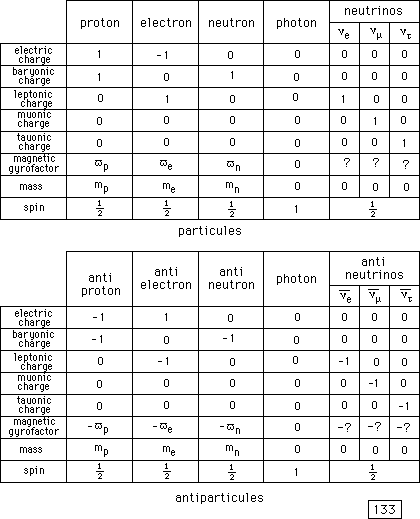
Particles possess various charges, attributes, which also do not emerge from the Poincaré group:
- Electric charge e = ± 1
- Baryonic charge cB = ± 1
- Leptonic charge cL = ± 1
- Muonic charge cm = ± 1
- Tauonic charge ct = ± 1
- Gyromagnetic ratio v
Inverting all these quantities corresponds to C-symmetry. Thus, we can group all of this as follows in the table below:
(133)
which can take any orientation, just like the spin.
The magnetic moment equals the gyromagnetic ratio v multiplied by the spin s.
(134)

Here we have used a bold letter s for spin. This means that the direction of particle spins can be arbitrary. However, their magnitude is one of their intrinsic characteristics and is fundamentally invariant (geometric quantization of particle rotation).
C-symmetry, charge conjugation, reversing the gyromagnetic ratio v, also reverses the magnetic moment.
Permanent magnets.
If we place a piece of soft iron in a sufficiently strong magnetic field, then reduce the field, the metal will retain a permanent magnetization. What happened?
The magnetic field aligns the spins of the electrons, which behave like tiny magnets, small magnetic dipoles.
But why do they then retain the direction imposed upon them? Through mimicry. Each electron aligns according to the magnetic field generated by its neighbors. And since all others do the same, all these moments preserve their parallelism. It's like "Panurge in space." Unless we heat the piece of metal or strike it, in which case we will eventually disrupt this beautiful electronic ordering.
Magnetic moment of antimatter.
Charge conjugation, related to the matter-antimatter transformation in the sense of Dirac (we will see later what this means), causes reversal of the magnetic moment due to reversal of the gyromagnetic ratio, while the spin remains unchanged.
Naturally, this C-symmetry does not alter either the energy or the momentum of the particle.
The four components of the Lorentz group.
As we have seen, the element L of the Lorentz group L is defined axiomatically. It must satisfy:
(135)
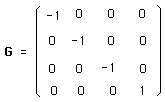
(136)

Any matrix L satisfying this definition belongs to the group L. It is a (4,4) matrix, which can, for example, act on:
(137)

in other words, on spacetime. We are then justified in asking whether these matrices might not represent symmetries in this space. Could we, for instance, change x into -x? Could the matrices be classified into different subsets—those performing this operation and those not?
Long ago (in English, many beautiful candles ago), all this was explored, and it was shown that the Lorentz group is actually composed of four types of matrices.
Ln — Those that invert neither space nor time.
Ls — Those that invert space.
Lt — Those that invert time.
Lst — Those that invert both.
We call these sets components of a group. Thus, the Lorentz group is a group with four components.
We can immediately produce four matrices, each belonging to the cited subset:
(138)
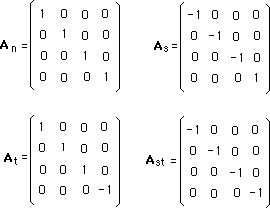
An = 1 (identity element), belongs to Ln: inverts neither space nor time.
As belongs to Ls: inverts space.
At belongs to Lt: inverts time.
Ast belongs to Lst: inverts both space and time.
To form a group (in this case, a subgroup of the Lorentz group), a set of matrices must contain the identity element 1 in the (n,n) format considered here: (4,4). Only the matrices from the set Ln satisfy this criterion. They form a subgroup of the Lorentz group. Since this set contains the group's identity element, it is also called the neutral component of the group. The other matrix sets do not form subgroups (impossible: they lack the identity element).
Note:
(139) At = - As Ast = - An
We can then consider the set Lo = Ln » Ls, which is a subgroup of the Lorentz group and is called orthochronous [1]. The matrices Lac = Lt » Lst do not form a group, but constitute the set of components associated with time inversion, which we call antichronous [12]. The complete Lorentz group is:
(140) L = Lo » Lac
But we can also observe that the element:
(141) m Lo, with m = ± 1
covers the entire group.