groups and physics coadjoint action momentum
| 13 |
|---|
The four components of the Poincaré group.
Starting from the Lorentz group, one constructs the Poincaré group, already mentioned:
(142)
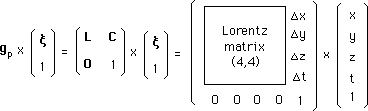
C is the "spacetime translation" vector.
(143)

This Poincaré group will also have four components, each associated with the corresponding component of the Lorentz group.
Above is the group's action on its space of motions. But what is interesting are the actions of the four components on the momentum. See: Souriau, Structure of Dynamical Systems, Dunod 1973 (and Birkhäuser 1997, in English), Chapter III, page 197, section titled: Space and Time Inversions.
Recall the components of the momentum associated with the Poincaré group:
E: energy
p: momentum
f: passage
l: rotation
To stay close to Souriau's notation, let us denote:
- Ln the neutral component of the Lorentz group.
- Ls the one that inverts space.
- Lt the one that inverts time.
- Lst the one that inverts both.
Since C is a spacetime translation, the four components of the Poincaré group are:
gp (Ln, C) neutral component
gp (Ls, C) space-inverting
gp (Lt, C) time-inverting
gp (Lst, C) inverting both space and time.
Let us examine their effects on the momentum components. We must consider the formulas giving the group's action on its momentum space:
(144)
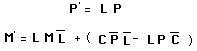
P is the four-vector:
(145)

We can write the matrices to analyze:
(146)

with l = ±1 and m = ±1.
Ln = L(l = 1; m = 1)
Ls = L(l = -1; m = 1)
Lt = L(l = 1; m = -1)
Lst = L(l = -1; m = -1)
(147)
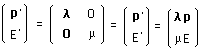
(148)
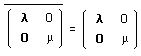
Now let us examine the action on rotation and passage.
(149)
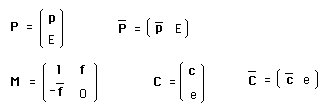
But in what interests us, C = 0
(150)
thus l' = l and f' = l m f
We deduce:
(151)
gp (Ln, C): E → E; p → p; f → f; l → l
gp (Ls, C): E → E; p → -p; f → -f; l → l
gp (Lt, C): E → -E; p → p; f → -f; l → l
gp (Lst, C): E → -E; p → -p; f → f; l → l
Inversions never change the rotation l.
However, time inversion and energy inversion, E → -E, are synonymous.
Rotation is synonymous with spin when quantized. No inversion alters it.
The spin (as the magnitude of the particle's rotation vector) is merely a number.
The energy of a particle at rest is mc².
Time inversion is synonymous with mass inversion, m → -m.
Space inversion does not invert mass.
The first two components of the group are named by Souriau orthochronous, and the last two antichronous.
He notes that all this raises the issue of negative masses, which physicists generally dislike. Indeed, what of the outcome of a collision between two particles with energies +mc² and -mc²?
Complete annihilation occurs. This is not merely matter-antimatter annihilation, which produces photons. Instead, this would be a process yielding pure nothingness.
To avoid the problem of negative masses, Souriau considers two solutions. The first is simply to decide that particles with negative mass do not exist. The second is to exclude antichronous transformations.
Paraphrasing, we might say:
- God, in His infinite wisdom...
Let us continue building elements that will serve as a foundation for our own work.