groups and physics coadjoint action momentum
| 14 |
|---|
Central extension of the Poincaré group.
A reference to such an extension can be found in J.M. Souriau's book, Structure des Systèmes Dynamiques. His method of geometric quantization allows one, starting from a group, to recover the equations of Quantum Mechanics. For example, the Bargmann group, describing a non-relativistic point particle, leads to the non-relativistic Schrödinger equation.
The starting point is the Galilei group. It is a (5,5)-dimensional matrix constructed as follows:
(152)
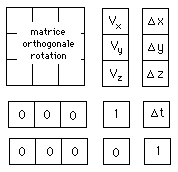
The rotation matrix depends on three parameters, the Euler angles. Thus, the dimension of the group is ten.
Using the notations:
(153)
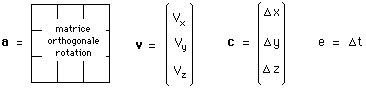
(154)
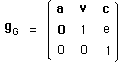
associated with spacetime:
(155)

Strangely enough, the construction of the coadjoint action of the group on its momentum space does not make the mass m appear as a geometric object. This can only be achieved through a non-trivial extension of the group, namely the Bargmann group (1960).
(156)
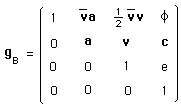
The presence of the scalar f increases the group's dimension by one: eleven.
This group acts on a five-dimensional space, spacetime, plus an additional dimension z, via the action:
(157)
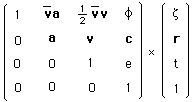
The coadjoint action of the Bargmann group on its momentum was given above. One sees that adding the scalar f—by increasing the group's dimension by one—adds a component to the momentum, which then identifies with the mass m (which is conserved in the process: m' = m).
Starting from the Bargmann group and using its method of geometric quantization, Souriau can then construct the non-relativistic Schrödinger equation.
The relativistic quantum equation is the Klein-Gordon equation. It was therefore logical to seek which group it could arise from. This is the central extension:
(158)
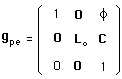
"pe" stands for "extended Poincaré." Here we have constructed the Poincaré group from the orthochronous subgroup of the Lorentz group Lo.
The space associated with this group is also five-dimensional:
(159) ( t , x , y , z , z ).
This extension is simpler than Bargmann's, but in fact things are always easier in the relativistic case. It can be shown, incidentally, that between the 1 and the f in the first row, only the row matrix 0 = (0 0 0) can appear: all zeros.
The method of geometric quantization then leads to the Klein-Gordon equation. Regarding the group's action on its momentum space, we obtain:
(160)
Jpe = { c , M , P } = { c , Jp }
The calculation is not complicated. It essentially mirrors exactly the calculation of the coadjoint action of the Poincaré group on its momentum.
We compute the anti-action:
(160 b)
Then we express the invariance of the scalar product (duality):
(160 c)
If you manage to get through this calculation, it will be a very good sign. It will mean you are beginning to enter this complex domain.
Thus, a scalar c appears, whose sole function is to be conserved. What does it represent? No explanation is given. It is simply "something that is conserved." One could assign it, for example, the status of electric charge.
The first idea that comes to mind is to perform this type of extension multiple times:
(161)
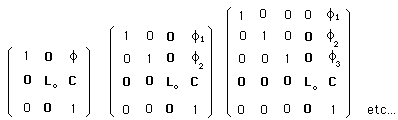
It will be shown later that this operation can be performed indefinitely, each time adding an extra scalar:
(162) Jpe = { c₁, c₂, c₃, ..., M, P }
Jpe = { c₁, c₂, c₃, ..., Jp }
with the following coadjoint action:
(163)
We will then consider certain discrete values of the momentum components as representing the particle's charges.
Well, the reader might say, indeed, we could add, for example, six extra rows. We would then obtain invariance of scalars that could be identified as:
(164)
c₁ = e (electric charge)
c₂ = cB (baryon charge)
c₃ = cL (lepton charge)
c₄ = cm (muon charge)
c₅ = ct (tau charge)
c₆ = v (gyromagnetic ratio)
It would suffice to consider the group, with its corresponding action, associated with a ten-dimensional space:
(165) (x, y, z, t, z₁, z₂, z₃, z₄, z₅, z₆)
(166)
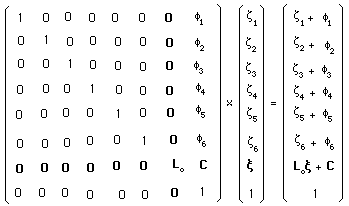
Once again, we construct the group around the orthochronous subgroup Lo of the Lorentz group:
Lo = Ln (neutral component) » Ln (space inversion).
This two-component group then simply produces six scalars that accompany the particle without interacting with anything else. The momentum becomes:
(167) Jpe = { q, cB, cL, cm, ct, v, Jp }
Jp being the "Poincaré part." But this remains of limited interest.