groups and physics coadjoint action momentum
| 15 |
|---|
Reflection on the question of momentum.
We are ready to embark on an adventure, meaning we write down a simple matrix, invent a group depending on a certain number of parameters and capable of acting on a space having a certain number of dimensions (here, ten, in particular). Then, working in the manner of boustrophedon (from bous, the ox, and strophedein, to plow), we calculated this famous coadjoint action of the group on its momentum space and defined it, its attributes, its components, and the way this coadjoint action acts upon them—toward which we will then attempt to give a meaning, a physical interpretation.
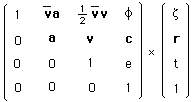
Let us briefly retrace the path taken, bringing back to the table a group that, although formally more complicated:
(168)
provided us with the following coadjoint action:
(169)
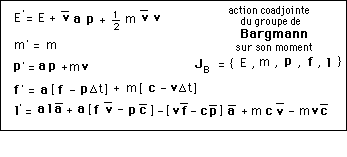
which immediately revealed the components of this point-like object, this material point.
(170)
JB = { E , m , p , f , l } JB = = { E , m , px , py , pz , fx , fx , fx , lx , lx , lx }
In any case, we already knew from the beginning that this mysterious momentum should consist of eleven scalars, since their number had to equal the dimension of the group, which is also eleven. A glance at the group elements matrix of Bargmann:
(171)
a is an "orthogonal" matrix, a "rotation" matrix, or one "associated with a rotation in 3D space." We had explicitly written it down in the two-dimensional case. In that case, this matrix depended on only one parameter, the rotation angle α.
In 3D, it will depend on three parameters, the Euler angles:
α β γ
The velocity vector v adds three more parameters:
vx vy vz
Spatial translation c introduces three more:
Dx Dy Dz
And temporal translation adds one more: e = Dt
Total: ten.
Add a mysterious eleventh parameter: f "related to the quantum world." Well...
Total overall: eleven. So an eleven-component momentum, which I could write in the form:
(172)
JB = = { J1 , J2 , J3 , J4, J5 , J6 , J7 , J8 , J9 , J10 }
In any case, I was able to identify relationships among these momentum components, the way they articulated with one another, grouped together to form:
- scalars (E and m)
- vectors (p and f)
- a matrix: l.
It's as if I were saying: a human being has a head, two arms, and two legs. But how does it move? How are these "components" "articulated" among themselves?
The coadjoint action then precisely indicated how the group acts on these momentum elements:
(173)
In this table, we immediately saw that within this famous momentum there exists one of its components, m (which we could just as well have kept under its initial arbitrary name: J2), a simple scalar, which remains unaffected by this group action.
We then thought this status would suit quite well what we believe we know about mass m in a non-relativistic world.
These momentum formulas provided us with the values of these appearances named attributes, components of the momentum associated with the material point: we are tracking matter in its states: when it is rotated (a), spatially displaced (c), temporally displaced (e), set in motion with velocity v, and mysteriously displaced in this equally mysterious fifth dimension z by an amount f, about which we are told that "all this is linked to the quantum."
Well...
The momentum undergoes a transformation via the coadjoint action acting upon it. It transitions from one "state":
(174)

to another "state":
(175)

Why not then consider a kind of "ground state," which would be:
(176) JB = { 0 , 0 , 0 , 0 , 0 } = { 0 , 0 , 0 , 0 , 0 , 0 , 0 , 0 , 0 , 0, 0 }
saying that a coadjoint action would then bring forth attributes that I could recognize?
But I see that I would need at least to include the mass m, since the coadjoint action does not change it. Thus, if I set it to zero, it would remain zero. Therefore, I must start from the basic object:
(177)
JB = { 0 , m , 0 , 0 , 0 } = { 0 , m , 0 , 0 , 0 , 0 , 0 , 0 , 0 , 0 , 0 }
This object has no energy. It is the group action that confers energy upon it. Similarly, it confers momentum, a displacement, and a rotation.
A kinetic energy:
(178)
A momentum (the purist physicist would say a "quantity of motion"):
(179) m v
A "rotation", a kind of "intrinsic angular momentum", as if our material point could rotate upon itself (which might be the case for a small metal ball, mass m, small enough to be considered a point-like object):
(180)
There remains this eminently puzzling object for a physicist, the "displacement." Acting on my material point, E has conferred upon it a "displacement attribute," whereas initially it had none, and this one turns out to be:
(181)
All components of the group matrix were treated as independent quantities. This is "the most general transport."
Finally, when acting on a human being, that being may find itself "transported" and "put into all its states."
Here, it would be the most general transport, where our material point is:
- either rotated: a
- or spatially shifted: c
- or temporally shifted: e
- or set in motion with velocity: v
- or displaced by a mysterious amount f in a no less mysterious space z.
That is:
- observed from a distance c
- by an observer moving with velocity v
- under an angle a
- according to a cinematic recording taken e = Dt earlier or later
- from a "fifth spatial viewpoint" z, where the observer has mysteriously "shifted by z"
All of this supposedly "coming back to the same."