groups and physics coadjoint action momentum
| 16 |
|---|
We have seen that we could cancel the passage f, according to the first idea: by imagining that the material point moves away (or approaches, in any case moves at velocity v) and that this produces, during a time interval e = Dt, a displacement c = v Dt.
From the opposite perspective, it would be the observer who moves at velocity v and covers the path c = v Dt during the time interval Dt.
Let us therefore forget this passage, which can always be canceled by following the particle in its motion, by linking velocity v and distance traveled c.
Mathematically, this is simply a subgroup—the subgroup of translations where we had the weakness of wanting to relate velocity, time, and distance traveled, where the log, the onboard stopwatch, and the speed indicator have scales that are not completely independent.
Physically reasonable.
There remain these strange underground movements, this addition of a quantity f to an extra dimension z. The "quantum underground," one of those aspects of the Platonic lantern of projection, to which we are supposed not to have access.
Well...
Let us now return to the group governing the relativistic motion of the point particle, the Poincaré group.
(182)
standard "orthochronous" version. Its momentum is:
(183) Jp = { M , P } = { M , p , E }
(184)
Count: ten. But I could just as well write:
(185)
Jp = { J1 , J2 , J3 , J4 , J5 , J6 , J7 , J8 , J9 , J10 }
I have constructed the coadjoint action. I sense how the new "material point" is transported, relativistically this time. I know that among these momentum components there is a scalar called energy E. But mass has vanished. Or rather, it has been absorbed into energy.
Mass and energy have become "the same entity," called energy-matter. It was therefore natural that only one scalar would be needed to describe this state of affairs.
Once again, I ask myself: could there be a kind of "ground state" (which, of course, is relative, relative to an observer who also considers himself to be in this same "ground state")?
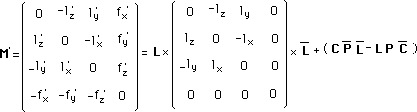
I have the expression of my coadjoint action:
(186)
For the first line, in detail:
(187)
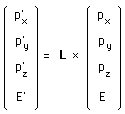
If this is a particle with non-zero mass, I can imagine that in this relative ground state, its initial momentum could have been zero. It would be a "particle at rest," possessing therefore a rest energy Eo:
I could thus impart momentum to this particle by acting on it with an element of the Lorentz group, according to:
(188)
operation which would be inconceivable for a "massless particle," such as a photon or neutrino, which travel at speed c, thus "always move." These are particles that never know rest. They are always a momentum p, which is moreover linked to their energy E.
The non-relativistic physicist, dragging his feet, might find it a bit strange that a massless particle could still possess momentum.
But it's a mathematical object, the relativistic physicist will say, who will write:
(189)

and couldn't care less.
There remains the second relation:
(190)

to try to decipher, if possible.
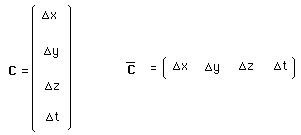
C is the spacetime translation ( Dx , Dy , Dz , Dt )
(191)
Continue detailing.
(192)
(193)
(194) (195)
Hey! This is the transpose of the previous one.
The mathematician would say, it's obvious, based on the following theorem (which you can verify for yourself as an exercise):
Let two matrices be given with dimensions such that they are multiplicatively compatible. Then:
(196)

The transpose of the product of two matrices equals the product of the transpose of the second matrix times the transpose of the first matrix (the order is reversed).