groups and physics coadjoint action momentum
| 17 |
|---|
Application to the above:
(197)

We have used the obvious property: the transpose of the transpose of a matrix is the original matrix.
Thus, globally:
(198)
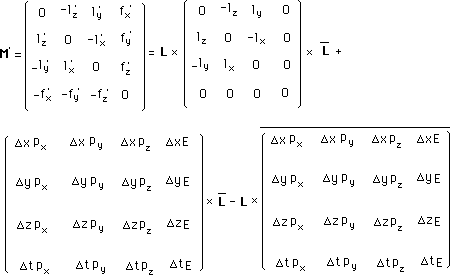
If I take a particle with non-zero mass, I can always imagine that I picked it from the tree of knowledge of rest and non-rest states, with zero momentum.
I have seen that I can also arrange things so as to cancel the transition, by placing myself in a reference frame that "accompanies the particle in its motion."
(199)
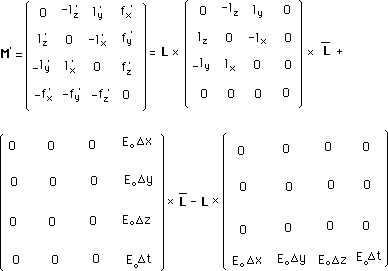
I cannot consider a particle with zero rest energy E₀. That would make no physical sense. But I also know—or am supposed to know—that a particle cannot have zero spin, even in a hypothetical rest state. Moreover, this spin—or "spin vector s"—always exists, and its magnitude s is invariant; indeed, it is a characteristic of the particle. It is a half-integer multiple of h/2π, the reduced Planck constant. This is also a consequence of the "geometric quantization" invented by Souriau.
Always from geometry...
These "attributes" are somewhat more puzzling than the non-relativistic attributes mentioned earlier.
But it should be noted that this "geometric quantization" also applies to the non-relativistic world (Bargmann group), quantizing spin, individual angular momentum, "vorticity," or whatever name one gives it, whether for a particle, a material point, or any object governed by the group. The direction may change, but: Don't touch my magnitude s.
All this passes through an additional variable z, which some theorists and mathematicians consider "a computational intermediary."
That said, in this five-dimensional space: z, x, y, z, t
we move, we transport ourselves.
There are things that pose no problem, such as: x → -x, y → -y, z → -z
which corresponds to a P-symmetry. If applied not to a point object, but to a set of connected points, the structures are transformed into their enantiomorphs, into their mirror images. But for an isolated particle, it is merely another "motion."
Still remaining within 5D, we have seen that certain attributes have emerged.
In non-relativistic physics: mass m, energy E
In relativistic physics: E and m are intertwined into a single entity.
They are simple scalars. The mathematician would say they can be chosen just as well positive or negative. These are merely choices made within a particular space of moments, forming the moment space, depending on n parameters (n being equal to the dimension of the group). In the moment associated with the Poincaré group (non-extended):
(200) Jp = { E, p, M }
the parameters can, a priori, take any possible values, positive or negative.
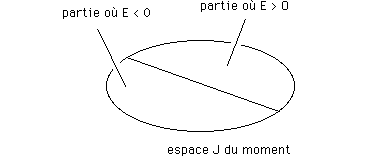
Let J be the set of parameters defining the moment. J is the moment space. In this space, we should then be able to distinguish two domains:
(201)
The group "overhangs" this space and ensures various kinds of transport. It thus contains elements that allow transforming one motion into another. As Souriau puts it:
The momentum follows the motion like its shadow.