groups and physics coadjoint action momentum
| 18 |
|---|
Dispelling a misconception. Providing clarifications.
The image is beautiful, appealing, but, at least in my case, it embedded a false idea that I struggled hard to overcome.
The verb to follow evokes a process. We follow a path, a person's gaze, the evolution of a point along a curve. Nobody would think of "following a point."
Therefore, when Souriau writes that the momentum follows the motion like its shadow, one is tempted to imagine this:
(202)
The false idea.
Here, you are completely wrong. A motion is a momentum, a point in the space of momenta:
(203)
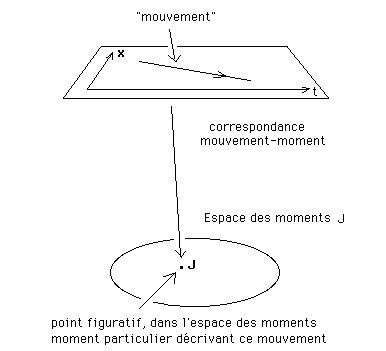
The correct image.
We have already said that with all these groups—Galilei, Bargmann, Poincaré, extended Poincaré—the massive points are subject to no forces. They therefore move in straight lines. Their trajectory, at least as we perceive it (which implies the emergence of this oddity called passage, which we have already discussed sufficiently), involves parameters such as:
- Energy E
- Momentum p — Rotation.
We are not free to choose the magnitude of the rotation (in a reference frame attached to the object), since it then becomes the spin vector, whose magnitude is fixed.
On the other hand (at least for a particle with non-zero mass), in a system governed by the Bargmann group, and if we have fixed the spin s, then v is a free parameter.
Let us simplify. Consider the set of all possible motions of a particle of mass m, with a given spin s, and spin vectors s all pointing in the same direction. Let us assume the particle's energy is its kinetic energy:
energy associated with momentum m v.
The different motions depend on only one parameter: the velocity v. I sketch this schematically. But graphically, considering a family of motions of the same particle, corresponding to straight-line trajectories passing through the same point, with different speeds v, we would have:
(204)
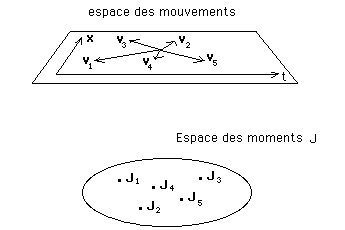
(I placed the momenta arbitrarily.)
That said, all these motions refer to the same particle of mass m. These particles, moving in different directions at different speeds, are of the same species.