groups and physics coadjoint action momentum
| 19 |
|---|
To slightly extend the problem, I could just as well consider that these trajectories are ... arbitrary:
(205)
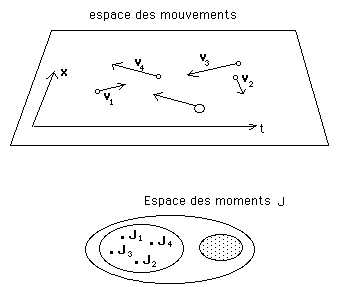
To each of these particles of mass m, moving with different velocities, corresponds a representative point in momentum space. But these particles have something in common: they all have the same mass m (and the same spin, etc.).
Therefore, there exists a group action that allows transitioning from one motion M1 to another motion M2. This is a coadjoint action, "driven" by the group. (206)
In my two previous figures, I indicated an object schematically represented by a larger ball, undergoing motion. The size of the ball suggests that it represents the motion of a particle with a different mass. But this is also a motion.
This mathematical object, called a motion, belongs to the space of motions. Therefore, it has its image in momentum space J.
However, this particle of mass m > m is not of the same species as the others. There does not exist a group action capable of identifying a particle of mass m with a particle of mass m
(we are here within Bargmann's dynamical group), since the coadjoint action yields: m' = m, implying conservation of mass.
In the (x,y,z,t) space, point particles can be located anywhere in spacetime. At a given point (x,y,z), at time t, any particle—of any mass, any charge—could be present. Thus, this space cannot be used to classify particles into species, or to sort them into "boxes."
A physicist might perhaps imagine classifying "particles at rest," corresponding to a spectrum of energies E₀, E₁, E₁, etc.
But if we classify them "dynamically," we will not classify by energies, but by the motions themselves.
The object to analyze is the set of motions of all particles governed by the group. We then use the coadjoint action as an analytical tool, like a sieve.
Let us change the drawing:
If we are given an element g of a group G, it will generate a coadjoint action that determines the change in momentum. Schematically:
(207)
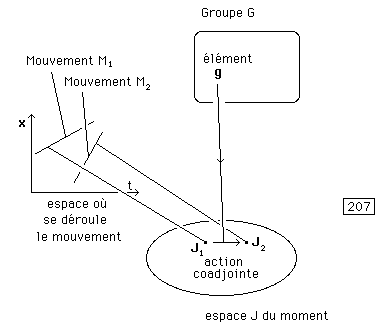
The group enables changing motion. We move from a representative point J₁ to another representative point J₂ in the space of motions. In "physical space," we change motion. You change, change your motion. The entire linguistic difficulty arises from the fact that mathematicians and physicists do not share the same definition of the word "motion." To a physicist, motion is something one observes "unfolding." To a mathematician:
-
either "it is already fully unfolded"
-
or it is a point in momentum space.