groups and physics coadjoint action momentum
| 20 |
|---|
Different motions.
As seen above, the full Poincaré group had contracted a disease linked to its close relationship with a four-component group, the Lorentz group. It thus consists of two parts: the orthochronous subgroup Go and the antichronous set Gat (which is not a group by itself). Here is the complete playing field:
(208)
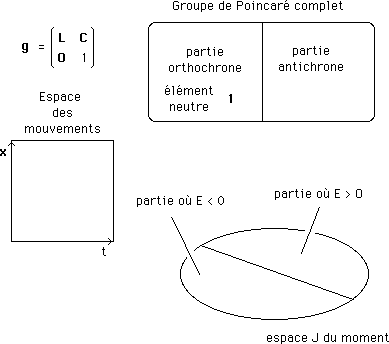
In the space J of momenta corresponding to motions occurring in the space of motions with negative energies:
(209)
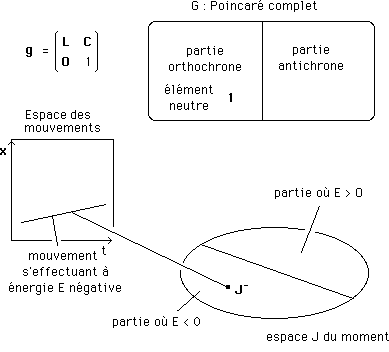
These are precisely the motions that greatly bother physicists. In the case of a collision between two particles in the same space, one with positive energy and the other with negative energy, the result is NOTHING.
Before tackling such thorny problems, couldn't we instead focus on "normal" particles, in Coluche's sense?
Agreed. Let's follow Souriau:
- Strip the group of its antichronous part and keep only the orthochronous subgroup.
- Remove from the momentum space the part referring to material points with negative energy and mass.
(210)
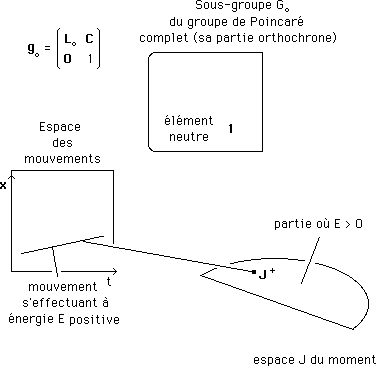
Restricted playing field, but then: no more problem.
J+ is supposed to represent a momentum associated with motion occurring at positive energy.
Conversely, J− will represent a momentum associated with motion occurring at energy E < 0.
I choose an element g from my orthochronous subgroup Go. It induces a change of motion. The representative point jumps within the momentum space. But this remains unproblematic.
(211)
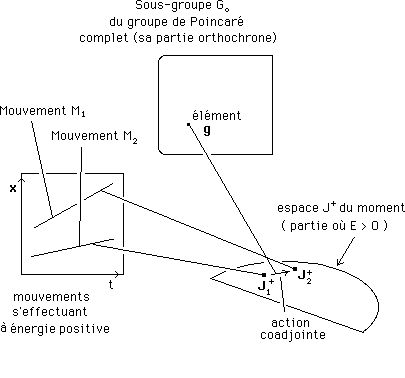
On the left, for example, I have two different motions of the same particle.
Particle species are "species of momenta." In this momentum space J, I can distinguish different regions corresponding to different species. Below, we have restricted ourselves to two particle species, corresponding to this linear boundary dividing the half-disk into two parts:
(212)
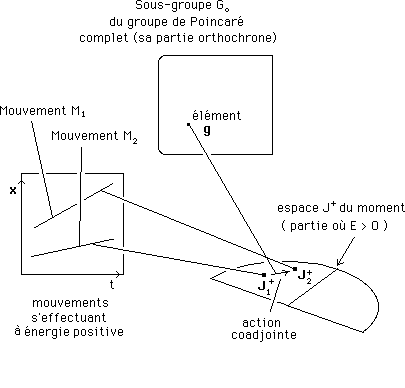
The representative points in the subspace J+ of momentum, associated with motions occurring at positive energies, I have placed two points corresponding to the same species. For example, these could be two motions of the electron species.
I have drawn an arrow (coadjoint action) showing a continuous transition from one of these motions to the other.
On the other hand, if my points were chosen in the momentum subspace, in regions corresponding to two different species (for example, electrons and protons), there would be no group element, hence no coadjoint action, allowing transition from one motion to the other. As previously mentioned.
(213)