groups and physics coadjoint action momentum
| 21 |
|---|
And antimatter?
It is directly linked to the additional variable z.
In his book, Geometry and Relativity, Hermann Editions, 1964, Chapter VII: Five-Dimensional Relativity, page 413, Souriau notes that its inversion is equivalent to charge conjugation.
We can represent this fifth dimension as a "fiber." Let us restrict spacetime to two dimensions x and t:
(214)
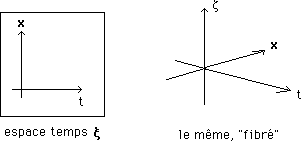
Equip this spacetime surface with a "fiber" z. At each point (x, t), a "fiber" extends on both sides, corresponding to a coordinate z.
The surface then serves as a boundary between two spaces of dimension (n+1), illustrated here as (2+1=3), with a half-space (z > 0) and a half-space (z < 0). On the surface z = 0.
(215)
In momentum space, we have represented three species:
- Matter species
- Antimatter species
- Photon species
In motion space, the corresponding motions are:
- Matter moves in the half-space (z > 0)
- Antimatter moves in the half-space (z < 0)
- Photons move on the boundary surface (z = 0): they are their own antiparticles.
Within my subgroup Go (orthochronous), I can find elements that allow transitions between motions, hence between momenta, provided these elements belong to the same species.
But I cannot transform a matter particle into an antimatter particle or into a photon.
These are three distinct species. * *
They traverse different "waters" in the full space (z, x, t), but for the observer who perceives only spacetime, the trajectories in (x, t) are indistinguishable.
We have seen that adding an extra dimension to the group, combined with its action on a five-dimensional space, led to the emergence of a mysterious scalar c. We will see later how to manipulate it, make it sensitive to group action. For now, we may attribute to it the rather vague status of "charge," with the photon's charge being zero.
With this in mind, we gain slightly clearer insight into the nature of antimatter. It possesses its energy E and its momentum p.
We also see that antimatter, as described through the extended Poincaré group (acting on five-dimensional space), corresponds to two different motions of an object defined by a positive energy E (same as its mass) and a given momentum—this second aspect of motion relating to the z dimension. For our point masses governed by the extended Poincaré group do not move in (x, y, z, t), but in (z, x, y, z, t).
Thus, matter is assumed to evolve in the half-space z > 0,
antimatter in the half-space z < 0,
and photons in the plane z = 0.
But for the Platonic observer, lurking at the back of his cave and unable to see these motions in (z, x, y, z, t), only perceiving their shadows (x, y, z, t) on the cave wall, it's all the same.
If, sitting at the back of your cave, you see a neutron and an antineutron pass by, nothing will indicate a priori:
- that one moves at z > 0
- and the other at z < 0.
Since we have restricted momentum space to the subspace J+, which handles only motions of particles with positive energy (including photons),
our antimatter will also have positive energy and positive mass.
But we see that if we reintroduce the antichronous components of the Poincaré group, problems immediately reappear:
(216)
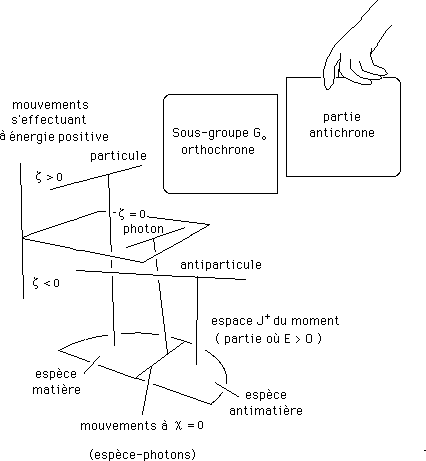
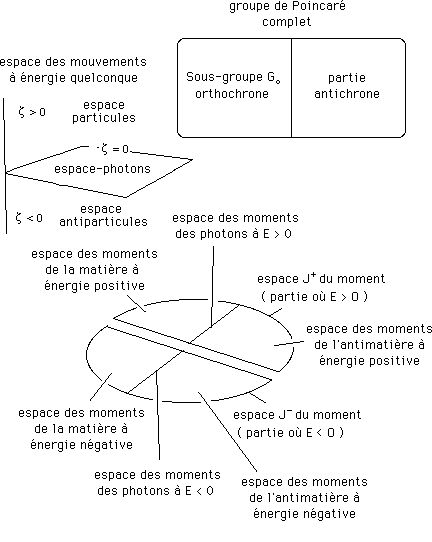
This antichronous part contains elements that produce coadjoint actions reversing energy for all particles—photons, matter, and antimatter alike. A quick glance at the full playing field.
(217)
The problem is that the antichronous elements of the Poincaré group generate energy inversions via the coadjoint action (E → -E; m → -m).
(218)
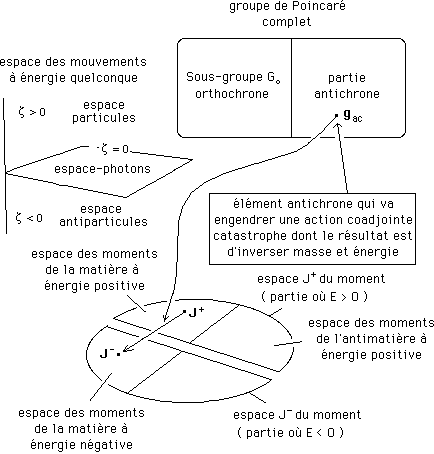
Souriau's "solution" (see Structure of Dynamical Systems, Dunod-France Editions, 1973, p. 200) consists in assuming that God is not so foolish as to have created such things, and that in His infinite wisdom He carefully excised the antichronous part of the Poincaré group, so that each type of matter remains in its place and the cows are safely guarded.
But another possibility may be considered.