| 22 |
|---|
Let us reason coldly. We have seen that different particles (photons, particles, antiparticles) form distinct species, corresponding to a partition of the space of momenta into subsets matching these same species.
A species is a particular subset of motions, a particular subset of momenta.
Tell me how you move, and I will tell you what you are.
The complete Poincaré group has four distinct, disconnected components. Within the orthochronous subgroup, there are two components: the neutral component (containing the identity element 1) and another component related to space inversion. This component does not affect the energy or mass of the particle. It simply corresponds to another type of motion that is an integral part of the momentum space associated with motions of particles possessing positive energy. All motions can occur within the same spacetime. Regarding antimatter, the "fiber" is simply opposite.
(219)
The First Petit Group.
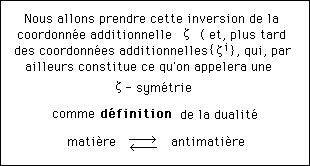
It is then possible to define a coadjoint action that transforms matter into antimatter and vice versa, by modifying the extended Poincaré group as follows.
We begin with the orthochronous component Go of the Lorentz group. We thus remove the achronous part of the Poincaré group, but we double it by writing:
(220)
The coadjoint action leads to:
(230) c' = l c
---- Same reasoning as before, with computation of the anti-action:
(230 b)
and invariance of the scalar:
(230 c)
But beware: when you differentiate the matrix, do not attach a dl.
l is not a group parameter, a free variable like f or C, or Lo.
l, taking values ±1, simply creates two components of the group (or more precisely, doubles the number of components, since the Lorentz orthochronous group already has two components).
The number of components then becomes 2 × 2 = 4. c can then be regarded as a charge. l = -1 induces a z-symmetry.
Extension of the Petit Group.
Earlier, we saw how successive extensions of the Poincaré group could be performed (six times).
(231)
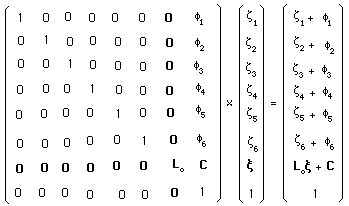
The momentum space was thereby extended accordingly:
(232) Jpe = { q , cB , cL , cm , ct , v , Jp }
We had previously suggested treating these additional scalars as quantum charges of the particles.
By analogy, we extend the group to:
(233)
The coadjoint action gives:
q' = l q
cB' = l cB
cL' = l cL
cm' = l cm
ct' = l ct
v' = l v
l = -1 induces a C-symmetry, a charge conjugation.
We can "compact" this using:
(234)
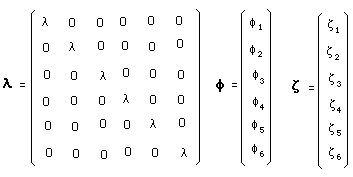
The first Petit group then becomes:
(235)
by writing the coadjoint action:
(236) **C' = **l C
**C --- - C **corresponds to C-symmetry.