Fake and use of fake
Fake Picasso: How could this happen?
November 11, 2004
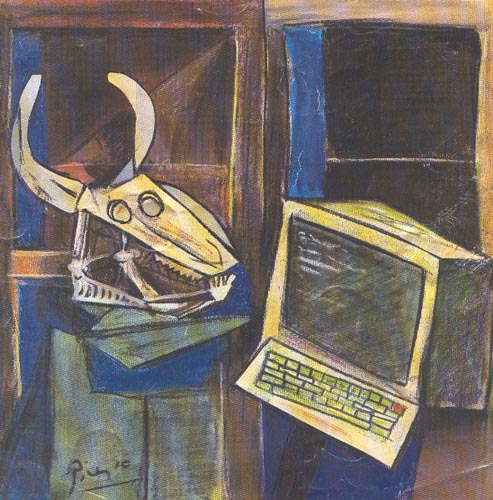
This fake Picasso belonged to the Malloway Museum in Toronto since 1947, the date of its acquisition. Although the invoice is quite faithful, it is quite surprising that the museum staff did not notice the presence, on the right side of the painting, of a microcomputer that did not exist at that time. It was an IT specialist who, upon discovering this painting, suddenly pointed out this anachronism, which put the museum authorities in a very understandable embarrassment.
This HTML page is a joke. I myself created these "works" twenty-five years ago, pastiches such as this fake Egyptian fresco or this fake Daumier, all of which clearly feature a ... microcomputer. A friend had a magazine called "Administrative Computing" and had asked me to make covers. Thus, there was this whole series. I have not been able to find a fake Toulouse-Lautrec that I had made at that time, in which a group of women of ill repute are counting their tricks on a ... Mac Intosh. I never imagined for a second that readers could have taken seriously pranks whose strings were so obvious. Who could have imagined that museum officials and art experts could have failed to notice the obvious presence of a microcomputer on an Egyptian bas-relief, a Daumier or a Picasso. But it turns out that some readers were taken in, in good faith.
When I placed a file on my website about the implementation of a test designed to detect stupidity, due to Wilfried Wurmstein and Laetitia Paparrazi, some readers rushed to Google, a reflex that has now become standard, to find traces of these two researchers in what Internet users today consider a real encyclopedia.
There is a lesson to be learned from these experiences, where I myself was the first to be surprised. I have written many times "learn to think for yourself, otherwise others will do it for you." These harmless pranks remind us how much information can be manipulated. Some people write to me "we follow your writings because we trust you." That is not the right approach. You must learn to read everything that comes your way with a critical mind, as I try to do myself. What may be the most interesting aspect of this information dissemination on a website is its interactive nature. Readers constantly write to me "what you say is inaccurate, Untel never was president of a Franco-Israeli association... things did not happen that way," etc. And I take this into account. Information that, on the Internet, can remain accessible without time limits, becomes dynamic, subject to daily revision, and I am grateful to my readers for this. It is this interactivity that has allowed me to venture into such specific topics as the Israeli-Palestinian problem or, as I am doing now, a reminder of the events of the Algerian War.
Finally, know that Google, so surprisingly efficient, is a structure that functions "in symbiosis" with the NSA, the American National Security Agency. By becoming immediately the most efficient search engine on the planet, Google enters your home, detects your interests, locates you, and in the end can manipulate you when you give it... absolute trust. Do you think one can have blind trust in the NSA? The current world is living through too serious times for us to keep our naivety. Lying is not an invention of our contemporary world. Contemporary history is there to remind us, which reveals its truths so slowly.