Gravitomagnetic Effect. Works by Frédéric Henry-Couannier, Marseille
Will the gravitomagnetic effect be detected?
August 15, 2005
**Frédéric Henry-Couannier now has a website where he presents and explains his work: **
http://toronto.dess-res.univ-mrs.fr/sitefred
Sources: http://einstein.stanford.edu and http://www.gravityprobeb.com
The NASA Gravity Probe B satellite completes its first year in space
Start by enjoying the spectacle of the launch of the machine. I swear, it's like being there:
http://www.gravityprobeb.com/movies/launch01.mov
General Relativity has a rather particular aspect, which can for example be detected in the "Kerr metric" used to describe rotating massive objects. When the object has a very large mass, a phenomenon called "frame-dragging" appears, literally "dragging of the coordinate system". What does this mean? Imagine you place a system consisting of two masses connected by a spring. You can stretch this spring in two ways:
-
By rotating this system. The centrifugal force will then manifest.
-
By "rotating space".
It turns out that people have asked these questions before the appearance of the theory of General Relativity. Newton first postulated the existence of an absolute space, independent of any content. This is his famous bucket experiment (described in my comic book Cosmic Story).
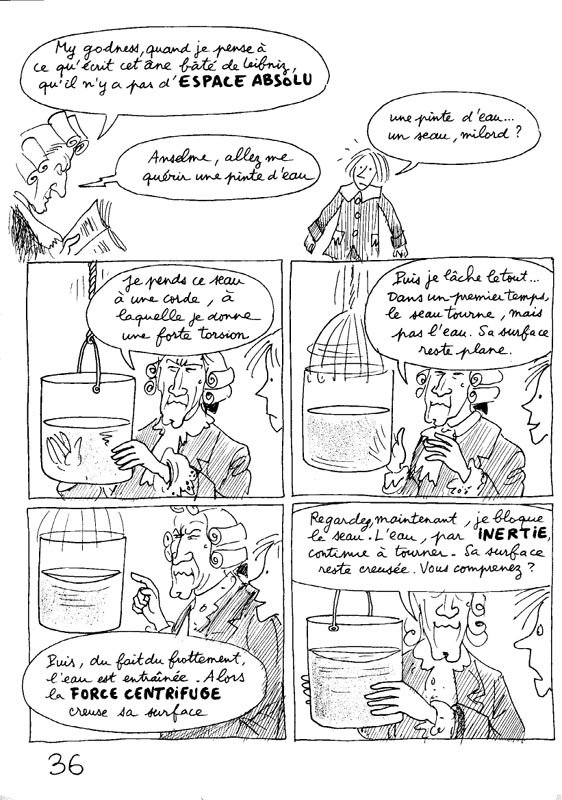
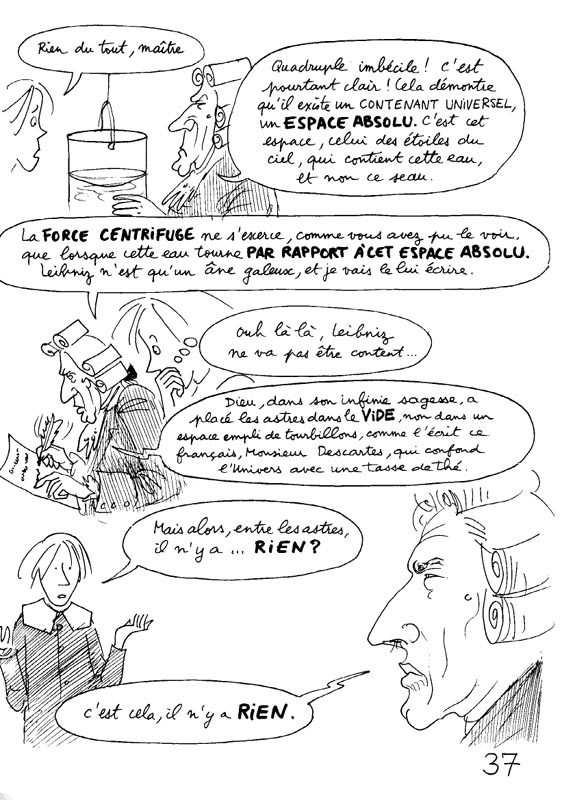
Later, the philosopher Mach (1883) suggested that space (the "inertial reference frame, with respect to which the motion of the water must be considered to have the observed effects") be locally "determined by its matter content" (the inverse of Newton's position). Mach claimed that if you enclosed a system consisting of two masses connected by a spring inside a very massive shell and rotated it rapidly, a "centrifugal force" would manifest, not because you are rotating these masses, but because you are "rotating the space in which they are immersed". He encouraged the Friedländer brothers in 1896 to perform this experiment, which did not yield conclusive results.
It turns out that today, experimenters are bringing up again this question about the relationship between space and matter. Consider a subcritical neutron star (i.e., one with a mass less than 2.5 solar masses), an object we observe (the "pulsars"). In its immediate environment, spacetime can be described by the "Kerr metric", just as the "Schwarzschild metric" describes spacetime around an object that does not rotate. The analysis of this Kerr solution to Einstein's equation leads to rather unusual conclusions. For example: if you consider a circular trajectory around the object, with the same rotation axis as the object, the speed of light will not have the same value depending on whether you follow the object in its rotation or move in the opposite direction! Again, it seems as if the object "drags the spacetime with it". This phenomenon has been given the name "frame-dragging".
What is valid for a neutron star should also be valid, in General Relativity, for any rotating mass, including the Earth itself, with the difference that the effects are then minuscule. Until recently, it would have been impossible to measure them, but since a very recent date, it has become possible to highlight these effects, and this was the reason for the launch of the "Gravity Probe B" satellite. These phenomena are called "gravitomagnetic", and this corresponds to a simple analogy. A moving electric charge creates a magnetic effect (a magnetic field). In General Relativity, it was decided that a moving mass must create a gravitomagnetic effect (which would manifest as a distortion of the gravitational field).
The experiment, set up by NASA, with the collaboration of Stanford University, has the required precision to highlight the effects predicted by General Relativity, which would manifest as a slight variation in the rotation axis of gyroscopes orbiting the Earth at an altitude of 720 km in a polar orbit (passing over the poles). The experiment is intended to show how the presence of the Earth and its rotational movement drag and twist spacetime. (In the article on dragg: drag, warp: twist).
Other predictions.
Frédéric Henry-Couannier is a lecturer at the University of the Mediterranean. For a year now, he has produced the following publications:
Publication in a peer-reviewed journal: International Journal of Modern Physics A
[Particles and Fields; Gravitation; Cosmology; Nuclear Physics], Vol. 20, No. 11 (2005) 2341- 2345
Presentations at international conferences: Sixth Alexander Friedmann International Seminar
on Gravitation and Cosmology 28 June - 3 July 2004 Cargèse Henry-Couannier frédéric Negative
energies in QFT and GR, the dark side of gravity 5th Rencontres du Vietnam Particle Physics and
Astrophysics Hanoi August 5 to August 11 Henry-Couannier frédéric Negative energies in QFT and
GR, the dark side of gravity GdR SUSY July 2004 Clermont-Ferrand Henry-Couannier frédéric
Negative energies in QFT and GR, the dark side of gravity Albert Einstein Century Conference 18 to
22 July 2005 Paris Discrete symmetries and GR, the dark side of gravity XVIII Spanish Relativity
Meeting "A Century of Relativity Physics", 6-10 Sept. 2005, Oviedo, Spain, Discrete symmetries and
GR, the dark side of gravity Preprints posted on arxiv : : " Discrete
symmetries and general relativity : the dark side of gravity
: " Negatives energies and time-reveral in quantum field theory and General relativity : the dark side of gravity "
: " Negative energies and a constantly accelerating flat universe".
The articles published by Frédéric Henry-Couannier open up many perspectives. In the article highlighted in red, there are predictions related to these measurements carried out by the Gravity Probe B satellite, the analysis of which is ongoing (the publication of the results of observations made over the past year is expected imminently). These differ significantly from those derived from General Relativity.
There is a fundamental principle of General Relativity, considered as unshakable, which is the equivalence principle. This principle states that there is no privileged reference frame. In other words: the laws of physics take the same form in all reference frames. What is a "reference frame"? It is a system of space and time coordinates linked to a given observer. The equivalence principle assumes that there is no privileged observer. However, Frédéric Henry-Couannier challenges this pillar of physics, which amounts to claiming that there would exist an "absolute space" (once called "aether"). This would amount to ... giving Newton the right, against Einstein, by predicting effects related to the motion of objects relative to this absolute space.
What could this absolute space be, which would then be "the space of cosmology"? (the "cosmotope", the place where the universe is, would say Tirésias). In the universe, absolute vacuum does not exist. If I consider a cubic meter in the universe, far from any star, any interstellar or intergalactic cloud of matter, a part of the universe where, apparently, there would be "nothing", it is actually filled with photons that constitute "the ashes of the Big Bang". Let's do an experiment (which has actually been done). Take a cylinder with a piston. The piston-cylinder seal is excellent. I pull the piston suddenly so that, apart from the very low leakage of my seal, I can consider that the volume thus released is "empty". In fact, it is instantly filled with photons emitted by the walls. If my wall is at ordinary temperature, these are infrared photons. To have no photons, the cylinder would have to be at absolute zero.
How do we know this? Because if we release the piston, it does not return completely to the bottom of the cylinder because of the "radiation pressure" opposing it. This is ... physics.
For the universe, it's a bit similar. Although it "has no wall", it contains a "photon gas" corresponding to a temperature of 3 degrees absolute. (their wavelength is 5 mm). If an observer is stationary relative to this huge photon cloud, then the photons will have the same color regardless of the direction in which he looks. The universe will seem isotropic to him. Therefore, there is a particular reference frame (the choice of a particular observer) relative to which the universe appears isotropic. Conversely, if we move relative to this photon gas, we will always have a redshift of the photons in one direction, due to the Doppler effect, and a blueshift in the opposite direction. The Earth moves at 300 km/s relative to this "CMB" (Cosmic Microwave Background).
The probe's orbit is polar. It is inscribed in a plane that is fixed. The Earth rotates around its axis, relative to this plane. The gravitomagnetic effect expected comes from the "dragging of spacetime" by the Earth.
In General Relativity, the "gravitomagnetic dragging effect" (frame-dragging effect) is related to the relative rotational movement of the Earth with respect to the measuring device. This is the effect that is expected to be measured with Gravity Probe B. Frédéric Henry-Couannier predicts that this effect will not be measured and tells us that if an effect is measured, it will be due to the movement of the gyroscope-measuring device relative to a privileged reference frame, such as that of the CMB.
According to General Relativity, the measured dragging effect (dragging effect) will result in a precession of the gyroscope's axis that will increase constantly over time. The effect will be on the order of a few hundredths of an arcsecond per year.
If there is a "privileged reference frame effect" ("Henry-Couannier effect"), the phenomenon will be periodic, with an amplitude of four hundredths of an arcsecond (if the privileged reference frame is that of the CMB). This position comes from a complete overhaul of General Relativity.
August 18, 2005. **An email from Frédéric Henry Couannier, who wants to clarify his position: **
Dear Jean-Pierre,
I have read the announcement you made on your site about the abnormal gravitomagnetic effect that my model would predict, and I would like to add some clarifications while putting a caveat on this announcement because the gravitomagnetic sector in my model is not completely clarified. It is only in certain cases, for example, if there is a single privileged reference frame (the one where the CMB is at rest), that I disagree with General Relativity. Therefore, the Gravity Probe B test will be crucial in the sense that it will allow me to clarify the number of privileged reference frames and in what typical volume each reference frame is valid. Moreover, the gyroscope must orbit in a region where my non-local gravity sector applies, which is not obvious either.
My conviction remains that the only test that can definitively exclude this model as it is, is the Post-Post-Newtonian parameter of the static solution. Nevertheless, I am taking "for fun" the bet of an abnormal gravitomagnetic effect on your site because there are very few other theoretical models making such predictions and if General Relativity were to be undermined, it would be a jackpot.
I will soon popularize these ideas and their surprising consequences on my own website.
Sincerely,
Dear Jean-Pierre,
I have read the announcement you made on your site about the abnormal gravitomagnetic effect that my model would predict, and I would like to add some clarifications while putting a caveat on this announcement because the gravitomagnetic sector in my model is not completely clarified. It is only in certain cases, for example, if there is a single privileged reference frame (the one where the CMB is at rest), that I disagree with General Relativity. Therefore, the Gravity Probe B test will be crucial in the sense that it will allow me to clarify the number of privileged reference frames and in what typical volume each reference frame is valid. Moreover, the gyroscope must orbit in a region where my non-local gravity sector applies, which is not obvious either.
My conviction remains that the only test that can definitively exclude this model as it is, is the Post-Post-Newtonian parameter of the static solution. Nevertheless, I am taking "for fun" the bet of an abnormal gravitomagnetic effect on your site because there are very few other theoretical models making such predictions and if General Relativity were to be undermined, it would be a jackpot.
I will soon popularize these ideas and their surprising consequences on my own website.
Sincerely,
Return to Guide Return to Home Page
**Number of consultations since August 15, 2005 ** :